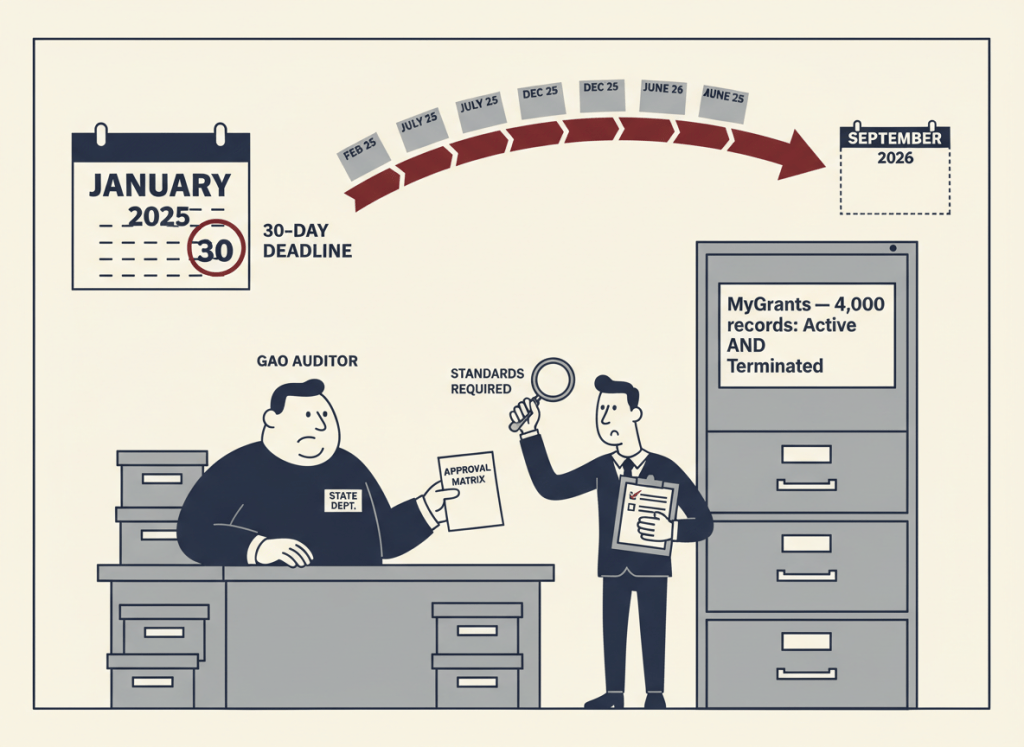
On January 24, 2025, four days after the President ordered a pause in foreign development assistance, the State Department sent a cable to its posts announcing the pause on new obligations and making a modest promise, that standards for reviewing foreign assistance would follow within thirty days. The Government Accountability Office (GAO) has now gone looking for those standards. Its report, released today, finds that they do not exist.
A Promise Made in a Cable
The executive order that started all this was not vague about who owed whom a rulebook. Section 3(b) of Executive Order 14169 directs agency heads to order reviews of each program “under guidelines provided by the Secretary of State,” with the Director of the Office of Management and Budget (OMB) consulted. Guidelines were State’s job. The cable agreed, and set itself a deadline.
GAO found that State’s Office of Policy Planning never developed, documented, and communicated that guidance to the bureau leaders deciding which programs lived and which died. When auditors asked in May 2026, State could produce no agencywide guidance containing standards of any kind. That is more than a year past a deadline the department wrote for itself, and the thirty days came from State’s own cable. A self-imposed deadline, missed, is the bureaucratic equivalent of writing a check and then declining to visit the bank.
The Matrix That Answers the Wrong Question
In July 2026, asked once more for its guidance, State gave GAO a document review and approval matrix for foreign assistance contracts. It tells you which officials must review a contract. GAO notes that it does not tell any of them how to decide anything, including whether an award should be terminated. A document that lists who signs, without saying why, is a fine thing to possess in the way a seating chart is a fine thing to possess at a dinner with no menu.
State may reply that the standard is the President’s foreign policy, and the order does say that no further assistance should be disbursed in a manner not fully aligned with it. That is a destination, not a map. GAO’s warning is that without documented standards, officials may make “inconsistent or ad hoc” decisions, and the department has been making a great many of them. By March 2026 State had terminated about 4,280 of roughly 17,200 foreign assistance awards, about a quarter, carrying some $2.98 billion in cumulative obligations. Those figures are multi-year totals, and GAO is careful to say they are not savings. Congress, for its part, appropriated about $56 billion in fiscal 2025 and $50 billion in fiscal 2026 for State and the other foreign affairs agencies.
To be fair, GAO did not judge whether any single termination was wrong. Its complaint is narrower and, for an agency handling sums of this size, arguably worse. Nobody can show the rule. Nor can the department reliably say which awards it has ended. GAO found that more than 4,000 of around 10,000 grants and cooperative agreements in State’s MyGrants system were listed as both active and terminated, because end dates had never been updated. A rulebook nobody wrote, and a ledger that disagrees with itself.
Ask OMB
When GAO asked why the promised guidance was never produced, State referred the auditors to OMB. GAO’s reply was courteous and devastating, observing that internal controls are implemented by an agency’s own leadership. Its Green Book of internal control standards expects management to document its policies and to communicate them internally so that staff can do their jobs. And the order, as noted, assigns the guidelines to the Secretary of State. Consultation is not a transfer of title.
State’s formal comments, dated September 16 and signed by Mark Erickson of the Office of the Under Secretary for Management, are worth reading slowly. They appear as Enclosure II of the GAO report. The letter says State concurs with the first recommendation, on the MyGrants data, while adding that the bureau GAO named is not responsible for data validation, which belongs to the programming bureaus. On the third recommendation, the one about guidance, the letter says the department continues to review and update its guidance “where appropriate,” including the Foreign Affairs Manual, and will weigh the recommendation “for future planning and budgeting cycles.” No deadline, no named owner, and no mention of the thirty days.
GAO’s summary says State agreed with all three recommendations. Read literally, the letter reaches that destination on the third by a very scenic route.
Everyone Was Busy in 2025
State is not alone, GAO found. USAID said it had conducted and documented a review, then produced no evidence of it and did not answer repeated requests through the summer of 2026. Officials at the Development Finance Corporation said they did not have time to write down guidance, given the speed of change. Officials at the Inter-American Foundation and the U.S. African Development Foundation said that DOGE teams took over and shared no documentation or formal guidance with the staff who remained. The U.S. Agency for Global Media had not formally answered GAO’s requests as of July 2026, a silence of nearly a year.
Then there is the control group. Treasury’s Office of Technical Assistance wrote a memo on each of its 63 projects, using existing internal guidance, and GAO reviewed 56 of them; four projects were terminated. The Millennium Challenge Corporation handed over board minutes and cited its existing selection criteria. Documentation, it turns out, was available to anyone who wanted it. It was merely optional.
It matters beyond archives. The State Department’s own inspector general reported in July 2026 that State took on 1,504 USAID programs and associated awards, with $51.5 billion obligated, and found continuing problems with staffing, training, award terms, and data. The department that could not write the rules for ending awards is now running the ones that survived.
What to watch is simple enough to fit in a cable. Does State put a date and an owner on the standards it promised in 2025? Does anyone fix the ledger? And will OMB, where State pointed the auditors, say whether the guidance was ever its to write?

