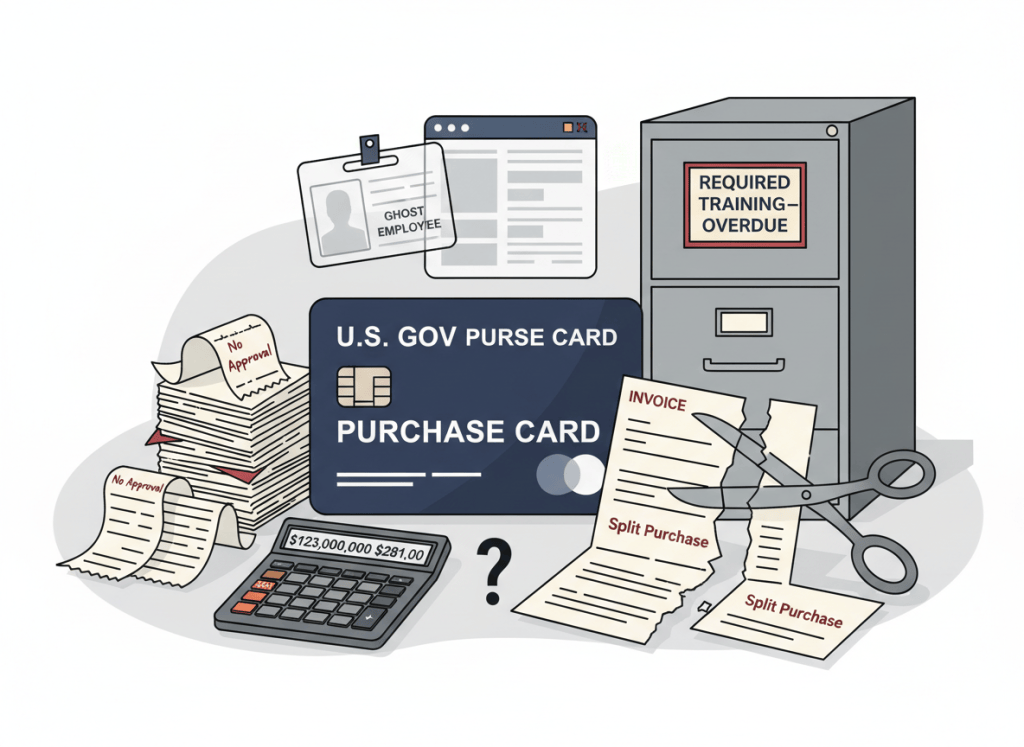
The Department of Transportation’s inspector general says weaknesses in the agency’s government purchase-card program affected an estimated $123 million in transactions.
The Department of Transportation thinks that number should be closer to $281,000.
The difference between those figures is not a rounding error. It is the centerpiece of a new audit examining how DOT and the Federal Aviation Administration oversee hundreds of millions of dollars charged to government purchase cards, and what exactly it means when a federal purchase is made without all the controls the government says should be there.
In a September 28 report, the DOT Office of Inspector General found that 45 of 107 statistically sampled transactions failed to comply with at least one required control. Those 45 transactions totaled $778,977.
Auditors projected those findings across the larger universe and estimated that approximately $123 million, or 34 percent of the transaction universe, failed one or more prescribed controls.
DOT does not agree with that interpretation.
And buried underneath the disagreement are government credit cards left open after employees departed, purchases made without documented approval, employees entering agreements without purchasing authority, competition requirements that were not followed, and one FAA purchase deliberately divided into multiple transactions to get around a spending limit.
In other words, the argument over $123 million may be the headline. The controls underneath it are the story.
According to the DOT Office of Inspector General’s audit, DOT employees made 384,527 purchase-card transactions totaling approximately $364.9 million during fiscal years 2023 and 2024.
After removing OIG’s own purchases, auditors examined a universe of 382,188 transactions worth approximately $362.3 million. They selected a stratified statistical sample of 107 transactions and examined whether cardholders followed required procedures and maintained adequate supporting documentation.
Forty-five did not comply with at least one required control.
From there, OIG made its $123 million projection.
That distinction matters. The inspector general did not report finding $123 million stolen, fraudulently spent or even necessarily spent on things the government did not need. Instead, auditors estimated that $123 million in transactions did not follow one or more required controls and classified that amount as funds that DOT and FAA “could have put to better use.”
DOT objected to that monetary conclusion.
The Department argued that the amount should instead be based on 10 transactions in the audit sample that specifically failed competition requirements. Those transactions totaled $280,775.
OIG declined to budge.
The inspector general said its projection covered more than failures to seek competition. It included purchases made without required approval, failures to follow procurement requirements and deficiencies in post-purchase controls.
The agency and its auditor therefore agree substantially on what went wrong. They disagree over how much money should be attached to it.
And what went wrong was not particularly exotic.
Auditors identified 21 sampled transactions totaling $176,773 where cardholders did not document that a certifying official confirmed that funds were available before the purchase. In another part of the review, OIG found transactions that lacked required advance approval.
Then there was the $24,591 purchase.
According to OIG, an FAA cardholder worked with a vendor to bill the government over several months so the purchase would not exceed the cardholder’s single-purchase limit.
Government SmartPay training and FAA policy prohibit that practice, known as a split purchase.
There is something impressively bureaucratic about establishing a spending limit and then solving the problem of exceeding it by simply dividing the bill.
Auditors were less amused. They said split purchases undermine procurement integrity and transparency and increase the risk of improper, illegal or erroneous use of government funds.
Other employees managed to skip another procedural inconvenience: having authority to buy something in the first place.
OIG found five unauthorized commitments totaling $14,706, including one at the Federal Highway Administration and four at FAA.
In the FHWA case, an employee without purchasing authority signed a contract for staff workshops. Another employee later sent the resulting invoice to a cardholder for payment.
At FAA’s Office of the Chief Counsel, representatives without purchasing authority hired a vendor to provide deposition transcription services. After the vendor performed the work, invoices were forwarded to cardholders for payment.
None of the unauthorized commitments identified by OIG had been submitted for the required ratification process.
The inspector general warned that such practices reduce transparency and could potentially lead to Anti-Deficiency Act violations.
Competition requirements presented another problem.
Auditors found 10 sampled purchases totaling $280,775 that did not meet applicable competition requirements.
One FAA cardholder rented aviation-training simulators for $10,920 and $39,880 without soliciting bids from multiple vendors or obtaining an approved sole-source justification. The cardholder believed the purchases were exempt.
Another FAA cardholder bought seven computer monitors for approximately $10,360 without following competition requirements because the employee believed the threshold applied to the price of each individual monitor rather than the total purchase.
The rules existed. Understanding them appears to have been more optional.
That problem extended into training.
DOT could not provide evidence that 16 of 62 purchase-card program participants reviewed by auditors had completed all required training. At FAA, one approving official took three years to complete refresher training, while another had gone nearly five years without completing any training.
FAA also failed to suspend participants who had not completed required training on time.
Some of the most striking findings, however, involved cards belonging to people who were no longer working there.
Federal law requires agencies to invalidate government purchase cards immediately when a cardholder separates from the agency.
Auditors found 33 DOT accounts and 140 FAA accounts that remained open at least one week after the employee separated.
Seventy-two remained open for as long as a month.
Four remained open for a year or longer.
OIG identified 11 transactions dated after the associated cardholders had separated. Four were disputed or otherwise resolved and credited back to the government. Agencies showed that five others had been initiated before the employees left.
For the remaining two, DOT could not provide supporting documentation.
That does not establish that former employees made unauthorized purchases. It does establish precisely the sort of control gap that the requirement to immediately deactivate cards is designed to prevent.
The inspector general also identified approximately 250 purchase-card accounts that had recorded no activity for more than a year. DOT and FAA could not demonstrate that they routinely assessed those inactive accounts to determine whether they remained necessary.
The findings become harder to dismiss as an isolated administrative lapse because DOT has been here before.
The inspector general’s 2020 purchase-card audit identified inadequate policies, procedures and controls in multiple areas. In 2022, OIG assessed DOT and FAA as having a medium risk for illegal, improper or erroneous purchase-card transactions.
When OIG announced the latest audit in October 2024, it specifically cited the weaknesses found in 2020 as part of the reason for returning to the program.
Six years after that earlier audit, OIG says several of the problems identified in its latest review are repeat findings.
The inspector general issued 11 recommendations. They include establishing better repositories for training and purchasing-authority records, enforcing suspensions for employees who fail to complete required training, reviewing inactive accounts, establishing specific deadlines for shutting down cards after employees leave and strengthening procedures addressing unauthorized commitments, split purchases and competition requirements.
DOT concurred with the first 10 recommendations and partially concurred with the eleventh.
It was Recommendation 11 that carried the $123 million price tag.
DOT agreed to take corrective action but rejected OIG’s contention that implementing the recommendation could put as much as $123 million in federal funds to better use. The Department maintained that potential savings should instead be tied to the $280,775 represented by the 10 transactions that failed competition requirements.
OIG responded that DOT was defining the problem too narrowly.
Its projection, auditors said, represents the broader collection of internal-control failures found in the statistical sample, including unapproved purchases, procurement violations and failures in post-purchase controls.
The inspector general stood by the $123 million figure.
That leaves DOT in an unusual position.
The Department largely accepts the corrective actions recommended by its inspector general. It accepts that purchase-card controls need strengthening. It accepts recommendations addressing training, inactive accounts, cards remaining open after employees depart and failures involving procurement procedures.
What it does not accept is OIG’s accounting of the financial significance.
Whether $123 million represents money that truly could have been saved is therefore debatable even inside the Department. The audit does not establish that $123 million was wasted, lost or improperly spent. It establishes that OIG believes its statistical findings support projecting control deficiencies across transactions representing that amount.
But the disagreement over the projection does not erase the underlying findings.
A government purchase card left active for a year after its cardholder leaves the government is still an open account. A purchase deliberately divided to circumvent a spending limit is still a split purchase. An agreement made by someone without purchasing authority is still an unauthorized commitment. And a competition requirement does not become less of a requirement because the cardholder misunderstood it.
The $123 million figure may be where DOT and its inspector general disagree.
The paperwork trail suggests they have considerably less disagreement about the fact that the controls need fixing.

