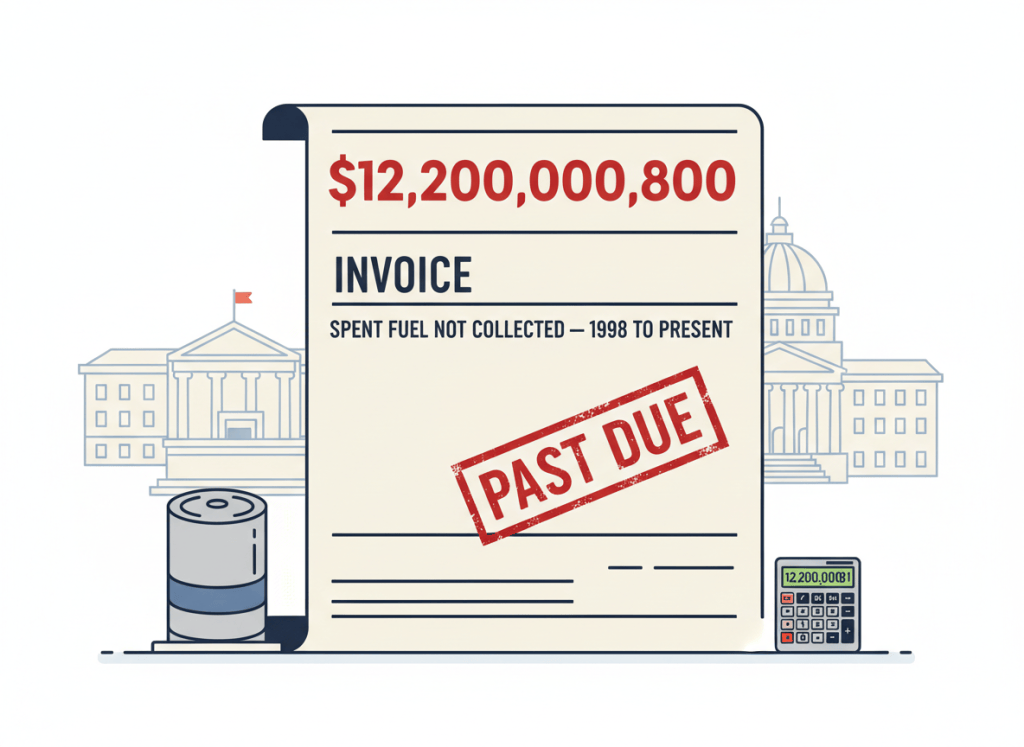
The federal government promised to take the nuclear industry’s spent fuel beginning in 1998. It didn’t. Taxpayers have been paying for that broken promise ever since.
The federal government has spent $12.2 billion because it failed to pick up the nuclear waste.
And that may be just the down payment.
As of Sept. 30, 2025, the U.S. Department of Energy reported that $12.2 billion had been paid from the Treasury Department’s Judgment Fund to nuclear utilities because the government failed to begin accepting their spent nuclear fuel as promised.
DOE estimates the government’s total liability could eventually reach between $50.8 billion and $56.5 billion. After subtracting what has already been paid, between $38.6 billion and $44.3 billion in estimated liability remains.
The remarkable part is what taxpayers received for the first $12.2 billion.
Not a permanent nuclear waste repository. Not disposal of the spent fuel. Not completion of the federal government’s original obligation.
The money largely represents damages for failing to do those things.
Welcome to one of the more expensive late fees in federal history.
A Deal With the Nuclear Industry
The origins of the bill stretch back more than four decades.
Congress enacted the Nuclear Waste Policy Act in 1982, establishing a federal system for disposing of commercial spent nuclear fuel and high-level radioactive waste. Nuclear utilities would pay fees into the Nuclear Waste Fund, and DOE would ultimately take custody of the material for disposal.
DOE entered into more than 69 “Standard Contracts” with utilities. The bargain was straightforward: industry paid into the system; the federal government would provide the disposal service.
DOE was supposed to begin accepting spent nuclear fuel by Jan. 31, 1998.
January 1998 came. DOE did not.
There was no federal facility available to receive the fuel, and the spent nuclear fuel did not disappear merely because the disposal program had stalled. Utilities continued storing it at reactor sites around the country.
Then came the lawsuits.
The Government Gets Sued for Not Taking the Waste
Nuclear utilities began pursuing damages against the United States for additional costs they incurred because DOE had not performed its contractual obligation.
DOE reported in its FY2025 Agency Financial Report that 45 suits had been settled involving utilities that collectively own 86 percent of the nuclear reactors involved in partial-breach litigation. Those settlements had resulted in $8.9 billion in Judgment Fund payments through Sept. 30, 2025.
Another 79 cases had been resolved through judgments or withdrawals. Sixty-three resulted in damage awards totaling another $3.3 billion. Sixteen additional cases remained pending in the U.S. Court of Federal Claims.
Add the settlement and judgment payments together and the number reaches approximately $12.2 billion.
That money comes from the Treasury Judgment Fund, a permanent, indefinite appropriation established under 31 U.S.C. § 1304 to pay qualifying judgments and settlements against the federal government.
In practical terms, Congress does not have to pass a new appropriation every time another spent-fuel judgment comes due.
The meter can keep running.
More Than $1 Billion in One Year
And it is running.
DOE recorded another $1.122 billion in Judgment Fund payments associated with spent nuclear fuel during fiscal year 2025 alone. Combined with a $1.084 billion change in the government’s liability estimate, DOE recorded $2.206 billion in current-year spent nuclear fuel contingency costs.
That matters because the $12.2 billion figure can sound like the cumulative cost of some long-ago policy failure. It isn’t. The government is still paying.
The underlying problem also remains unresolved: DOE still has not begun the disposal service that was supposed to start in 1998. DOE’s own financial statement says the department has no facility available under the Nuclear Waste Policy Act to receive the spent fuel and therefore has been unable to begin disposal as required by its contracts.
That turns the Judgment Fund into something resembling a very expensive holding pattern.
Utilities incur eligible costs because the government hasn’t taken the fuel. They pursue damages. The government pays. The fuel remains.
Repeat as necessary.
The Bill Could Exceed $50 Billion
DOE estimates total spent-nuclear-fuel litigation liability at between $50.8 billion and $56.5 billion. After accounting for payments already made, another $38.6 billion to $44.3 billion remains in estimated liability.
Those figures are estimates, not a guaranteed final price. Reactor operating lives, future storage costs and the duration of the federal delay can all affect the ultimate bill.
There is another unusual feature of this litigation: a settlement does not necessarily end the government’s exposure.
DOE says additional payments can be made in already settled and adjudicated cases when utilities incur additional costs because of the continued delay. Paying damages does not necessarily close the account.
This Is Not the Nuclear Waste Fund
There is an important distinction buried beneath all those billions.
The Judgment Fund is not the Nuclear Waste Fund.
The Nuclear Waste Fund was created as part of the system under which nuclear utilities paid fees in exchange for the federal government’s eventual disposal of their spent fuel. The Judgment Fund, by contrast, pays qualifying judgments and settlements against the United States.
So the billions being paid in spent-fuel litigation are not simply the government finally spending utilities’ disposal fees on disposal. They are payments resulting from the government’s failure to perform the disposal service contemplated by those contracts.
The distinction is the heart of the story.
The government established a system intended to finance nuclear waste disposal. It failed to provide the disposal service on schedule. Another federal funding mechanism then began paying damages resulting from that failure.
Meanwhile, the waste still needs somewhere to go.
We’ve Asked DOE for the Ledger
Bureaucracy Times has filed a Freedom of Information Act request with DOE seeking the records underneath that $12.2 billion figure.
The request seeks an accounting of Judgment Fund payments arising from DOE’s failure to accept spent nuclear fuel and high-level radioactive waste under the Standard Contract, including records identifying payments, recipients, underlying cases or settlements and related DOE accounting.
DOE received the request Sept. 20 and assigned it tracking number HQ-2026-02565-F. The department subsequently notified Bureaucracy Times that the request does not fall solely within the jurisdiction of DOE’s Office of General Counsel and invoked the FOIA provision allowing additional processing time under “unusual circumstances.”
The aggregate number is public. Reconstructing the underlying ledger may be considerably more complicated.
Bureaucracy Times intends to do exactly that: determine who received the money, how much was paid, which facilities and cases generated the payments, how frequently repeat claims occur and how the cost accumulated over time.
The Cost of Not Solving the Problem
None of this means utilities received a $12.2 billion windfall. The payments arise from costs claimed as damages resulting from DOE’s failure to perform its contractual obligations, with courts and settlement processes determining what damages are compensable.
Nor does $12.2 billion represent the entire cost of America’s nuclear waste problem.
It represents something narrower—and, in some ways, stranger.
It is the cost of delay.
GAO warned years ago that failure to take custody of commercial spent nuclear fuel was creating a substantial taxpayer liability. In 2021, GAO reported that DOE then estimated total federal liability at $39.2 billion, including $8.6 billion already paid and another $30.6 billion expected in future payments.
Four years later, DOE’s estimate had climbed substantially. The department now puts total liability as high as $56.5 billion.
And there is a brutal simplicity to the arithmetic.
DOE promised to begin taking spent nuclear fuel in 1998.
It didn’t.
Utilities kept storing it. The government kept getting sued. Taxpayers kept paying.
And after $12.2 billion in Judgment Fund payments, the federal government still needs somewhere to put the nuclear waste.

