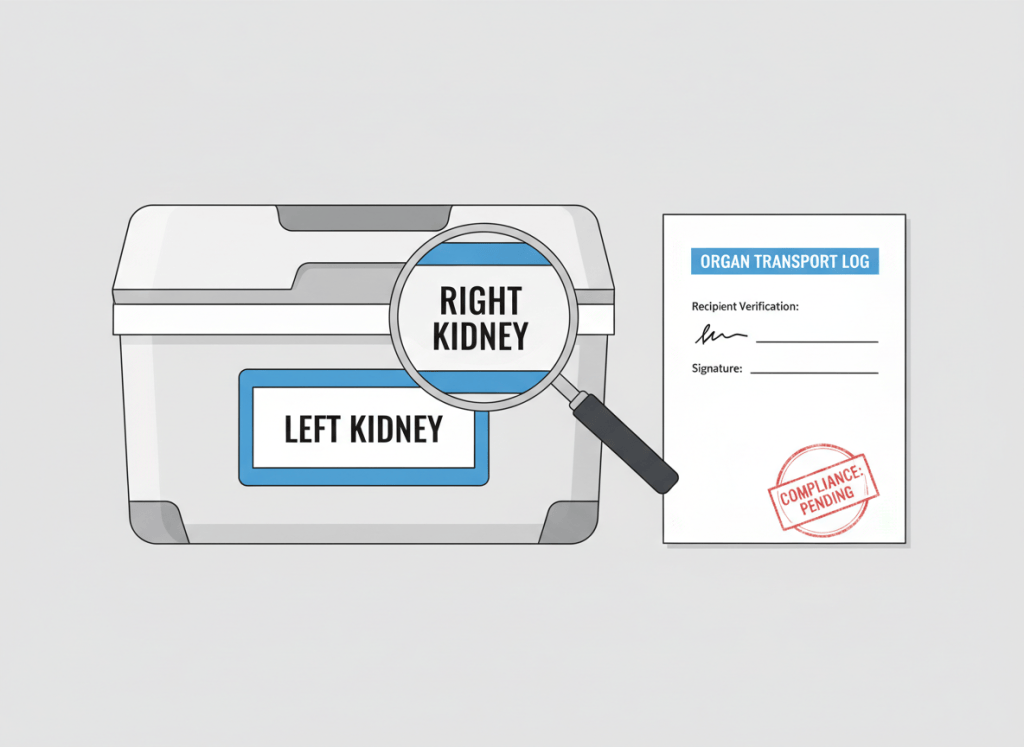
Every kidney that leaves an organ procurement organization is supposed to travel with two things attached to it: a label confirming which kidney it is, and the signatures of two separate human beings swearing that label is correct. The federal government built that redundancy on purpose, because the alternative to redundancy is a courier showing up at a transplant hospital with the left kidney labeled as the right one. According to a new HHS Office of Inspector General audit, that alternative has already happened. More than once. The report just wasn’t supposed to be the one that found it.
An Audit About Money That Found a Body Problem
OIG set out to check whether independent organ procurement organizations, the not-for-profit entities that recover and ship organs for transplant, were reporting their kidney transportation costs correctly on their Medicare cost reports. That is, on its face, an accounting story. Auditors sampled 213 high-dollar kidney transportation costs across 43 of these OPOs and found that 32 of them had reported a combined $428,325 in unallowable expenses, either by dumping the cost of flying a multi-organ recovery team onto the kidney line item, or by billing Medicare for driving a donor’s body to a funeral home, which is not, whatever an OPO’s accounting department may have believed, a step in organ acquisition.
That’s a real finding, and a real number, though a modest one against the $53.6 million in kidney transportation costs the audit actually covered. It is also, and this matters, not the finding buried five pages later. Four of the 43 OPOs failed to meet Medicare’s separate requirement that two people, one of them an OPO employee, physically verify the label on an organ before it ships. Three of those four submitted verification forms signed by exactly one person. The fourth never sent the required donor documentation to three transplant hospitals at all. OIG did not find a mislabeled organ in its own sample. But it did note, almost in passing, that “some OPOs mentioned incidents in which labeling errors had resulted in the wrong organs being sent for transplant,” including one case in which a label for a left kidney ended up on the container for the right one. That sentence is doing more work than the entire cost-allocation section, and it arrives as a footnote to a footnote.
“Clerical Error,” Four Times in a Row
Ask an OPO why it filed for reimbursement of a lung recovery team’s flight as a kidney expense, and the answer, nearly every time, is clerical error or a misunderstanding of Medicare’s rules. Ask an OPO why it billed the transportation of a dead body to a funeral home as an organ acquisition cost, same answer. Ask an OPO why only one person signed a label verification form that federal regulation requires two people to sign, same answer again. Four separate OPOs gave OIG the identical explanation for the identical failure; staff made a mistake, nobody caught it.
There is a point at which “clerical error” stops describing an incident and starts describing a system. Three OPOs out of four, independently, produced a verification form with one signature where the rule requires two. That is not a typo. That is a control that exists on paper and does not exist in practice, at three different organizations that likely never spoke to each other about it. The audit’s own explanation for why this keeps happening is almost sympathetic (Palmetto GBA, the Medicare administrative contractor responsible for reviewing these cost reports, has never provided direct training to OPOs on how to report transportation costs). It has, per its own account to auditors, discussed the subject “frequently.” Frequent conversation is not instruction, and OIG’s two recommendations to CMS, recover the money and “provide additional education,” read less like accountability and more like a request that someone finally hold the seminar that should have happened years ago.
The Kidney Gets Reviewed. Everything Else Doesn’t.
Here is the structural reason 32 of 43 OPOs found it so easy to misfile these costs; Palmetto reviews and caps an OPO’s standard acquisition charge for kidneys, and only kidneys. Nonkidney organs, livers, hearts, lungs, get no such review, and Medicare settles up retroactively with OPOs for kidneys but never for anything else. That asymmetry creates an obvious, if unglamorous, incentive; a cost that gets scrutinized as a kidney expense and a cost that gets waved through as a liver expense are not treated the same way on the back end, and an OPO’s accounting staff does not need to be dishonest to notice which line item is safer to pad.
CMS has actually acknowledged this is a problem, just not urgently. Its FY 2027 Inpatient Prospective Payment System final rule, issued July 31, 2026, extends MAC review to standard acquisition charges for all organ types, and requires retroactive settlement adjustments for nonkidney organs too. The effective date is October 1, 2028. That is two full budget cycles from now, during which the exact incentive structure that produced $428,325 in documented misallocation over an 18-month audit window remains fully intact, uncorrected, and unreviewed for anything that isn’t a kidney.
CMS Concurred, Which Is Not the Same as CMS Acting
CMS’s written response to the draft report is exactly what a government agency’s written response to a draft OIG report usually is; concurrence with both recommendations, a promise to instruct Palmetto to recover the identified reimbursements “consistent with relevant law and the agency’s policies and procedures,” and a commitment to “explore the most effective and efficient way” to get education to OPOs about costs they’ve apparently been miscoding since at least the start of this audit period. Nothing in CMS’s comments, at least in the portion of the letter accompanying the report’s narrative summary, addresses the labeling failures directly, and nothing in either OIG’s recommendations or CMS’s response proposes anything beyond training for the four OPOs that shipped organs without proper verification. Federal rule gives CMS the authority to decertify an OPO that is out of compliance with a process performance measure, making it ineligible for Medicare reimbursement entirely. That authority goes unmentioned. What gets recommended instead, for a failure OIG itself says “may increase risks to patient safety and may lead to compromised transplant outcomes,” is the same fix proposed for OPOs that miscoded a funeral home bill, education.
The 43 OPOs in this audit are never named. OIG’s own account of the industry describes each one only as “one OPO” or “another OPO,” a convention that protects individual organizations from scrutiny while the aggregate failure gets a press release. Whether that anonymity survives a records request is a question for another piece. Whether a two-year runway before nonkidney costs get reviewed at all survives without another mislabeled kidney reaching a transplant hospital is a question nobody in this report seems in a hurry to answer.

