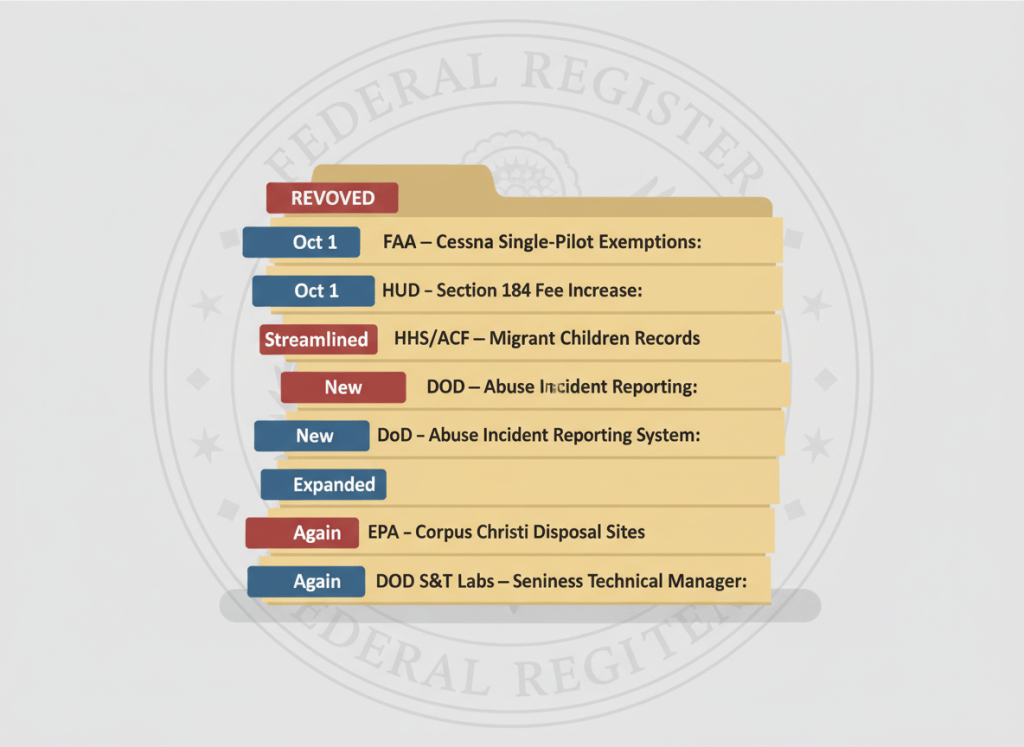
The Federal Aviation Administration used today’s Federal Register to shut down a long-running exemption program for twin-engine Cessna aircraft, revoking permission for single-pilot operation after an internal review turned up what the agency called “widespread non-compliance.”
Six items from today’s 101-document Federal Register docket stood out for institutional significance or for details that raise a “why now” question. Here is what to know.
- Federal Aviation Administration — The FAA announced it is ceasing new exemptions that had allowed certain twin-engine Cessna models, which normally require two pilots, to fly with only one. The agency said a compliance review of exemption holders found “widespread non-compliance,” though it did not detail what the violations were. Because the exemption functioned as a waiver from the aircraft’s own type certification, revoking it means operators who had been flying single-pilot must now add a co-pilot or ground the aircraft, and the notice gives little detail on how quickly that transition has to happen. Read the notice.
- Department of Housing and Urban Development — HUD is raising the upfront guarantee fee on its Section 184 Indian Housing Loan Guarantee Program from 1.00 to 1.50 percent of the loan amount, and adding a new 1.00 percent fee, up from zero, on loans made under the program’s Skilled Workers Demonstration track. Because that guarantee fee gets folded into a borrower’s closing costs, the increase directly raises what it costs Native American homebuyers to use this government-backed loan product. The change takes effect October 1, just three days after publication, a compressed runway that leaves lenders and applicants little time to adjust loans already in process. Read the notice.
- Health and Human Services, Administration for Children and Families — HHS renamed and revised the records system covering unaccompanied immigrant children, redesignating it the “ORR Unaccompanied Alien Children Bureau Administrative Program Records” and, per the notice, “streamlining” the routine uses that govern who outside the agency can receive the data. A routine use is the specific legal permission a Privacy Act system carries to share personal information without the subject’s consent, so broadening it expands who can access records on a particularly vulnerable population. The notice does not spell out which new parties or purposes the streamlined language covers, which is the detail worth watching for. Read the notice.
- Department of Defense, Office of the Secretary — DoD established a new Privacy Act system of records, the Abuse Incident Reporting System, to centralize tracking of child abuse, neglect, and domestic abuse cases department-wide for what the notice describes as policy development and trend analysis. Standing up a new department-wide case-tracking database is a notable institutional move on its own, and the filing is worth watching for what access controls and retention limits eventually accompany it, details a system-of-records notice is not required to spell out up front. Read the notice.
- Environmental Protection Agency — EPA finalized a rule expanding two federally designated ocean dredged-material disposal sites off Corpus Christi, Texas, about six months after proposing the change in March. A final rule is the last procedural step before an action takes legal effect, so the expanded disposal boundaries are now in force. That proposal-to-final timeline is fast by the standards of Clean Water Act ocean-dumping site designations, which more typically take a year or longer to work through comment and review. Read the notice.
- Department of Defense, Office of the Secretary — DoD authorized its Science and Technology Reinvention Laboratories to create a new tier of “Senior Business Technical Manager” positions, classified above the General Schedule’s top GS-15 level, to advise commanding officers and senior executives on business and technology operations. This is the second Federal Register notice this year establishing the same position structure, following one published in January, and neither notice explains why the program needed a second round of authorization within the same year. Read the notice.
This edition draws on all 101 documents published in the Federal Register on September 28, 2026. Excluded without an anomaly signal: routine advisory-committee and fishery-council meeting notices, OMB/PRA information-collection requests, foreign-built-vessel coastwise-trade petitions, antidumping and countervailing-duty proceedings, SEC self-regulatory-organization fee filings, airworthiness directives, and museum-exhibition cultural-property determinations.

