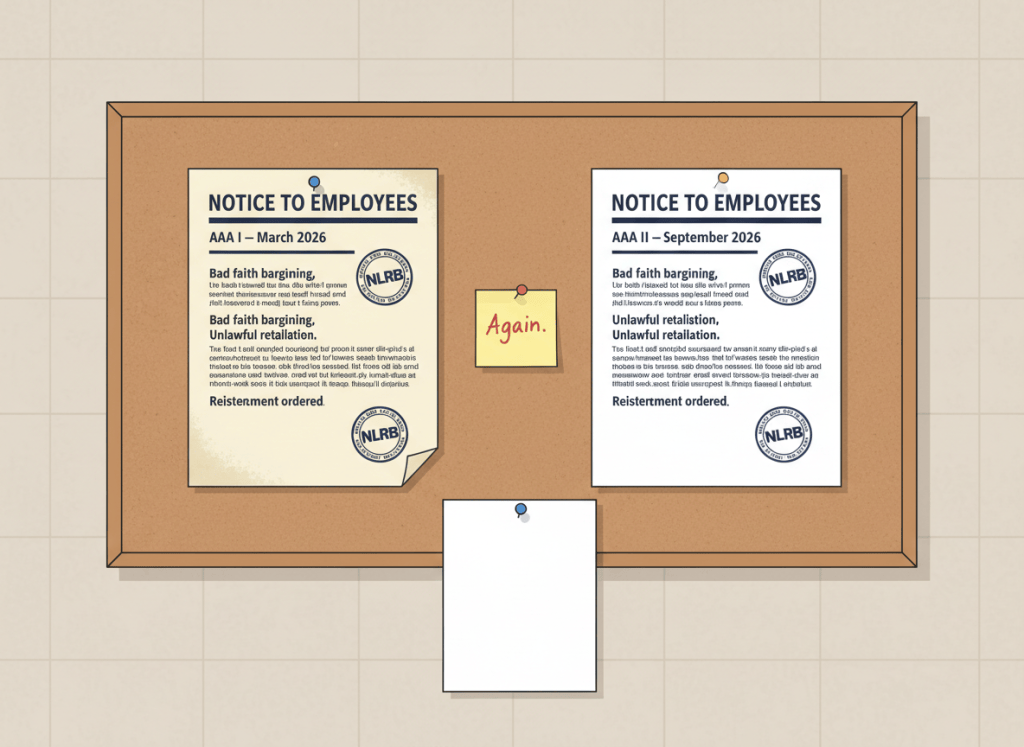
American Automobile Association of Northern California, Nevada and Utah sells roadside assistance, home insurance and the comforting idea that someone competent is coming to help you. It has spent the last five years demonstrating, in triplicate, that this idea does not extend to its own workforce.
On September 24, 2026, a second National Labor Relations Board administrative law judge found the company had engaged in the exact species of misconduct a different judge had already punished it for once. If institutional learning were a job requirement at AAA, half its insurance agents would be out of work.
The new decision, issued by Judge Mara-Louise Anzalone of the Board’s San Francisco branch, consolidates six unfair labor practice cases (32-CA-321155 and five related dockets) filed by International Brotherhood of Teamsters Local 665 after it organized AAA’s California sales agents in 2021. It runs seventy-eight pages and concludes that AAA bargained in bad faith for four years, prematurely declared impasse, imposed a pay cut worth nearly a third of some agents’ income, retaliated against a union steward, and offered severance agreements that illegally required workers to sign away their federal labor rights.
The judge ordered reinstatement, backpay, a bargaining order and, in an unusual touch, a video of AAA’s own in house labor counsel reading the notice of violations aloud to the workforce she helped mislead (Administrative Law Judge’s Decision, NLRB Case 32-CA-321155).
A Sequel Nobody Asked For
This is not AAA’s first ALJ decision. In March 2026, Associate Chief Judge Arthur Amchan issued findings in a companion case, known informally as AAA I, covering conduct between 2021 and 2022. He found AAA unlawfully fired five agents for union activity, unlawfully withdrew a long-standing employee award program the moment the Teamsters won their election, and issued subpoenas demanding information about workers’ protected activity.
He specifically credited testimony that a senior AAA official told branch managers to “pull back our support on the agents” without making it obvious, direct evidence, in his words, of the company’s animus (NLRB Region 32, Administrative Law Judge Decision, Case 32-CA-280838).
Judge Anzalone’s decision picks up almost exactly where Amchan’s left off, and finds the same company doing the same thing. Where AAA I documented unlawful discharges and unilateral changes, AAA II documents four more years of bargaining conducted, in the judge’s words, with “the intent to frustrate the possibility of reaching an initial collective bargaining agreement.”
The company’s own in house counsel supplied the tell. Asked at the table whether she had ever previously proposed a fifty percent wage cut in negotiations, she said yes, and volunteered that afterward, the union involved had been decertified. Judge Anzalone treated the remark as the case’s Rosetta Stone; it explained, more efficiently than four years of testimony could, exactly what AAA thought “bargaining” meant.
Process as a Feature, Not a Bug
There is a temptation to read this as a story about one bad actor. It is more usefully read as a story about what happens when the machinery meant to punish that actor takes half a decade to grind.
The underlying union election was certified in June 2021. Some of the conduct Judge Anzalone found unlawful, the elimination of renewal commissions worth an average of $98,000 a year to affected agents, was announced before the ink on that certification was dry, and not fully resolved by an ALJ until more than five years later.
In the interim, AAA implemented its final offer anyway, in August 2023, and only a federal district judge’s injunction under Section 10(j) of the Act stopped it from also killing commissions outright in February 2025 (NLRB Region 32, “NLRB Region 32 Oakland Wins Injunction Requiring AAA to Rescind Unlawful Policy and Maintain Employee Commissions,” January 2025).
None of this is unusual for the Board’s adjudication process, which is precisely the point. An employer facing a well resourced legal team can implement the disputed change, litigate for years, and absorb whatever remedy eventually lands, confident that the remedy (backpay with interest, a notice on a breakroom wall) will cost less than simply not doing it would have.
Judge Anzalone’s decision even quotes AAA’s own counsel bragging that a prior fifty percent cut had led to a decertification vote; the calculation being described, in open bargaining session, was that provoking employee anger at the union might be cheaper than raising wages. Whether or not that specific bet paid off here, the broader one, that years of litigation are a survivable cost of doing business, generally does.
Two Judges, One Company, No Deterrent Effect
What makes the AAA record instructive is the redundancy. This is not an agency inferring a pattern from a single set of facts; it is two ALJs, working from separate evidentiary records and separate hearings years apart, independently finding that AAA treated its newly organized workforce as an obstacle to be managed rather than a party to bargain with.
Amchan found unlawful discharges and unilateral changes in 2021 and 2022. Anzalone found bad faith bargaining, a second wave of unilateral changes, two more constructive discharges and retaliation against a steward, running from 2022 through 2025. The AAA II decision is dated the same day the Board’s own docket shows the case being formally transferred upward, meaning this finding, like Amchan’s before it, is not yet final; AAA retains the right to file exceptions with the full Board, a process that can itself take years (NLRB Case Search, Case 32-CA-321155, Docket Activity).
That is the institutional health problem worth dwelling on. The National Labor Relations Act does not fine repeat offenders more heavily, does not accelerate review for employers with an open prior finding against them, and does not treat a second ALJ decision covering the same company and the same union as evidence that the first remedy failed to remedy anything. Each case proceeds as though the last one had never happened, on its own clock, toward its own possible appeal.
A company that loses twice, in sequence, on the same underlying dispute, pays roughly the same price as one that loses once. Judge Anzalone’s unusual remedy, ordering AAA’s labor counsel to personally read the notice of violations aloud on camera, reads less like standard relief and more like a judge trying, within a toolkit that offers her almost nothing else, to make the second loss feel different from the first.
Whether the Board upholds even that gesture on review remains, like the rest of this case, an open question with a very long clock.

