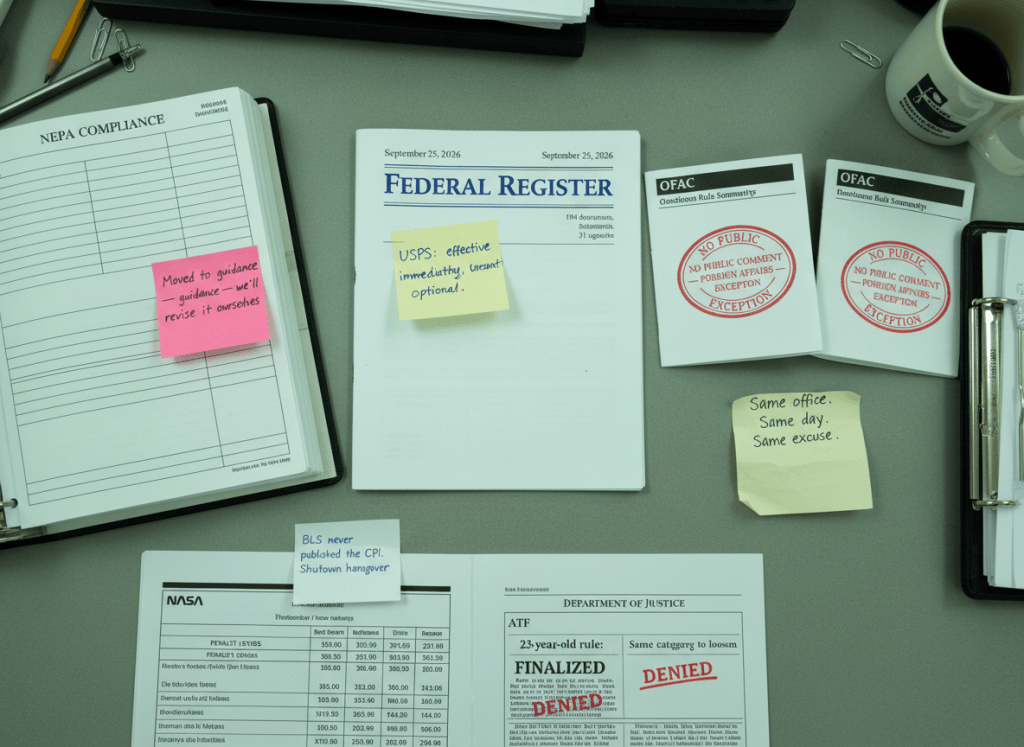
The U.S. Postal Service used an interim final rule to move most of its environmental-review procedures out of binding federal regulation and into guidance it can revise on its own, taking effect the same day it was published rather than waiting on the comment period it opened alongside it.
- United States Postal Service — an environmental-review rulebook moves out of binding regulation, effective immediately. USPS published an interim final rule rewriting how it complies with the National Environmental Policy Act, relocating most of its detailed review procedures out of the Code of Federal Regulations and into guidance documents the agency can revise without going through notice-and-comment rulemaking. Because it issued this as an interim final rule rather than a proposed one, the changes took effect on publication day even though USPS is voluntarily taking comments through October 26; ordinarily the public would get to weigh in before a change like this became binding, not after. The agency points to a recent Supreme Court decision describing NEPA as a “modest procedural requirement” and to congressional amendments passed in 2023 and 2025 as its legal footing for the rewrite.
- Treasury/Office of Foreign Assets Control — a Syria policy shift becomes binding law with no public notice. OFAC amended its Terrorism List Governments Sanctions Regulations to eliminate a Syria-specific general license, formally catching the sanctions code up to Syria’s earlier removal from the State Sponsor of Terrorism list. The office skipped notice-and-comment rulemaking entirely under the “foreign affairs function” exception, the standard justification sanctions regulators use to put changes into effect without the public input that most rules require; that means a decision with real diplomatic consequences became enforceable law without anyone outside government getting a chance to weigh in on how it was carried out.
- NASA — a penalty freeze traces back to last year’s shutdown. NASA announced it will keep its civil monetary penalties at 2025 levels for 2026 rather than adjusting them for inflation as the law requires each year, because the Bureau of Labor Statistics never published the October 2025 consumer price index data the calculation depends on. That gap traces back to last fall’s lapse in federal appropriations, which halted BLS data collection for weeks; under governmentwide guidance from the Office of Management and Budget, agencies across the federal government are freezing their penalty tables at 2025 levels instead, a small sign that routine regulatory housekeeping is still catching up nearly a year after the shutdown ended.
- ATF/Department of Justice — a 23-year-old rule gets finished the same day a new one proposes to loosen it. The Bureau of Alcohol, Tobacco, Firearms and Explosives finalized regulations it first issued as interim rules back in 2003, working through public comments that had been sitting since that year to lock in background-check, licensing, and delivery-verification requirements under the Safe Explosives Act. The same day, the bureau proposed a separate rule that would loosen how explosives must be stored, eliminating an entire category of required storage magazines and giving industry a 60-day comment window, the standard period regulators allow for the public to weigh in before a final version can take effect; ATF estimates the change would save industry roughly $4.9 million over ten years. Closing out a two-decade-old rulemaking and proposing to loosen the same category of rules on the same day is a pairing worth noticing, whatever the reason behind the timing.
- Treasury/OFAC — a second same-day rule, and a second time comment was skipped. OFAC also consolidated its scattered civil and criminal sanctions-penalty provisions into a single regulatory framework, again invoking the foreign-affairs exception to bypass public comment on the grounds that the change is purely organizational and doesn’t alter any existing sanctions program. Two rules from the same office on the same day, both skipping comment under the same justification, is enough of a pattern to flag, since that exception rests entirely on the agency’s own say-so that a change is non-substantive rather than on any outside review.
- Justice Department — ten petitions for new rules, all denied in one notice. DOJ published a single notice denying ten separate petitions filed under the Administrative Procedure Act asking the department to begin rulemakings covering immigration enforcement, health care, and firearms licensing, some of which had been pending since 2021. For several of the immigration-related denials, the department cited “alignment with current executive orders” as part of its reasoning, a reminder that a formal petition for rulemaking, one of the few tools the public has for forcing an agency to consider a specific change, can be turned down for policy reasons and not only legal ones.
This edition draws on the full day’s Federal Register docket for September 25, 2026: 104 documents across 31 agencies. Excluded as routine: fifteen Securities and Exchange Commission self-regulatory-organization filings, agency information-collection and OMB/Paperwork Reduction Act notices, foreign-trade-zone and antidumping/countervailing-duty determinations, disaster declarations, Sunshine Act meeting notices, and four recurring CAFTA-DR textile-availability determinations.

