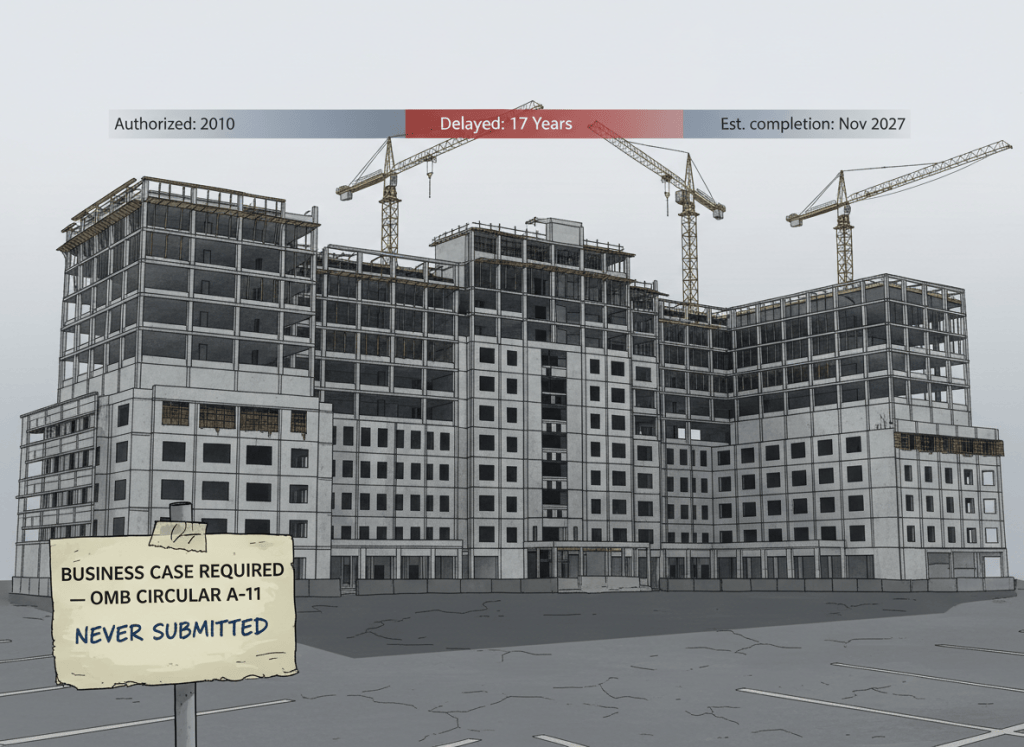
In September 2026, the Department of Veterans Affairs Office of Inspector General published a review of the new VA medical center in Louisville, Kentucky, a hospital that Congress authorized in 2010 and that, as of this writing, still is not open. The current completion estimate is November 2027. That puts the project at thirteen years behind its original schedule, sixteen years past its congressional authorization, and about $700 million over its 2007 cost estimate of $418.8 million. The bill now stands at more than $1.1 billion.
None of that is the interesting part. Federal construction runs late; everyone involved has made peace with it. The interesting part is what the OIG found when it went looking for the document that was supposed to justify all of it, the “business case” that federal budget rules require agencies to submit to the Office of Management and Budget before spending real money on a capital project. VA never submitted one. Not a bad one, not an outdated one. None. The OIG’s entire review of thirteen extra years and $700 million in overruns had to be built on a draft business case from 2007 that VA itself says was abandoned when the project got left out of the fiscal year 2009 budget request. The department spent nineteen years building a hospital against a plan that was never finished and never approved, and then acted surprised when the OIG asked to see the paperwork.
A Billion Dollars, Zero Documentation
Under OMB Circular A-11, a business case is not a formality. It is the instrument that establishes a project’s cost, schedule, and performance goals, the baseline against which everyone (Congress, OMB, and eventually inspectors general) is supposed to measure whether the government got what it paid for. VA’s executive director of the Office of Asset Enterprise Management confirmed to the OIG, on the record, that no business case for Louisville was ever submitted to OMB. Because VA could not produce one, the OIG did the only thing it could do under the Inspector General Act, classifying the entire $1.17 billion in project obligations as a questioned cost, meaning money spent without adequate supporting documentation to justify it.
VA’s defense, offered in its official response, is that the business case “was not required” because Louisville funding did not make it into the fiscal year 2009 budget request. This is the bureaucratic equivalent of explaining that you never filed a permit application because the building got built before you got around to filling out the form. The OIG did not buy it, noting plainly that being left out of one year’s budget cycle does not relieve a department of its ongoing obligation to maintain a supportable basis for a billion-dollar decision. VA also leaned on the fact that the Army Corps of Engineers has managed construction execution since 2015, arguing that anything that went wrong afterward was the Corps’ problem, not VA’s. The OIG’s response to that one is worth quoting for the sheer bluntness of it; the mandated construction services provided by the Corps do not absolve VA of its own responsibility to approve and report changes and account for costs. In plain terms, VA does not get to outsource the paperwork along with the construction.
The Books Do Not Add Up, and Nobody Told Congress
The missing business case would be a bureaucratic embarrassment on its own. What makes it worse is that VA also cannot accurately tell Congress what the project has actually cost. The congressionally approved cost ceiling, set in fiscal year 2023, is just over $1.013 billion. The OIG’s own reconciliation of VA’s accounting systems found $1.17 billion in actual obligations and pending user costs, once you add in $43.4 million in advance planning charges, $76.6 million in Army Corps management fees, and $40 million in unreported “user-requested changes” (design fixes for sterile processing, mental health space, and interventional radiology that must happen before the hospital can even open) that never made it into the reported total. That is a discrepancy of nearly $160 million, comfortably past the 10 percent threshold that federal rules say requires notifying Congress that a project has blown through its authorized ceiling. VA did not send that notice. It also missed two consecutive quarterly cost reports to Congress that are legally required under 38 U.S.C. § 8120 for any project over $100 million, a category Louisville has occupied for well over a decade.
Layered on top of the money problem is a change-control problem. VA’s internal process requires anything altering a project’s scope, schedule, or cost by more than 10 percent to be signed off by the Secretary and a body called the Construction Review Council. The OIG found five major change requests on this project. Two of the three that should have gone to the Secretary or the Council never got that approval. Four of the five were missing at least one required signature. In one memorable stretch documented in the report, a design contractor was told in May 2013 to build the new hospital as a shared structure with a Veterans Benefits Administration office, then in August was ordered to stop and redesign around an entirely new atrium concept, then was formally suspended in October and not cleared to resume until the following February. That is 288 days of paid design work thrown out for a change nobody ran through the approval process, on a project that did not have years to spare.
Sixteen Years of Warnings the Department Had Already Heard
If any of this sounds familiar, that is because GAO told VA the same story more than a decade ago. In an April 2013 report examining VA’s largest medical-facility projects at the time (Denver, Las Vegas, Orlando, and New Orleans), GAO found cost increases ranging from 59 to 144 percent and schedule delays averaging nearly three years, driven by the same failures the Louisville OIG report identifies now (inadequate planning, unmanaged scope changes, and a construction management structure that could not keep pace with its own decisions). Congress held hearings. GAO made recommendations. VA implemented some of them. And Louisville, which had already been under construction for years by the time that 2013 report came out, went on to rack up cost increases north of 170 percent anyway.
The environmental review process alone cost the project years it did not have to lose. VA had planning funds available to start environmental assessments before its 2010 budget authorization and used them for a feasibility study, but let initial design work sit idle for lack of funding and did not award its first environmental assessment contract until ten months after authorization. The agency then spent a year deciding whether to pursue a lighter environmental assessment or a full environmental impact statement, chose the lighter path, and got burned for it: in 2015, the assessment’s own contractor concluded a “finding of no significant impact” was not supportable and warned that proceeding anyway would leave VA exposed to litigation. VA pivoted to the full impact statement, which was not finalized until 2017, by which point a nearby community had already sued to block the project outright, adding roughly three more years of delay before a federal court ruled in VA’s favor.
Seven recommendations came out of this review, and VA concurred with all of them, which is what agencies do when there is no plausible way to disagree. Target completion dates stretch out to May 2027, conveniently just before the hospital itself is supposed to open. The OIG says it will keep the recommendations open until VA proves it actually fixed things. Given that this department was already living through nearly identical GAO findings when ground had barely broken on this project, there is no particular reason to expect the sixth recommendation letter to land any differently than the first.

