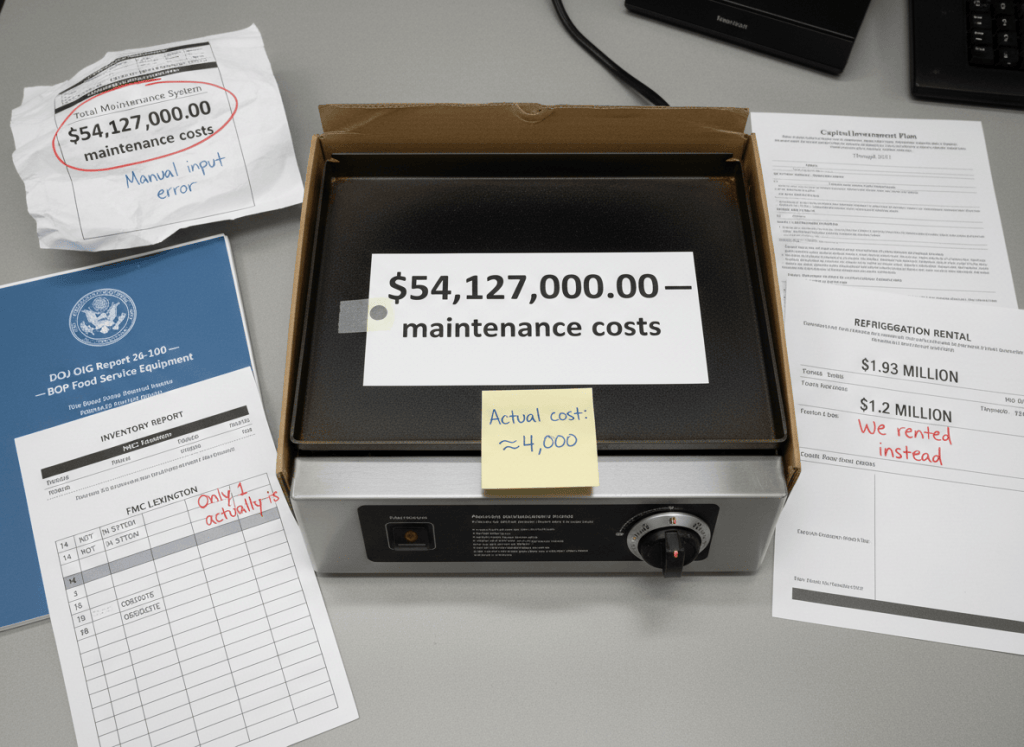
The Federal Bureau of Prisons wants Congress to believe it has a plan for the five billion dollars it just received, three billion of which is earmarked for hiring and retaining staff under Public Law 119-21. To have a plan, an agency needs to know what it owns, what that equipment costs to keep running, and what it will cost to replace. The BOP has a system for tracking exactly that. It is called the Total Maintenance System, and according to a new DOJ Inspector General audit, it once recorded that a single electric griddle, placed into service in 2017, had racked up more than fifty four million dollars in maintenance costs. The actual figure was about four thousand dollars, a rounding error’s rounding error, off by a factor of roughly thirteen thousand. (See “Audit of the Federal Bureau of Prisons’ Acquisition and Life Cycle Management of Major Equipment Supporting Food Services,” Report 26-100, September 2026.)
BOP officials told auditors this was a manual input error, which is technically true in the way that every clerical mistake is technically true. The more interesting question is why nobody caught it. The griddle sat in the system, presumably serene in its fictional status as one of the more expensive appliances in the federal government, until an outside auditor happened to ask.
The System of Record That Nobody Trusted Enough to Use Correctly
TMS exists to give BOP leadership a reliable inventory of the more than 5,700 pieces of major food service equipment spread across 118 institutions, so the agency can plan replacements and budget accordingly. When a new asset is entered, the system automatically builds a maintenance schedule and lets staff log work orders, labor, and material costs against it. In principle this is exactly the kind of system that should make a five billion dollar hiring and infrastructure infusion easier to spend well.
In practice, auditors compared TMS records against physical equipment at two institutions and found the data barely resembles reality. At FMC Lexington, the system listed 58 major food service items; fourteen more were in actual use but never entered at all, meaning no maintenance plan or cost tracking existed for them. Of the items that were listed, the assigned condition codes were wrong across the board; eighteen items were coded as “obsolete or inoperable” when only one actually was, while items genuinely falling apart were logged as merely fair or poor. At FCC Butner, auditors found the reverse problem in miniature; eighteen items on the books could not be located at all, and six more had been quietly replaced or retired without anyone updating the record. Officials blamed manual data entry, thin quality assurance, and a general lack of training on how to use the system, which is a polite way of describing an inventory that functions mostly as folklore.
None of this is abstract. The BOP is currently paying to rent 168 mobile refrigeration units and off-site cold storage across 52 institutions, at a cost of more than nine million dollars over six years, because its own refrigeration units are too often broken to trust with food that inmates are legally entitled to eat safely. At FCC Butner alone, six years of rental and off-site storage cost about $1.93 million, roughly $729,000 more than simply buying new freezer storage would have cost. That is not a rounding error. That is a spreadsheet nobody opened.
A Definition Problem Dressed Up as a Data Problem
The deeper issue, which the griddle merely dramatizes, is that the BOP has never settled on what “major food service equipment” means. A 2012 Central Office memo defines it one way, the 2023 Facilities Operations Manual defines it another way, and institution-level staff apply a third, broader definition that includes ice machines, mixers, and exhaust hoods nobody at headquarters considers major at all. Since the entire replacement-planning apparatus, TMS included, depends on knowing which assets even count, an agency that cannot define its own equipment cannot be expected to track its cost with any precision. The griddle’s fifty four million dollar phantom debt is what happens when a system built on a shaky definitional foundation also lacks the basic supervisory review to catch an extra six zeros.
The Bureau’s official response, dated September 15, 2026, is a tidy stack of bureaucratic present-perfect tense (standards issued, certifications scheduled to begin October 1, training “planned” for fiscal year 2027, a Capital Investment Plan that reaches all the way out to 2031). The BOP requested that the OIG close two of the five recommendations outright. The OIG agreed to close exactly one, the definitional standard, and left the other four open until it sees actual documentation that the certifications happened, the training occurred, and the refrigeration units got replaced rather than merely scheduled. Bureaucracy Times has covered this instinct before; an agency describes its own promises as accomplishments and asks the watchdog to take its word for it. The OIG, to its credit, did not.
Where the Money Actually Goes While Nobody Is Counting
This audit lands squarely inside the piece we have been building on the BOP’s $5 billion supplemental funding under P.L. 119-21, and it sharpens the stakes considerably. Three billion of that money is meant for hiring and retaining Food Services and Facilities staff, the same staff who, according to this report, often lack basic training in the very system meant to track the equipment they are hired to maintain. Auditors found Facilities personnel at FCC Butner who did not know how to enter routine work orders into TMS and instead filled out paper forms for a supervisor to input on their behalf. That is not a training gap so much as a training absence, extending back years, by the Bureau’s own account, due to lack of budget.
Congress is being asked to trust that an agency will spend its new money wisely, on the strength of a system that once believed a griddle cost more to maintain than most small businesses are worth. The BOP says the fix is coming. The OIG’s response, essentially, is: show us the paperwork first, and this time make sure someone checks the math.

