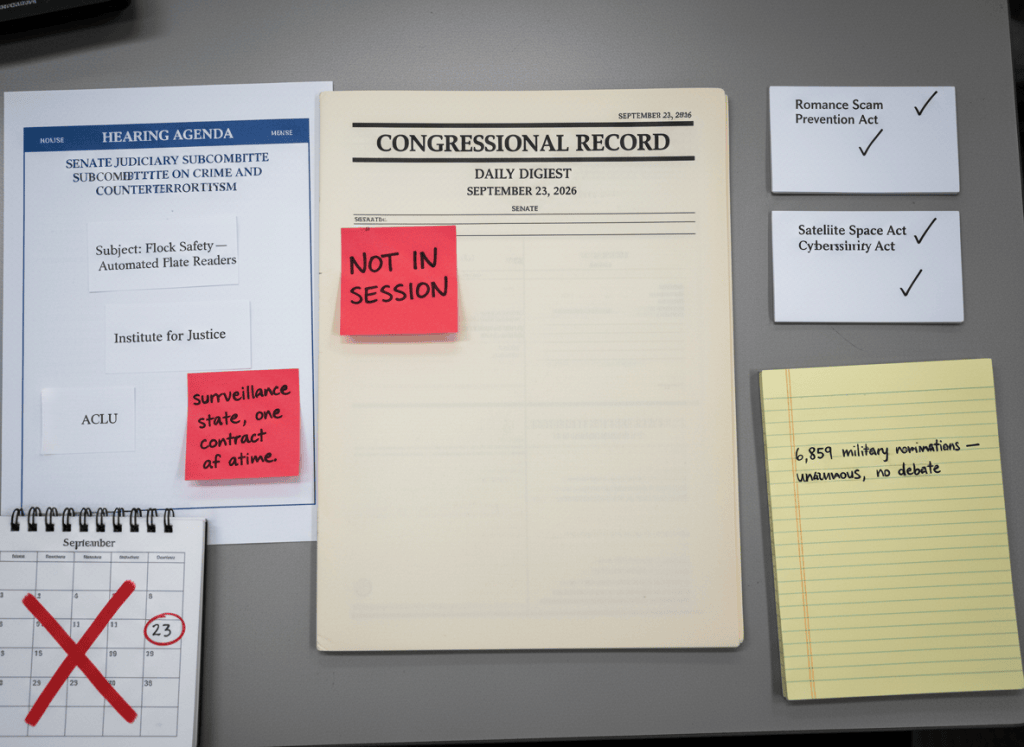
The House of Representatives was not in session on Wednesday, September 23. It did not meet, it did not vote, it did not do anything a citizen could point to as work, and it will return Thursday only for a pro forma session lasting long enough for someone to gavel it open and closed again. The Senate, left to run the government’s daily errands alone, spent part of its day on a subject that actually deserves a headline; the rest went to student athlete compensation and eight National Whatever Day resolutions.
The lede belongs to the Judiciary Committee’s Subcommittee on Crime and Counterterrorism, which held a hearing on Flock Safety’s nationwide automated license plate reader network. The witness list did the arguing for itself. The Institute for Justice and the American Civil Liberties Union warned that a private company’s cameras, feeding a searchable database used by thousands of police departments with no warrant requirement, is exactly the kind of infrastructure a country builds when nobody in particular decided to build a surveillance state; it just accumulated one contract at a time. A sheriff from Pinal County, Arizona showed up to say the cameras solve crimes. Both things can be true, which is the entire problem with oversight hearings that end in “concluded” rather than “acted on.”
Elsewhere the Senate did pass things. The Romance Scam Prevention Act (H.R. 2481) requires online dating services to warn users about fraud, which is Congress discovering in 2026 that people lie on the internet. The Secure Space Act (S. 1962) bars the FCC from licensing satellite systems tied to entities on its own Covered List, a belated acknowledgment that the same national security concerns applied to telecom equipment for years apply just as well to something orbiting the planet. The Satellite Cybersecurity Act (S. 3404) orders a federal report on commercial satellite cybersecurity, which is to say a report about a report, since the underlying vulnerability isn’t news to anyone who has read a GAO study on the subject.
The Senate confirmed Angela Veronica Colmenero to a federal judgeship in the Southern District of Texas on a 50 to 47 party line vote, and reported out 6,859 military nominations in a single Armed Services Committee motion, the kind of bulk personnel action that never gets a floor debate because nobody’s staff wants to read 6,859 names. The Environment and Public Works Committee held a hearing on nuclear waste management policy, a subject that has generated testimony since before some of the witnesses were born and will generate testimony long after this Congress is gone. The Special Committee on Aging examined the collapse of domestic generic drug manufacturing, which is the kind of hearing that produces excellent testimony and no legislation, because reshoring a pharmaceutical supply chain requires money, and money requires a vote nobody wants to cast.
Homeland Security and Governmental Affairs declined to authorize its own legal counsel to seek immunity for a witness, a small item buried in the Digest that is more interesting than everything that got its own press release, and got none of the coverage.
The House Chamber, notably, produced nothing today except a scheduling notice. Democracy’s most photographed branch is apparently also its most occasionally optional one.
Sources: Congressional Record, Daily Digest, September 23, 2026 (Vol. 172, No. 151).

