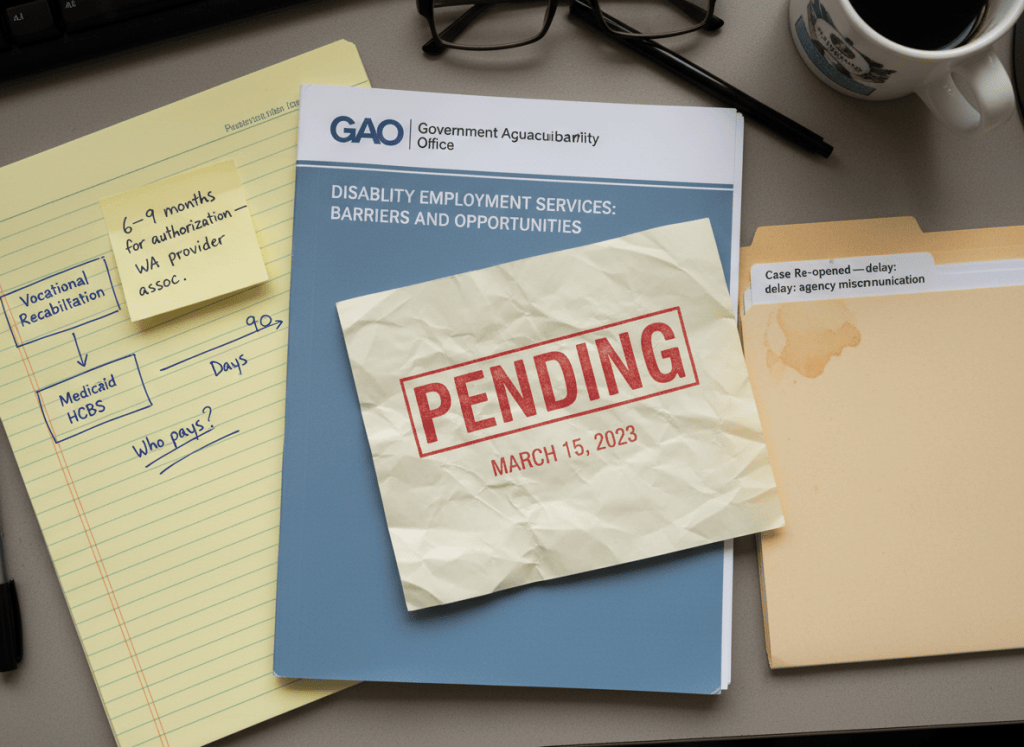
The federal government has programs designed to help people with intellectual and developmental disabilities find and maintain jobs.
It also has procedures for deciding which program is supposed to pay for that help.
Sometimes the second part gets in the way of the first.
A new Government Accountability Office report examining disability employment services in Georgia, Pennsylvania and Washington found that providers encountered administrative confusion, reimbursement delays and gaps in services as individuals moved between state Vocational Rehabilitation programs and employment supports financed through Medicaid.
In one particularly striking example, a Washington provider association told GAO that funding authorizations for job-placement contracts that should take a week or less could instead take six to nine months because of staffing shortages.
For someone who is ready to work, that is a rather long administrative definition of “ready.”
Two Programs, One Worker
Vocational Rehabilitation, or VR, is a joint federal-state program overseen nationally by the Department of Education’s Rehabilitation Services Administration. Medicaid Home- and Community-Based Services, or HCBS, is overseen federally by the Centers for Medicare & Medicaid Services.
Together, they represent the primary federal programs funding employment services for people with intellectual or developmental disabilities, according to officials interviewed by GAO.
The scale is substantial.
Federal VR grants to states totaled approximately $3.7 billion in fiscal year 2023, and people with intellectual or developmental disabilities represented about 22 percent of VR cases nationally that year. Separately, a federally funded study estimated roughly $1.5 billion was spent on employment services for people with I/DD in FY2023, with Medicaid HCBS supplying most of that money. That estimate did not include the VR grants.
The programs perform different roles, and on paper the transition between them is fairly orderly.
VR typically finances shorter-term services such as job discovery and placement. Once an individual reaches job stabilization, generally after 90 days of employment, the VR case closes and Medicaid HCBS can finance longer-term assistance such as job coaching.
If the worker loses or changes jobs, however, the process can begin again.
That handoff is where things can become complicated.
Mind the Gap
GAO interviewed 12 employment service providers across the three states. Six reported service gaps caused by administrative burden or confusion between VR and state I/DD agencies.
In Pennsylvania, one provider told investigators that support coordinators sometimes waited for a formal VR closure letter before beginning Medicaid-funded job coaching, even though individuals became automatically eligible after reaching 90 days of job stability.
GAO said the practice caused “unnecessary gaps in services.”
Providers can also find themselves financing the gap.
Four of the 12 providers told GAO they experienced reimbursement delays as individuals transitioned from VR to I/DD services. One Georgia provider reported continuing to serve individuals without reimbursement during a three-month transition period while the agencies completed closure letters and prior authorizations.
According to GAO, providers are not reimbursed for services delivered while an individual is caught between agencies after the VR case has closed.
The consequences do not necessarily remain confined to accounting departments.
One Washington provider told GAO that some families simply give up on obtaining employment services because of the administrative workload and back-and-forth between agencies. A Georgia provider described a woman who lost her job and then experienced months of delays reopening her VR case because of agency miscommunication.
Pick Your Payment Problem
Behind the coordination problem is another peculiarity: the two systems generally pay providers differently.
VR agencies in the three states generally used a milestone model, paying providers when an individual achieved specified employment outcomes. Medicaid HCBS programs primarily used fee-for-service, paying according to units of service or time.
Each approach comes with its own incentive problem.
Under milestone payments, providers can perform substantial work without receiving full reimbursement if the worker fails to reach the prescribed outcome, even when circumstances are outside the provider’s control.
GAO gives a particularly revealing example. One provider supported an individual whose workplace went out of business before the worker could demonstrate job stability. Because the required milestone wasn’t reached, the provider faced the reimbursement risk.
Pennsylvania officials told GAO that providers considered milestone payments too risky compared with fee-for-service arrangements.
Fee-for-service solves that problem and introduces another.
The more services a provider delivers, the more it gets paid.
Yet the objective of supported employment is generally for workers to become increasingly independent, with on-the-job assistance fading over time. GAO notes that fee-for-service therefore does not financially incentivize providers to reduce or eliminate services.
In other words, one model can penalize providers when a desired outcome isn’t achieved. The other can reward them for continuing to provide the very services the program hopes workers will eventually need less of.
Federal program design has apparently discovered diversification.
Washington Has Been Told Before
None of the coordination problem is entirely new to the federal government.
In 2022, the Labor Department’s Office of Disability Employment Policy, Education’s Rehabilitation Services Administration, CMS and other federal agencies jointly encouraged state and local governments to coordinate funding through techniques known as blending, braiding and sequencing.
The guidance also encouraged interagency agreements specifically to prevent confusion over responsibilities and delays in services.
Georgia and Pennsylvania officials told GAO they found the guidance useful.
Washington officials told GAO they had not yet implemented it.
States have made other changes. Pennsylvania, for example, established guidance allowing an individual to proceed to Medicaid HCBS-funded employment services if VR has not made an eligibility determination within 120 days. Georgia officials said their VR and I/DD agencies now meet weekly to track transitioning cases and monthly to troubleshoot stalled ones.
Those efforts matter, because GAO’s report is not a nationwide census of disability employment programs.
The auditors examined only three states and interviewed 12 providers. GAO explicitly cautions that the results cannot be generalized to all states or all service providers.
But within that limited sample, the pattern is difficult to miss.
The government has programs to help people with intellectual and developmental disabilities enter and remain in the workforce. It has federal money supporting those programs. It has guidance explaining how different funding streams can be coordinated. And states have procedures intended to move people from one system to another.
Yet GAO still found workers encountering service gaps, providers waiting months for reimbursement and families navigating enough administrative machinery that some reportedly abandoned the process altogether.
For a system designed to remove barriers to employment, the paperwork occasionally appears to have erected a few of its own.

