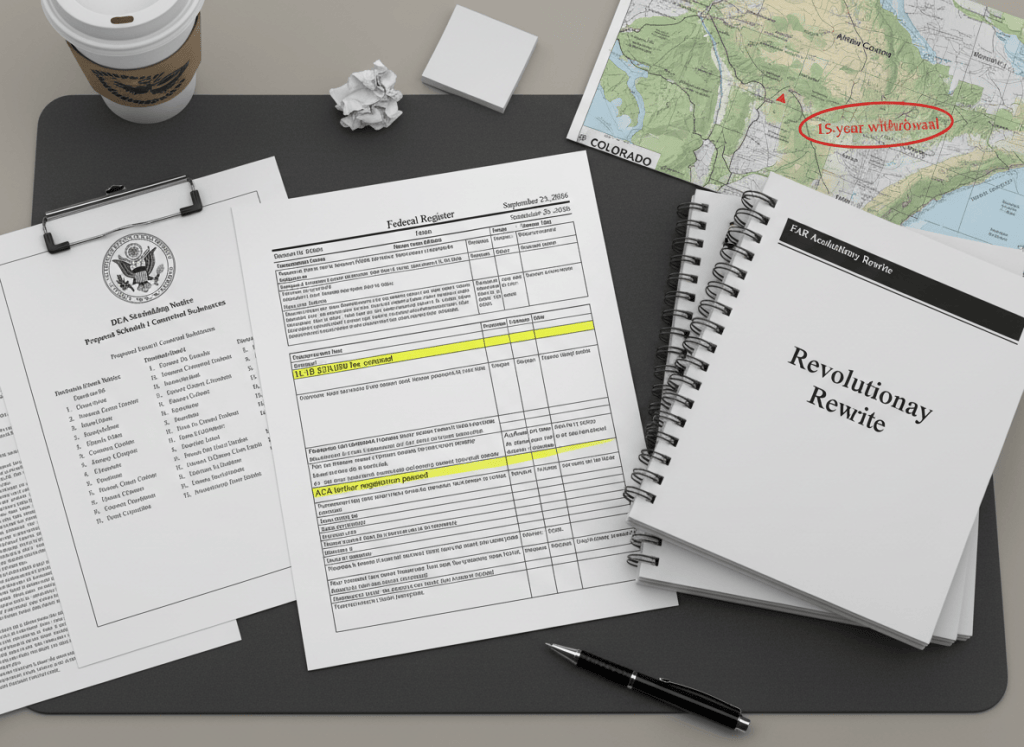
President Trump extended the $100,000 fee on new H-1B visa petitions for another year, and the same day’s docket also revived a shelved drug-scheduling plan, quietly relabeled a foreign-aid advisory council, and locked in a Colorado military land withdrawal for another decade and a half.
- Executive Office of the President — H-1B fee extended, program-integrity order issued alongside it. Proclamation 11069, signed September 18 and published today, extends through September 21, 2027 the rule that H-1B petitions for specialty-occupation workers must be accompanied by a $100,000 payment, with only narrow national-interest exceptions. The administration cited what it called a 92 percent drop in H-1B filings from major IT outsourcing firms since the fee took effect as evidence it worked. It paired the extension with Executive Order 14431, directing agencies to coordinate more closely on policing the program. Renewing the fee for a second year, rather than letting it lapse, is a stronger signal that it is becoming a permanent feature of the visa system rather than a temporary emergency measure.
- HHS — an interim final rule that took effect the moment it was published. The new rule pauses registration for ACA marketplace agents and brokers who lack a current Plan Year 2026 agreement with the federal exchanges, blocking them from registering for Plan Year 2027 until February 1, 2027. HHS invoked authority to skip the advance notice-and-comment process that precedes most rules, meaning the policy bound brokers before anyone outside the agency had a chance to object; the public only gets to comment after the fact, which limits how much the process can still change before it takes hold.
- Interior/BLM — a 15-year renewal of the Army’s hold on Fort Carson and Piñon Canyon. Public Land Order No. 7971 keeps roughly 5,650 acres of public land and more than 141,000 acres of federal mineral rights in Colorado off-limits to the mining, grazing, and homesteading uses normally allowed on public land, reserving them for Army training and live-fire exercises. A “withdrawal” of this kind removes land from the ordinary rules that let private parties stake claims or apply for permits on it; renewing one for 15 years, rather than a shorter term, locks in military control of the long-contested Piñon Canyon Maneuver Site well into the 2040s.
- Millennium Challenge Corporation — a council “reestablished” months after it was renewed. MCC published a notice reestablishing its Advisory Council for the 2026–2028 term, less than three months after a July 2 notice announced that same council’s charter had already been renewed for that identical term. Agencies typically renew an advisory committee’s charter once per term rather than following a renewal with a reestablishment of the same body soon after, so the change in language is the kind of “why now” wrinkle worth a second look. Neither notice explains what changed between July and September, or why “renewal” stopped being the operative word.
- DEA — reviving a scheduling plan it shelved four years ago. The agency proposed placing five tryptamine hallucinogens — 4-OH-DiPT, 5-MeO-AMT, 5-MeO-MiPT, 5-MeO-DET, and DiPT — into Schedule I, the most restrictive drug category, reserved for substances found to have no accepted medical use, that carries the strictest handling requirements and criminal penalties. DEA proposed the same scheduling action back in 2022 but withdrew it to seek updated scientific evaluations from HHS. Its return now, with the same five substances and no public explanation of what new evidence closed that gap, is the sort of resurfacing worth flagging.
- OMB/DOD/GSA/NASA — paperwork notices tied to a “Revolutionary” rewrite of federal contracting rules. Three linked notices (FAR Case 2026-011, 2026-006, and 2026-010) seek public comment on the paperwork burden of a sweeping Federal Acquisition Regulation overhaul proposed on September 18 under Executive Order 14275, spanning twelve coordinated proposed rules that touch contractor qualifications, contract types, patent and data rights, bonding, and dozens of other subjects. The FAR governs how the government spends hundreds of billions of dollars a year on contracts, so a rewrite at this scale reshapes federal procurement well beyond the routine paperwork notices that formally introduced it today.
This edition draws on the full Federal Register docket for September 23, 2026: 98 documents in all. Excluded as routine: roughly two dozen NAGPRA repatriation and inventory-completion notices, about ten SEC self-regulatory-organization rule filings, routine FERC pipeline and hydroelectric project notices and combined filings, antidumping/countervailing-duty determinations, bank holding company formation and control notices, standard Paperwork Reduction Act information-collection notices unrelated to the FAR overhaul, and routine advisory-committee and agency meeting notices.

