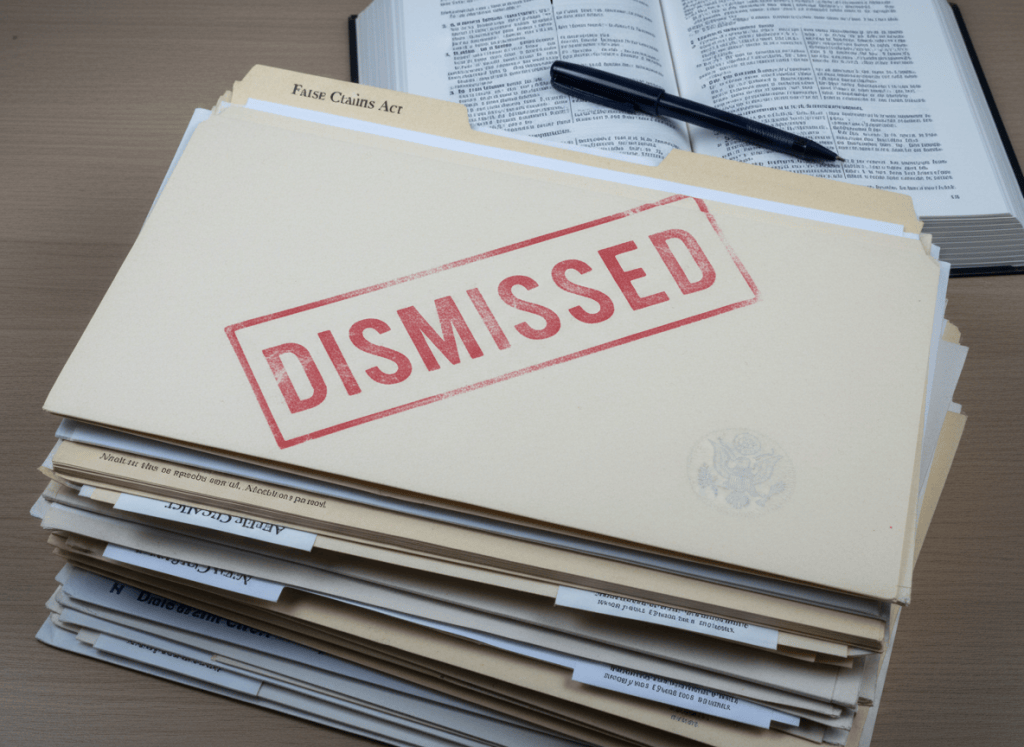
The Justice Department announced on September 18 that it was revising two sections of the Justice Manual governing the False Claims Act, the statute the government has used since 1986 to recover more than $85 billion from contractors, hospitals, and grant recipients who lied to Uncle Sam. Associate Attorney General Stanley E. Woodward Jr. described the changes in suitably poetic terms: “The Department of Justice should enforce the law, not make law through enforcement.”
A fine sentiment, and one that would carry more weight if the policy in question were not primarily a formal blessing for something DOJ was already doing at quadruple its previous rate.
This is not the Department’s first pass at the Manual, and it won’t be the last; the document is a living internal rulebook, revised whenever an administration wants to signal, in writing, how it intends to point the FCA’s considerable weaponry.
What makes this revision worth a second look is not its stated content but its timing, arriving four and a half months after a senator started asking pointed, on-the-record questions about exactly the authority the Manual now blesses.
The Manual Gets a Rewrite
The first revision reinstates the 2017 “Brand Memo” doctrine, which holds that sub-regulatory guidance (the informal circulars, bulletins, and advisory letters agencies issue between actual rulemakings) cannot create legal obligations that don’t already exist in statute or regulation.
This is presented as a fair notice measure, to wit, a company should be liable for breaking the law, not for failing to intuit an agency’s unpublished preferences. Reasonable enough, and DOJ is right that guidance documents have a way of acquiring the force of law without ever going through the trouble of becoming law.
The second revision is the one that matters. It directs DOJ attorneys to affirmatively consider seeking dismissal of qui tam suits (the whistleblower-initiated cases that make up the bulk of FCA litigation) whenever the Department declines to intervene, and to keep revisiting that option as the case proceeds. This authority comes from 31 U.S.C. § 3730(c)(2)(A), and the Supreme Court blessed its broad use in the 2023 case United States ex rel. Polansky v. Executive Health Resources.
Assistant Attorney General Brett Shumate framed the update as keeping “enforcement efforts remain aligned with those interests” of the United States, which is bureaucratic for “we intend to throw more of these cases out.”
The Numbers DOJ Would Rather You Learned From a Senator
Here is what the press release does not mention. Senator Chuck Grassley, the Iowa Republican who wrote the 1986 amendments strengthening the FCA in the first place, sent a letter to Shumate on April 2 asking pointed questions about dismissal practices. In it, Grassley noted that DOJ dismissed roughly 25 qui tam cases under § 3730(c)(2)(A) in 2025, compared to an average of about six per year under the prior administration.
That’s not a policy adjustment; that’s a quadrupling, delivered months before the Manual itself caught up to reflect it. Deputy Assistant Attorney General Brenna Jenny made the posture explicit at an industry conference in January, telling a room full of FCA defense lawyers that “(c)(2)(A) is back.”
None of this is happening in a vacuum of litigation. FY2025 was a record year for whistleblowers by every measure that counts, with 1,297 new qui tam suits filed, up from 980 the year before and 712 the year before that, nearly doubling in two years. Those suits generated $5.3 billion of the $6.8 billion the government recovered under the FCA in FY2025, or roughly 78 percent of the total, a figure DOJ’s own Civil Division touted as a historic high the same month Grassley was asking why the Department was dismissing whistleblower cases at four times the prior rate.
The Department is, in other words, simultaneously bragging about relators bringing in most of its money and building the institutional machinery to throw more of their cases out. Both statements can be true. Neither makes the other look good.
It’s worth noting where that money actually comes from. Health care accounted for roughly 84 percent of FY2025 recoveries, north of $5.7 billion, which means the cases most exposed to a more dismissal-friendly Department are precisely the ones involving hospital systems, pharmaceutical manufacturers, and Medicare and Medicaid billing practices, the same institutions that tend to have the resources to make a dismissal motion attractive to a Department weighing its limited litigation bandwidth against a case’s “alignment with the interests of the United States.”
The Article II Question Nobody in the Press Release Mentions
There’s a reason DOJ might want its dismissal muscle memory in good working order right now, and it has nothing to do with fair notice. The qui tam mechanism itself is under constitutional siege. In Polansky, three Supreme Court justices (Thomas, Kavanaugh, and Barrett) suggested in a concurrence and dissent that there are “substantial arguments” the entire relator-driven structure violates Article II, on the theory that private citizens cannot represent the interests of the United States in litigation the Executive Branch hasn’t chosen to bring.
A Florida federal district court subsequently agreed and held the qui tam provisions unconstitutional outright; that ruling is now sitting with the Eleventh Circuit.
A more aggressive dismissal posture is one of the cleanest ways for DOJ to reassert that it, not some private relator’s contingency-fee attorney, controls whether a False Claims Act case lives or dies, regardless of how the Eleventh Circuit eventually rules on the underlying constitutional question.
Revising the Justice Manual to formalize that posture, quietly, four months after a sitting senator started asking uncomfortable questions about it, reads less like a course correction and more like an agency building the paper trail to justify a practice it had already adopted.
What We’re Requesting
Grassley’s 25-dismissals figure and DOJ’s own “six per year” baseline both trace back to the same letter and the same set of conference remarks. Neither is an independently verifiable dataset, and DOJ has not published a public accounting of which qui tam cases it moved to dismiss in 2025, on what grounds, or with what success rate in front of the actual district courts hearing them.
Bureaucracy Times is filing a Freedom of Information Act request with the Civil Division’s Commercial Litigation Branch for the underlying dismissal log, including case names, filing dates, the grounds cited under § 3730(c)(2)(A), and the disposition of each motion. If DOJ’s new posture really is about “fair and effective enforcement,” as Associate Deputy Attorney General Paul Perkins put it, the underlying record should hold up to daylight.
We’ll report back on what, if anything, we get.

