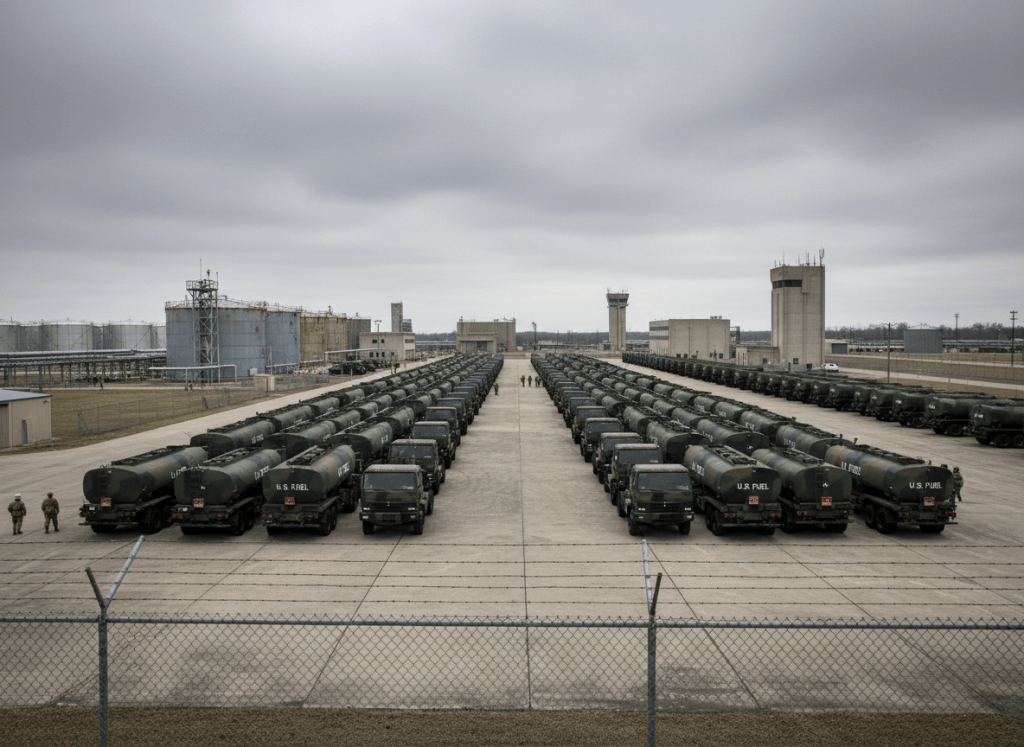
Somewhere inside the Defense Logistics Agency’s ledgers this year sits a small, almost comic failure of arithmetic, the kind that would get a corner store shut down but barely rates a footnote in a war. CBO’s letter on the cost of Operation Epic Fury records that DLA, the office responsible for buying and reselling fuel to the entire Department of Defense, raised its surcharge on military fuel purchases by $42 a barrel this year to cover the war’s energy costs. The Government Accountability Office had already told Congress the increase would not be enough. By CBO’s account, GAO expected DLA to lose $1.82 billion on fuel sales in fiscal year 2026 anyway, meaning the agency set a price, watched its own watchdog tell it the price was wrong, and kept charging it. This is the kind of detail that never makes it into a floor speech about supporting the troops, because it is not about the troops at all. It is about a supply agency’s internal pricing model failing in real time, in public, while Congress is being asked to backfill the shortfall.
The Gas Station That Loses Money on Every Gallon
DLA is not a charity. It exists to buy fuel in bulk and resell it to the services at a price meant to cover its costs, full stop. When CBO adds up the $835 million in extra surcharge revenue DLA actually collected from April through June against the $1.82 billion GAO says it is on track to lose for the year, the agency comes out roughly $1 billion short of covering what it spent to run the exact same shop. DLA’s own remedy list, as CBO relays it, amounts to drawing down cash reserves, raising prices later to cover this year’s shortfall, or going back to Congress for a supplemental, some combination of an institution quietly eating its own losses and passing the bill forward. This is not exotic mismanagement. It is a government gas station that cannot price gas correctly even with its own accountants standing next to the pump.
The Magazine Is Empty
While DLA was losing money on diesel, the missile defense side of the ledger was spending down something that cannot simply be reordered at market price. CBO’s letter states that Operation Epic Fury and the Twelve Day War against Iran that preceded it in 2025 together consumed, by the agency’s estimate, somewhere between one half and two thirds of the entire US inventory of Patriot, THAAD, SM 3, and SM 6 interceptors. A CSIS assessment of the same stockpiles puts the replacement timeline at two to three years for the cheaper interceptors and considerably longer for the most sophisticated ones, because, as CBO notes, it typically takes three to five years just between placing an order for these systems and actually receiving one. CBO’s letter is explicit about why this matters beyond Iran; it points directly at a hypothetical conflict with the People’s Republic of China, whose missile arsenal dwarfs Iran’s and which would draw on precisely the interceptor types the United States just burned through defending Gulf allies and Israel. These are not cheap items to begin with. CBO puts Patriot and SM 6 interceptors at roughly $4 million apiece, THAAD interceptors at about $12 million, and the most advanced SM 3 variant at $28 million, all produced at rates too low to absorb a war’s worth of demand without years of lag. Congress authorized a war against Iran. Nobody voted on drawing down the country’s missile shield for a war with China that has not happened, and CBO is telling them, gently, that this is what occurred anyway.
A War Bill With a Farm Subsidy and a Train Station Stapled to It
Then there is the part of the ledger that has nothing to do with fighting at all. The administration’s June supplemental request, justified almost entirely by reference to the Iranian conflict, included $20.5 billion for agencies and purposes CBO could not connect to the war in any meaningful way. The single largest chunk, $11.1 billion, went to the Department of Agriculture, mostly to compensate crop farmers for higher fuel and fertilizer costs tied to the closure of the Strait of Hormuz, a connection CBO is willing to grant even if it is several steps removed from combat. A separate $1 billion of the same wartime request, however, was earmarked for the design and construction of a modernized Penn Station in New York, a project CBO states plainly has no connection to the decision to go to war at all. It rode into an Iran war supplemental request the same way a rider always does, quietly, attached to something urgent enough that nobody wants to be the member of Congress who voted against funding the troops in order to strip out a train station.
The Invoice Nobody Reconciles
None of these three items would sink a budget on its own. A rounding error at DLA, a stockpile drawdown with a five year lag, a train station riding along on a war appropriation, each is survivable in isolation. What they share is a pattern this publication keeps finding wherever it looks at federal spending under pressure, which is that the institutions responsible for pricing, replenishing, and appropriating money for a national emergency are not actually very good at doing any of those three things cleanly, and the emergency itself becomes the cover under which the sloppiness gets funded rather than fixed.
DLA will eventually raise prices again to cover this year’s hole, quietly, in a future fuel bill nobody will connect back to Iran. The interceptors will eventually get rebuilt, five years and several billion dollars from now, for a war that may or may not arrive, against an adversary far better supplied than the one that just emptied the shelves. And Penn Station, whatever its architectural merits, will get built partly on the strength of a line item that borrowed its urgency from a war eight time zones away that had nothing whatsoever to do with commuter rail. Add it up and the pattern is not corruption in any prosecutable sense. It is simply what a bureaucracy does when nobody outside it is required to check the receipts before the money moves.
Sources: Congressional Budget Office, Cost of Operation Epic Fury (September 2026); CSIS, Last Rounds: Status of Key Munitions After the Iran War Ceasefire; Office of Management and Budget, June 24, 2026 supplemental funding request letter to Speaker Johnson. See also: Congress Asked the Pentagon What the War Costs. The Pentagon Didn’t Pick Up.

