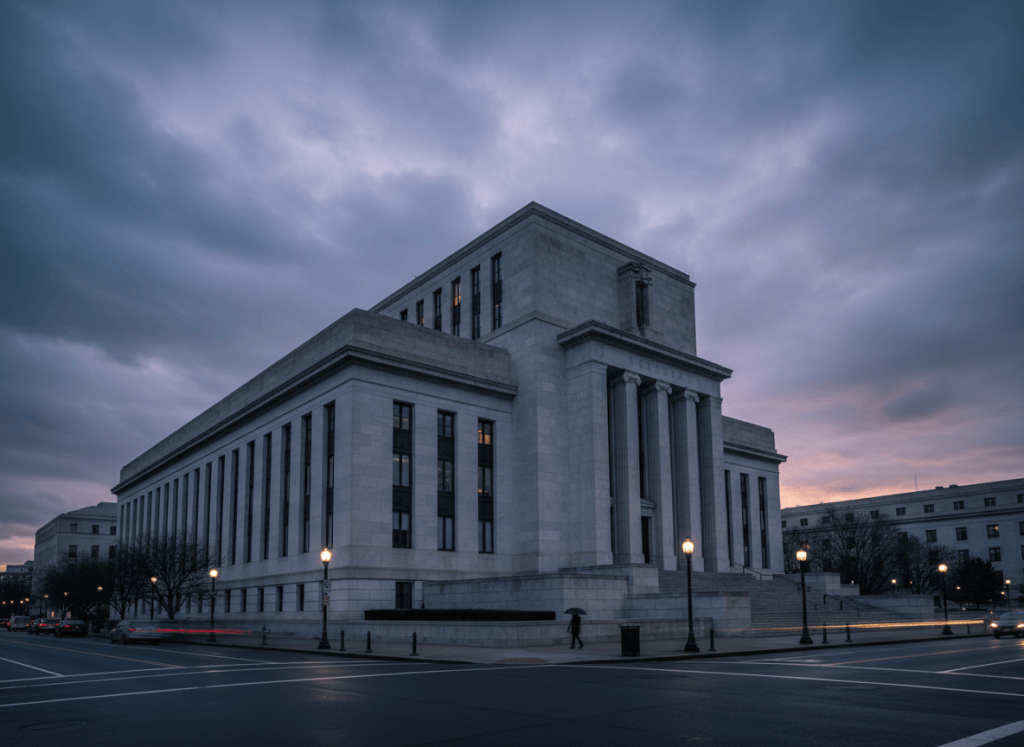
The Reversal Nobody at the Podium Wanted to Name
On September 16, 2026, the Federal Open Market Committee did something it had not done since 2023. It raised interest rates. The vote was 12 to 0, a quarter point, lifting the target range to 3.75 to 4 percent.
You would not know from the statement itself that this was a reversal of years of cutting. The Committee’s prose, as always, arrived sanded down to the texture of a hospital waiting room…
“Economic activity is expanding at a solid pace.”
“Productivity growth is strong.”
“Job gains have kept pace with the workforce.”
Four sentences later, almost as an afterthought: “Inflation remains elevated.” Today’s action, the statement assured us, “will support a timelier return to the Committee’s 2 percent goal.”
Timelier than what, exactly, the statement does not say. Timelier than the last several years of the Committee insisting inflation was transitory, then persistent, then manageable, then, apparently, in need of an actual hike to fix.
If you have whiplash, you are reading the sentence correctly. The institution that spent 2024 and 2025 cutting rates on the theory that inflation was heading obediently toward target has just told you, in the driest possible language, that the theory did not hold.
“Geopolitical Developments” Is Doing an Enormous Amount of Work
The statement attributes elevated uncertainty, in part, to “geopolitical developments.” This is a phrase built for a press release, not a diagnosis.
Chair Kevin Warsh, at the podium, came slightly closer to naming the mechanism, telling reporters that the Fed “cannot affect any individual price” on items like oil or groceries but would work to ensure that any change in relative prices “don’t broaden out, don’t have second and third order effects on the economy.”
That is a serviceable description of what a central bank actually does. It is also, notably, not a description of any specific tool the Fed is using to accomplish it. Raising the federal funds rate a quarter point does not touch the price of oil, does not touch the price of eggs, and does nothing to whichever geopolitical development is allegedly driving both.
What it does is tighten financial conditions broadly and hope the broadening effect Warsh described never shows up. That is a bet, not a mechanism, and the statement’s studious refusal to name the underlying driver means the public is being asked to trust the bet without being told its odds.
A Skip Calendared Suspiciously Close to an Election
Here is where the institutional story gets more interesting than the monetary one. Most FOMC participants pencil in a total of two hikes this year in their updated projections, and the Committee is expected to skip its October meeting, a decision one asset manager tied explicitly, in reporting following the announcement, to the meeting’s proximity to the midterm elections.
The Federal Reserve has spent decades building a reputation, however imperfect, on the idea that its calendar answers to data, not to ballots. A skipped meeting is not itself a scandal. But when the skip is reported in the same breath as the midterms, and nobody at the Fed rushes to correct the record, the silence tells you something.
Either the independence is real and the timing is coincidental, in which case the Fed has an obligation to say so plainly; or the timing is not coincidental, in which case the public deserves to know that too.
What the Institution Owes the Public It Did Not Deliver
None of this means the rate decision was wrong on the merits. A quarter point hike after a multiyear cutting cycle, with inflation still running hot, is a defensible call, and 12 to 0 votes do not happen by accident. But defensible policy and adequate disclosure are two different things, and the September statement gave the public one while withholding the other.
The Fed will tell you, correctly, that a terse statement is a feature, not a bug, designed to avoid spooking markets with unnecessary color. Fair enough. But if the data justified a reversal this stark, the institution owes the public more than four sentences of boilerplate.
And if the October skip really is unrelated to the midterms, the burden is on the Fed to say so, not on financial reporters to speculate in its absence.
The Committee reconvenes, by the current schedule, well after voters have had their say. Whether that is coincidence or caution dressed up as one, the Fed has not told us, and until it does, the question is not going away.
Primary sources: Federal Reserve, September 16, 2026 FOMC statement.
 Bureaucracy Times