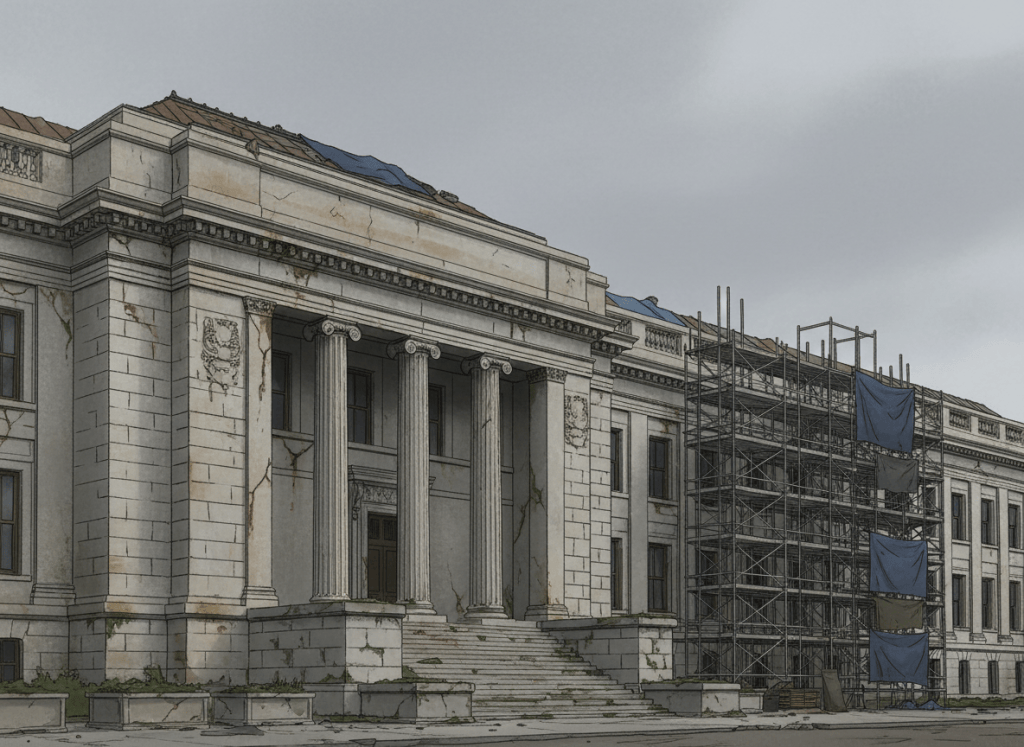
The federal government has a building maintenance problem measured in billions of dollars, fewer people managing those buildings than it did two years ago, and a new policy allowing as much as five years to pass between the physical assessments it uses to estimate what many of those buildings need.
That combination sits at the center of a new audit by GSA’s Office of Inspector General, which found that the agency’s Public Buildings Service was already understating repair and maintenance liabilities in some of its building assessments.
The September audit examined 196 buildings and found that 79 surveys underreported repair and alteration costs by a combined $73.2 million.
The OIG did not extrapolate that figure across GSA’s entire portfolio, and neither should anyone else. The audit does not establish that every federal building assessment is understated by the same percentage.
What it does establish is more consequential for the future: the system GSA relies upon to understand the condition and repair costs of its buildings was capable of missing known liabilities before the agency substantially lengthened the time between required physical assessments.
And the government already has quite a maintenance bill.
A $17 Billion Backlog
GSA’s Public Buildings Service serves as the federal government’s civilian landlord, providing workspace for hundreds of thousands of federal employees across a portfolio that requires continuous attention — roofs, elevators, boilers, chillers, electrical systems, fire protection equipment. The backlog has been growing for years.
The Government Accountability Office reported in 2025 that deferred maintenance and repair across Defense Department and civilian federal properties had more than doubled, rising from approximately $171 billion in fiscal year 2017 to $370 billion in fiscal year 2024.
GSA’s portion exceeded $17 billion by March 2025, and GAO warned that allowing the trend to continue could cause federal assets to deteriorate further and require premature replacement — potentially costing substantially more than performing maintenance when originally scheduled.
The problem was serious enough that GAO added the condition of federal buildings as a new concern within federal real property’s longstanding designation on its High-Risk List.
GSA was therefore already trying to manage an aging portfolio carrying billions of dollars in deferred work when its workforce shrank dramatically.
PBS Lost 45 Percent of Its Workforce
Between September 2024 and November 2025, the Public Buildings Service went from 5,683 employees to 3,126 — a reduction of approximately 45 percent.
GAO later found that PBS had not conducted strategic workforce planning before making those reductions.
The consequences were not purely theoretical: officials from federal agencies served by PBS told GAO about concerns regarding the organization’s capacity, including project delays associated with having fewer employees available to perform essential real-estate work.
PBS officials subsequently began trying to determine where workforce and skills gaps existed, even as the schedule for assessing federal buildings changed.
Two Years Became Five
GSA uses its Building Assessment Tool, or BAT, to estimate the cost of correcting major deficiencies in buildings for which PBS has maintenance responsibilities.
A BAT survey is not simply an accounting exercise.
It is a 40-section assessment based on a physical inspection of an individual building. The information produced through that process feeds GSA’s financial reporting, long-term capital planning and decisions about which repairs receive priority.
Previously, PBS required those surveys every two years; beginning in fiscal year 2025, GSA moved to a five-year assessment cycle.
The agency’s FY2025 financial reporting attributed the change to resource constraints and alignment with the minimum assessment frequency established by the Federal Real Property Council.
GSA is not violating the federal minimum by inspecting buildings every five years. It has moved from its previous, more frequent schedule to the minimum interval permitted under the applicable government-wide standard.
Nor does a building’s maintenance estimate simply sit untouched until someone returns with a clipboard five years later.
GSA updates BAT estimates annually to account for changes in labor and material costs and other circumstances. Better project-specific information can also be incorporated when it becomes available.
Those procedures can help keep the estimated price of known repairs current.
But updating the estimated cost of a problem isn’t the same thing as discovering a new problem.
A spreadsheet can tell GSA that the roof repair it identified three years ago is more expensive today.
The spreadsheet cannot look at the roof.
That distinction is precisely why the timing of the new OIG audit matters.
The Inspector General Found Missing Repairs
The GSA OIG concluded that PBS was not consistently following its own procedures for ensuring that BAT estimates were complete and accurate.
Auditors found 79 surveys among their 196-building sample that underreported repair and alteration liabilities by approximately $73.2 million.
The problem was not always that GSA lacked the information; in some cases, relevant records existed elsewhere within the agency, but surveyors and approvers did not consistently review them when preparing assessments.
That means the agency could possess records showing that work was needed while the building assessment used to calculate maintenance liabilities failed to incorporate it.
The OIG concluded that the deficiencies limited assurance that PBS was consistently using and reporting complete, accurate and reliable information about the repair and maintenance needs of its portfolio.
Because PBS underwent significant staffing reductions and a major reorganization in 2025, the OIG noted, BAT surveys are now required every five years instead of every two, explicitly connecting that problem to the longer inspection schedule.
The longer interval, auditors warned, increases the risk that GSA will be working with outdated maintenance-liability information.
In other words, the five-year cycle isn’t the reason auditors found $73 million missing from the sampled surveys.
But discovering that the system can miss liabilities makes the additional three years between required physical assessments considerably more important.
Avoiding a Future Television Career
There is, admittedly, an entertaining way to contemplate the eventual destination of buildings whose maintenance problems are allowed to accumulate.
Fans of Mysteries of the Abandoned know the formula.
Somebody builds an impressive structure. Somebody stops taking care of it. Nature begins submitting its own change orders. Eventually, a television crew arrives to explain why there are trees growing through what used to be the conference room.
A federal building does not become Discovery Channel material merely because GSA inspects it every five years.
But the joke works because deterioration isn’t particularly interested in the government’s inspection calendar.
Roofs leak. Pipes corrode. Boilers age. Concrete cracks. Electrical equipment becomes obsolete. Water intrusion produces new problems while existing problems become more expensive.
And the federal government is already carrying a maintenance backlog large enough that preventing deterioration ought to be considerably cheaper than documenting the ruins afterward.
The Minimum Standard Meets a Maximum-Sized Problem
There is nothing inherently improper about a five-year assessment cycle — it meets the federal minimum. That may actually be the more important point.
GSA did not move to a five-year cycle while managing a pristine portfolio with abundant staff and a maintenance system demonstrating exceptional accuracy.
It made the change amid resource constraints, a major reorganization, a 45-percent reduction in PBS staffing and a deferred-maintenance backlog exceeding $17 billion.
The federal government’s broader maintenance backlog, meanwhile, has more than doubled since 2017.
Now the GSA inspector general has demonstrated that the information system helping the agency understand those liabilities can omit repair costs already documented elsewhere inside the government.
The OIG has recommended tighter controls over how BAT surveys incorporate maintenance information and stronger quality-control procedures. PBS agreed with the recommendations.
Those changes may improve the accuracy of the information GSA collects, but they do not change the arithmetic of time. Under the old schedule, a required physical assessment returned every two years. Under the new one, it may not return for five.
For a government already trying to decide which of billions of dollars in building repairs it can afford to make, three additional years is a long time for something to start leaking.
 Bureaucracy Times