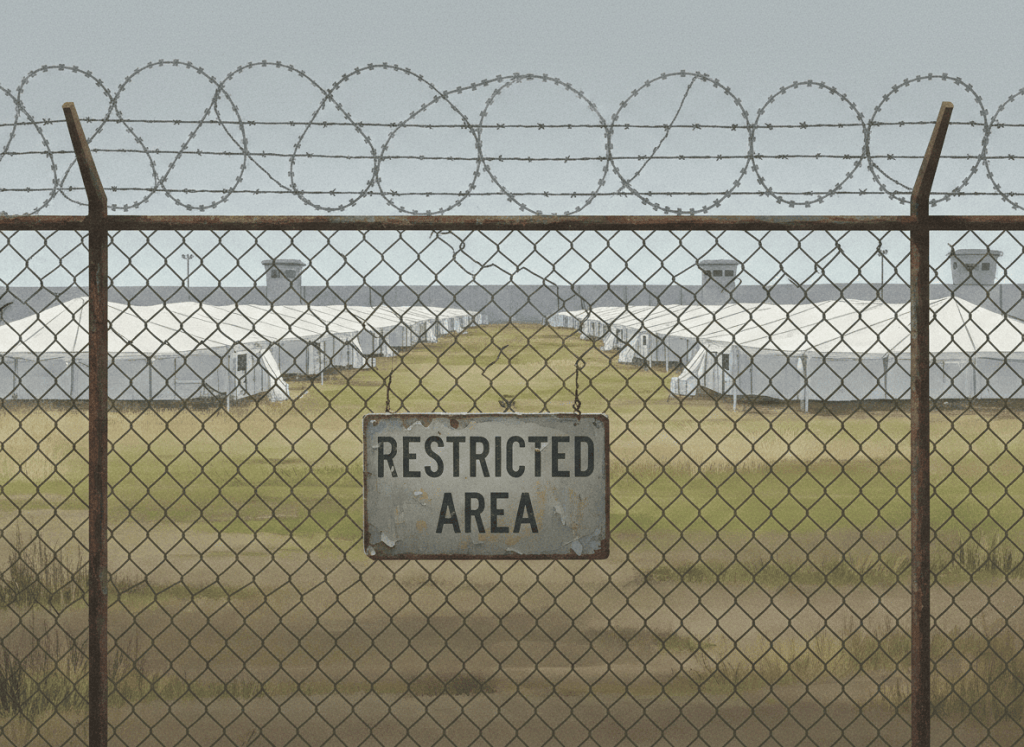
The Department of Homeland Security has a defense for what happened at Alligator Alcatraz, and it is a good one, in the sense that lawyers use the word good. DHS told its own inspector general that it never held a contract to manage detention space at the Florida Soft-Sided Facility. Florida, the department says, detained people there under authority delegated through Section 287(g) of the Immigration and Nationality Act, and Florida ran the place day to day. It is a tidy argument. It is also contradicted, point by point, by evidence gathered during the same inspection that produced it, evidence that happens to include a paper trail worth over six hundred million dollars.
The Argument From Absence
Section 287(g) is the mechanism by which the federal government deputizes state and local authorities to perform immigration enforcement functions they would otherwise lack the power to perform. It is a genuinely useful tool for describing how Florida came to be in the detention business at all. What it does not do, on its own, is answer the question OIG actually asked, which is not “who had legal authority to detain these people” but “who was actually running this facility, and who is accountable for what happened inside it.” DHS answered a question nobody put to it and left the one that mattered sitting on the table.
The department’s response, as recorded in the report, amounts to three moves: no direct contract existed, Florida held operational authority, and the facility has since closed anyway so the point is largely academic. Each of these statements can be true and still fail to describe reality. OIG did not simply accept the framing. It went and checked.
There is also something worth noticing in the timing of the third move. DHS’s response leans on the fact that the facility had already closed by the time the report came out, as though a closed facility retroactively becomes nobody’s responsibility. This is precisely backward. The facility’s closure does not answer who ran it while it was open. It only ensures that whoever did will never have to answer under active operational pressure, since there is no longer an operation to pressure.
What the Inspectors Actually Found
The report documents ICE personnel present on site. It documents ICE informational materials posted throughout the facility, the kind of signage that exists precisely so detainees and staff both understand whose rules apply. It documents ICE’s own involvement in facilitating the inspectors’ entry to conduct the inspection in the first place, which is an odd thing for an agency to arrange on behalf of a facility it claims not to run. None of this required subpoenas or forensic accounting. It required inspectors to look around the building DHS says was not its concern and write down what they saw.
Then there is the money, which tends to settle arguments that language cannot. FEMA obligated $608.4 million to the Florida Division of Emergency Management for the temporary detention facility on September 30, 2025, and disbursed $58.3 million of that sum on May 15, 2026, categorized as allowable operational costs. Operational costs is doing a great deal of quiet work in that sentence. Money does not get classified as an allowable operational cost for a facility the paying agency considers someone else’s problem. FEMA is a component of DHS. The department that told its own watchdog it had no direct hand in managing this facility was, at the same time, the one holding the checkbook and deciding which of the facility’s expenses counted as legitimate.
Six hundred million dollars is not a rounding error in anyone’s budget, and it is certainly not the kind of sum a federal agency disburses to an operation it regards as arm’s length. Obligating funds requires someone inside DHS to review a cost estimate, judge it reasonable, and sign off on the disbursement schedule. Every one of those steps is an act of active federal involvement in how the facility ran, not merely in whether it existed. A landlord who reviews and approves the tenant’s monthly expenses is not a bystander to what happens on the property, whatever the lease says about who holds the keys.
Jurisdiction as a Liability Shield
None of this is unique to Florida or to immigration detention specifically. It is a structure familiar to anyone who has watched a federal agency route politically inconvenient work through a state partner, a contractor, or a hybrid arrangement that keeps the agency’s name off the most visible parts of the operation while keeping its funding, personnel, and branding embedded throughout it. The 287(g) program exists for legitimate reasons, and states genuinely do run day to day operations at facilities like this one. But “genuinely involved” and “solely responsible” are different claims, and DHS’s response conflates them in exactly the direction that reduces its own exposure.
The report itself does not resolve the dispute so much as document both sides of it and let the funding figures speak. OIG did not accuse DHS of bad faith. It did something more useful: it built a record. Personnel on site, signage throughout, participation in arranging its own inspection, and $58.3 million in operational disbursements are not accusations. They are facts a future accountability proceeding, a congressional inquiry, or simply a more careful piece of journalism can build on without having to reconstruct any of it from scratch. The State of Florida, notably, offered no response of its own in the report at all, which leaves DHS’s framing standing unopposed on one side and directly undercut by its own funding trail on the other.
That is the real finding here, more durable than any single square footage measurement or enclosure log. When something goes wrong at a facility built from a patchwork of state authority, federal money, and shared personnel, the patchwork itself becomes the first line of defense. Responsibility gets diffused across every seam in the arrangement, and each party can, with a straight face, point to the others. The inspector general’s job in this instance was not to settle who is right. It was to make sure the seams were visible to anyone willing to look, and on that count, ironically, it is the one part of this story that actually worked as intended.
Source: DHS Office of Inspector General, Unannounced Inspection of ICE’s Florida Soft-Sided Facility (“Alligator Alcatraz”) in Ochopee, Florida, OIG-26-22, September 11, 2026.
 Bureaucracy Times