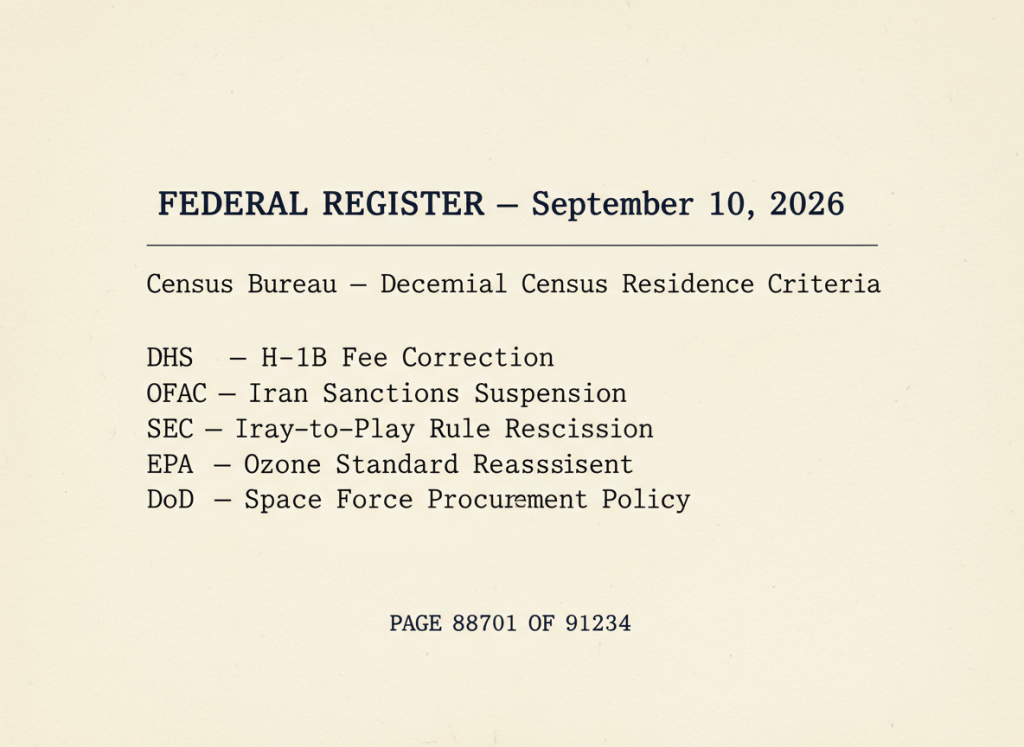
Today’s Federal Register carried 119 documents, headlined by a Census Bureau proposal that would exclude people without legal status from congressional apportionment counts and strip race, ethnicity, and sexual-orientation questions from the census questionnaire entirely.
- Census Bureau (Commerce Department): The Bureau proposed writing formal residence criteria into regulation for the first time, including a rule that would exclude people without legal status from the count used to divide up House seats and Electoral College votes, while still counting lawful permanent residents, prisoners at their facilities, and military and federal personnel at their duty stations. A companion proposal would limit the census questionnaire to biological sex, date of birth, and household relationship, dropping race, ethnicity, and sexual orientation questions altogether. Because apportionment decides how much political weight each state carries and federal agencies lean on census demographic data to enforce civil rights law and steer funding formulas, this is a rewrite of how power and money get divided among the states rather than a clerical update. Comments are due October 13, 2026. Read the proposal.
- Homeland Security Department: DHS issued a correction to the data table underlying its August 25 proposal to charge $103,265 for most cap-subject H-1B petitions, fixing the historical petition-volume figures it used to estimate how many petitions the fee would apply to and how much revenue it would raise. The correction touches exactly the numbers that justify the fee’s size, yet the comment period and the proposed fee amount are untouched, so the public is left commenting on a rule whose supporting math changed midstream. Read the correction.
- Office of Foreign Assets Control (Treasury Department): OFAC indefinitely suspended three general licenses and a licensing policy that had authorized narrow categories of transactions with Iran, covering overflight payments, aircraft-safety licensing, bunkering and emergency repairs, and the temporary return of certain civil aircraft, with the suspension effective September 8, two days before the rule was published. The agency invoked the Administrative Procedure Act’s foreign-affairs exception to skip notice-and-comment rulemaking entirely, which is a lawful shortcut for sanctions actions but one that means the public had no chance to weigh in before the change took effect. Read the rule.
- Securities and Exchange Commission: The SEC proposed rescinding the 15-year-old rule that bars investment advisers from collecting fees from a government client for two years after the adviser or a covered employee makes a political contribution to an official who could influence that business. The Commission argues the rule produced blanket contribution bans and hiring restrictions beyond its original purpose and that existing fraud and fiduciary-duty rules can police pay-to-play conduct instead, trading a bright-line restriction for one that depends on case-by-case enforcement. Comments are due November 9, 2026. Read the proposal.
- Fish and Wildlife Service (Interior Department): FWS reopened public comment on its proposal to remove the Gila chub, a small Southwestern fish, from the endangered species list, more than a year after the original comment period closed in August 2025. The agency cites a statutory obligation to give proper notice as the reason for reopening, but the notice does not explain what happened to the rule during the thirteen months in between, which is the kind of gap worth watching for what surfaces when a final rule eventually appears. Comments are now due September 25, 2026. Read the notice.
- Executive Office of the President: The White House published two executive orders signed September 4. “Supporting America’s Ranchers” frames ranching as central to food security, while “Promoting Fair Competition in Livestock Markets and Expanding Market Access for American Meat Producers” takes up ranchers’ complaints that concentrated meat processors squeeze them on price and make it harder to sell across state lines. Because executive orders direct agencies rather than create enforceable rules on their own, the pair mainly signals where USDA and other agencies are expected to focus rulemaking and enforcement in the months ahead. Read EO 14425 | Read EO 14424.
This edition reflects the full day’s docket of 119 documents published in the Federal Register for September 10, 2026. Excluded as routine: agency information-collection and OMB/PRA notices, self-regulatory-organization rule filings from national stock exchanges, antidumping and countervailing duty administrative review notices, FEMA flood hazard determinations, airworthiness directives, foreign-trade zone production-activity notices, procurement list additions and deletions, medical device classification notices, USPS product-change notices, and routine advisory-committee meeting and marine-event notices.

