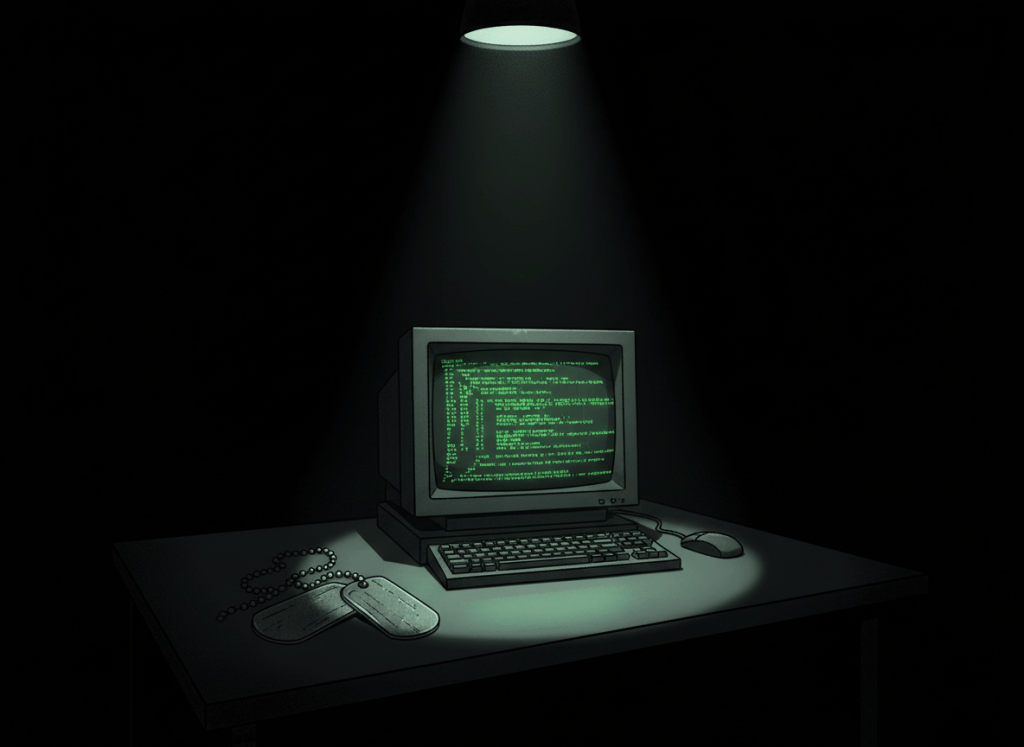
The Command That Talks For A Living, And Says Almost Nothing
Type “cybercom.mil” into a browser in late August 2026 and you meet a curious vacuum. The official press release page, the place where the Pentagon usually hangs its official verbs, carries a single line: “No Items”.
The homepage news carousel shuffles through items from multiple years with no obvious chronology. Links that promise congressional testimony route to 2023 hearings. The @US_CYBERCOM and @CNMF_CyberAlert accounts on X exist, but they function as occasional bulletin boards, not as real time operational feeds. This is the public face of United States Cyber Command in August 2026.
The gap between what cybercom.mil communicates and what has actually been happening inside the command over the past eighteen months is not subtle. It is structural.
Over that period, U.S. Cyber Command has navigated a year long leadership gap at the top, announced the most sweeping reorganization in its history, watched a president sign a National Security Presidential Memorandum (NSPM) that invites private companies into offensive cyber operations, and confronted a cluster of deaths by suicide in its ranks.
The website that belongs to the command at the center of these events has, by design or neglect, remained nearly silent. For an institution that writes doctrine about the fight over information, that silence is not incidental. It is evidence.
A Command Built To Act, Not To Hide
U.S. Cyber Command did not appear by accident. It came into existence through a Secretary of Defense directive on June 23, 2009, and became a unified combatant command in 2018.
From the start, the structure carried weight. The commander serves in a dual hat arrangement as Director of the National Security Agency. The command oversees the Cyber Mission Force, the units that defend Department of Defense networks, support other combatant commanders, and conduct offensive cyber operations when ordered.
This is not a sleepy support shop. It sits inside the same tier of authority as U.S. Central Command or U.S. European Command, with the added friction of NSA on the other side of the wall. Its operators run hunt forward missions, execute offensive campaigns against foreign military targets, and defend critical infrastructure in coordination with domestic agencies.
In raw operational tempo, it is one of the busiest commands in the federal government. In public, at least as reflected on cybercom.mil, you would never know it.
A Year Without A Confirmed Commander
In April 2025, the dual hat office at Fort Meade emptied out. The previous commander departed, and the role of acting commander fell to Lieutenant General William Hartman, long time chief of the Cyber National Mission Force. His official Defense Department biography notes that he assumed the job as acting commander in spring 2025. He would hold it for nearly a year.
The Senate finally confirmed General Joshua M. Rudd on March 10, 2026, as reported by the Washington Post.
According to his NSA leadership biography, he assumed the dual hat command on March 20, 2026.
A year long vacancy at the top of one of the country’s most sensitive combatant commands, during an active period of cyber conflict and heightened tension with peer adversaries, is not a routine personnel wrinkle. It is a governance failure with operational implications. Yet the command’s own public affairs machinery offered no sustained public accounting of the gap, its causes, or its effects.
The absence is itself a choice.
“CYBERCOM 2.0” Without A Home Page
On August 14, 2026, the Pentagon tried to turn the page. In a news release posted to the Department of Defense site, Secretary of Defense Pete Hegseth announced what the department styled as “CYBERCOM 2.0”.
The release describes the largest transformation of the command since its creation. It establishes a Revised Cyber Force Generation Model and creates three new enabling organizations: a Cyber Talent Management Organization, an Advanced Cyber Training and Education Center, and a Cyber Innovation Warfare Center.
In his June 5, 2026 posture statement posted on cybercom.mil, General Rudd framed the goals in the expected confident language of a new commander talking about readiness and modernization. The force generation overhaul, the talent management reforms, the new training and innovation hubs, all appear in his prepared testimony and in the Pentagon press release.
What does not appear, at least as of late summer, is a matching narrative on the command’s own press release page. The most sweeping structural change in the command’s sixteen year history was announced through the Pentagon’s general press apparatus and the national security press corps. Cybercom.mil, the digital front door of the institution being transformed, did not carry a corresponding press release.
For a command that spends its working life advising others on how to shape information environments, this is a remarkable failure to shape its own.
Inviting Cyber Privateers Into The Fight
The same day Secretary Hegseth rolled out CYBERCOM 2.0, the White House released a National Security Presidential Memorandum titled “Expanding Capabilities to Combat Transnational Cyber-Enabled Crime”.
This was not an executive order. It was an NSPM that quietly authorized vetted private U.S. companies, under federal oversight and control, to conduct cyber surveillance and cyber effects operations against foreign transnational criminal organizations engaged in cyber enabled crime. The memorandum established a National Coordination Center to supervise the effort.
The Washington Post described the move as a first of its kind opening for private sector offensive cyber operations in a space that had largely belonged to U.S. Cyber Command and the NSA.
Federal News Network highlighted fresh questions about Computer Fraud and Abuse Act exposure, Fourth Amendment constraints, and oversight architectures for companies now invited to conduct state authorized hacking abroad.
A legal analysis by Mayer Brown walked through potential liability shields and diplomatic friction points created by unleashing commercial actors in foreign networks.
In other words, the White House used a national security instrument to redraw, at least at the margins, the exclusive domain of USCYBERCOM and NSA.
It created a new class of state supervised cyber privateers. The command whose remit is closest to the new authorities did not, as of this writing, see fit to explain or contextualize any of this on its own website. Outsiders are left to read between the lines of others’ reporting, while cybercom.mil maintains the fiction that nothing especially novel happened in mid-August.
A Cluster Of Deaths, And A Public Silence
On August 6 and 7, Bloomberg reported that U.S. Cyber Command was confronting an unusually high number of deaths by suicide among its personnel over a roughly month long period in early summer 2026, describing as many as five deaths between early June and early July, based on unnamed sources.
Breaking Defense followed with a report describing the pattern as a cluster significant enough to merit intervention from senior Pentagon leadership.
The facts as reported are grave, and they sit in a context that is already hard on human beings.
Cyber operators work under unusually dense classification, chronic shift work, and the psychological weight of offensive missions conducted far from any visible battlefield. A cluster of deaths by suicide inside that community is a personnel welfare and institutional accountability story of the first order.
Yet the command’s news feed and press release page, as visible to the public, carry no notice, no statement of condolence, no description of resources, no acknowledgement that Congress is asking questions. The command is talking, or preparing to talk, to lawmakers behind closed doors. It is not talking to the public about what is, at bottom, a human crisis within its ranks.
The Doctrine Of Information, Ignored At Home
Cyber Command’s own doctrine, strategy documents, and posture statements are fond of reminding everyone that information is a contested domain, that perception shapes deterrence, and that adversaries exploit every vacuum.
The command publishes a public affairs contact line, USCYBERCOM Public Affairs, reachable at uscybercom_pao@cybercom.mil.
It maintains a presence on the Defense Visual Information Distribution Service.
It runs two branded X accounts.
These are not the hallmarks of a command that lacks public communications infrastructure. They are the footprints of a command that has built the tools and then chosen, for some combination of operational security caution, resource constraints, and leadership priorities, to let its own primary website sit in a state that resembles abandonment.
OPSEC concerns in this space are real. So are classification rules. No one expects live targeting updates on cybercom.mil. But it does not require revealing sources and methods to acknowledge a prolonged leadership vacancy, to summarize a publicly announced institutional reorganization, to explain what a presidential memorandum does or does not change for the command, or to recognize publicly that multiple members of the workforce have died by suicide and that the institution takes that seriously.
Those are choices about accountability, not about secrecy.
“No Items” In A Very Busy Year
The front door to U.S. Cyber Command’s public presence still insists that it has no press releases. Its carousel still spins news items from assorted years with all the coherence of a forgotten bulletin board. Its homepage still sends readers to 2023 testimony while 2026 hearings unfold elsewhere.
In the same span of months, the command has gained a new dual hat commander, undergone a sweeping reorganization, watched a presidential memorandum invite private actors into offensive cyber operations, and begun fielding congressional scrutiny over a cluster of deaths by suicide in its workforce.
The information is not hidden.
Bloomberg has it.
The Washington Post has it.
Breaking Defense has it.
Specialty legal analysts have it.
Congress has it.
USCYBERCOM Public Affairs, whose email address sits quietly on cybercom.mil, appears content to let others tell the story.
For a command built on the premise that information is power, there may be no sharper indictment than its own decision to leave its primary window to the public marked “No Items.”
CYBERCOM’s accountability gap has a parallel in the conventional defense world. The Navy’s attack submarine fleet — another category of high-stakes military capability where public accountability has lagged operational reality — is the subject of our $3.4 billion submarine maintenance report. Both cases show the same pattern: an institution managing a crisis internally while its public face insists everything is on schedule.
- The Red Tape Roundup — October 18, 2026
- Built to Prevent Another Studebaker, Saved From Its Own Studebaker Moment by a $91 Billion Check
- The $1.6 Million Ghost Transit Company: How Federal Grant Money Paid for Services That Never Existed
- Six Agencies Let DOGE Into the Building and Kept GAO on the Porch
- CMS Found $2.2 Billion in Unauthorized Obamacare Enrollments. So Who Did It?

