Fifteen Thousand Lost Days: The Submarine Fleet That Waited at the Pier
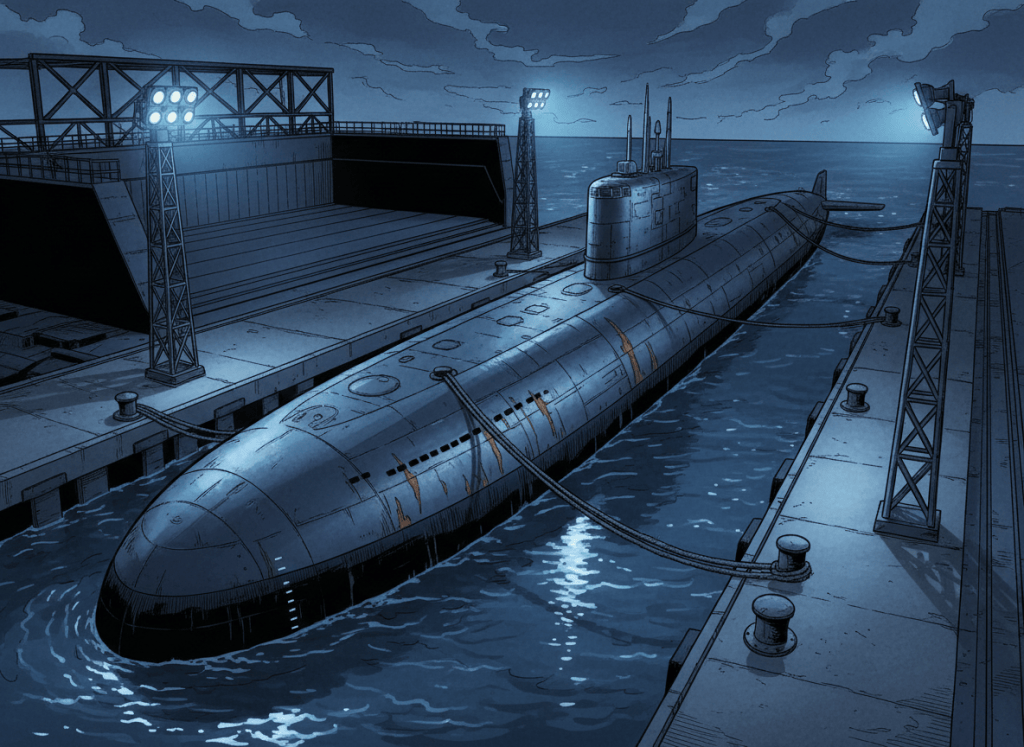
USS Boise was supposed to be a workhorse, not a case study. Commissioned in 1992, the Los Angeles class attack submarine spent much of the last decade not hunting adversary submarines, not collecting intelligence, but waiting. First she waited for an overhaul that slipped year after year while the public shipyards had no room for her. Then she waited for a solution that never arrived.
In February 2024, the Navy finally awarded a $1.2 billion contract to Huntington Ingalls Industries to perform Boise’s long delayed refueling overhaul, nine years after it should have begun, as Defense News reported. The message was simple enough: late, but at least the boat would return to the fleet. Then, in April 2026, the Navy quietly announced Boise’s inactivation, closing the books on a submarine that never received the overhaul taxpayers had just funded on paper.
Boise has become the most expensive illustration of a problem the Government Accountability Office has now quantified in GAO 26 109256, released publicly on August 27, 2026. Over the past decade, the Navy’s attack submarines have lost more than 15,000 operational days because the service could not get them into, through, and out of depot maintenance on time. The bill for that failure, according to GAO’s public report and coverage by Defense News and Breaking Defense, is roughly $3.4 billion. From fiscal 2016 through 2025, only about 11 percent of depot maintenance availabilities at the Navy’s public shipyards finished on schedule.
Boise is a cautionary tale. GAO’s numbers show it is also a preview.
The Numbers Behind the Pier
GAO 26 109256 dissects the problem in terms that leave little room for creative interpretation. Lost time falls into two main buckets. First, maintenance delays, when a submarine is in the shipyard longer than planned. Second, inactive idle time, when a submarine sits pier side waiting for a dry dock or shipyard slot that is not available.
Neither bucket is theoretical. Over the past ten years, attack submarines accumulated more than 15,000 lost operational days in these two categories, GAO found. That is more than forty years of submarine availability erased from the fleet’s usable inventory. Breaking Defense reported GAO’s estimate that the resulting cost to the government is about $3.4 billion over that period, with Defense News underscoring the scale of the time loss.
The report does not publish detailed figures on National Reconnaissance Office or National Geospatial Intelligence Agency spending related to submarine operations. Those numbers sit behind the classification wall. The attack submarine maintenance figures do not. GAO lays out a future in which the problem gets worse before it gets better. Between fiscal 2026 and 2030, the watchdog projects that 15 attack submarines will enter inactive idle time, generating more than 14,000 additional idle days and about $3.1 billion in associated costs.
In theory, a growing fleet could absorb some of that dead time. In practice, the fleet is not growing at the rate Navy leaders have advertised. As USNI News reported in May 2026, the Virginia class production line was turning out about one submarine per year as of mid 2025, half the Navy’s stated goal of two per year. Chief of Naval Operations Adm. Daryl Caudle projected that the two per year build rate would not be achieved until the 2030s. When the industrial base delivers new hulls at half speed while existing boats stack up in maintenance queues, the arithmetic does not favor operational commanders.
How a Submarine Ends Up Waiting for Years
The structural cause is not mysterious. Four public naval shipyards perform depot level maintenance on nuclear powered submarines and carriers. Portsmouth Naval Shipyard in Maine, Norfolk Naval Shipyard in Virginia, Puget Sound Naval Shipyard in Washington, and Pearl Harbor Naval Shipyard in Hawaii each have fixed dry dock capacity and infrastructure that was old when many of the current crews were in elementary school.
When a major availability runs long, the queue behind it does not disappear. The next submarine in line waits at the pier, crew embarked, reactor shut down, systems aging instead of operating. That wait can stretch for months or years, as with Boise. During that time, the Navy pays operating and support costs for a submarine that is not operating and cannot be supported back to readiness because there is no place to put it.
The Shipyard Infrastructure Optimization Program, or SIOP, is the Navy’s answer on paper. SIOP is the multi decade effort to modernize and expand dry docks, facilities, and equipment at the four public yards. GAO’s 2026 report acknowledges SIOP’s role but also points out a simple fact of civil engineering. Dry docks take years to design, years to build, and years more to bring fully online. They are not a quick reaction capability.
Workforce is the other half of the problem. Nuclear qualified shipyard workers are not interchangeable with generic labor. They take years to recruit, clear, train, and season. The shipyards have struggled to retain experienced personnel while competing with private industry and facing demographic headwinds. GAO identifies these capacity constraints in both infrastructure and workforce as root causes of missed maintenance schedules and rising idle time.
None of this is new information inside the Navy. In GAO 19 229, published in 2019, the watchdog documented that attack submarines had lost more than 10,000 days of availability between 2008 and 2018 due to maintenance backlogs and idle time at the public shipyards. The 2026 report does not reveal a surprise. It simply updates the score, and the score has worsened.
From Boise to a Fleet Wide Condition
It is tempting to file Boise under tragic one off mismanagement. GAO’s data argues the opposite. Boise is an extreme case, but not an outlier. She illustrates what happens when inactive idle time stops being the rare exception and becomes a routine phase in a submarine’s life cycle.
The projection that 15 attack submarines will enter inactive idle time through fiscal 2030 is more than a statistic. Each hull represents a crew that must either sit and wait or be reassigned, an operational commitment that slips into the future, and a maintenance bill that grows with every idle day. Systems do not age gracefully while sitting unused in salt air.
These numbers intersect badly with the strategic commitments the United States has made. Under the AUKUS agreement with Australia and the United Kingdom, the United States has pledged to support Australian acquisition of nuclear powered submarines and to host rotational deployments of Virginia class boats at HMAS Stirling in Western Australia. The joint statement from AUKUS defence ministers in May 2026 reaffirmed those ambitions. They rest on an assumption that the United States will have enough attack submarines in working order to rotate through these deployments while still meeting U.S. Indo Pacific Command and other combatant commanders’ needs. GAO’s maintenance and idle time projections invite a hard look at that assumption.
GAO’s Workarounds and the Navy’s Shrug
GAO 26 109256 does more than add up days and dollars. The watchdog recommends that the Navy evaluate options for managing submarines that are approaching inactive idle time so that the fleet can squeeze more utility out of constrained shipyard capacity.
The options GAO lists will sound familiar to anyone who has listened to maintenance planners for more than five minutes. Pier side defueling, where a submarine’s nuclear fuel is removed at a pier rather than in a dry dock, could free up scarce dry dock space for other work. Reduced crewing arrangements could cut the cost of keeping a submarine idle while still preserving the core cadre needed for eventual return to service or inactivation. Service life extensions, when technically sound, could keep boats in the fleet longer while newer construction lags.
These are not elegant fixes. They are triage plans for a system that cannot be expanded quickly. GAO’s recommendations read like the bureaucratic equivalent of telling the Navy to stop leaving fully crewed submarines parked at the pier out of habit when cheaper, more rational options exist.
The Navy’s formal response, as summarized in the public report, was to verbally concur with GAO’s recommendations and provide no written comments. Readers of GAO reports know what that phrase means. It is the institutional version of nodding politely at a briefing and then walking back to the office to keep doing things the old way. GAO issued the report in classified form on July 16, 2026; the public version arrived six weeks later, on August 27, a normal interval. The seven year gap between GAO 19 229 and GAO 26 109256, with the same core findings and larger numbers, is harder to categorize as normal.
Why the Lost Days Matter
Attack submarines are the Navy’s most strategically versatile conventional assets. They hunt adversary submarines and surface ships, collect intelligence, support special operations forces, launch cruise missiles, and complicate the planning of any potential adversary. They are the quiet part of American power that foreign naval officers worry about when they look at a map.
Every day an attack submarine sits at a pier waiting for a dry dock that is not available is a day it is not doing any of those things. The 15,000 lost operational days GAO tallies over the past decade are not abstract bookkeeping. They represent patrols that never sailed, signals that were never intercepted, exercises that relied on fewer submarines than planned, and allied navies that saw less American presence than they were told to expect.
The report arrives at a moment when the Navy is juggling multiple pressures. AUKUS commitments require more available attack submarines, not fewer. The Virginia class construction line is below the desired production rate, as senior leaders acknowledge. The surface fleet has its own readiness and maintenance problems that compete for shipyard resources and political attention. The submarine maintenance crisis does not sit apart from this picture. It lives at the center of a maritime strategy that depends on stealthy, persistent undersea presence.
GAO has now spent more than a decade documenting, in public, that the Navy’s ability to maintain that presence is constrained by shipyards and processes the service controls. USS Boise’s lost overhaul and quiet inactivation are not merely an unfortunate footnote in that record. They are a warning of what happens when an institution learns to live with failure at scale and calls it a scheduling problem.
The submarine maintenance crisis is not the only place where a U.S. military command’s public accountability has failed to keep pace with what’s actually happening inside the institution. Our coverage of CYBERCOM’s ghost town website documents a command that underwent its largest reorganization in history, absorbed a suicide cluster among its personnel, and watched a presidential memorandum redraw its operational domain — all without a single press release on its own site. Both cases point to institutions that have learned to manage their public narrative by simply not having one.
- The Red Tape Roundup — October 18, 2026
- Built to Prevent Another Studebaker, Saved From Its Own Studebaker Moment by a $91 Billion Check
- The $1.6 Million Ghost Transit Company: How Federal Grant Money Paid for Services That Never Existed
- Six Agencies Let DOGE Into the Building and Kept GAO on the Porch
- CMS Found $2.2 Billion in Unauthorized Obamacare Enrollments. So Who Did It?

