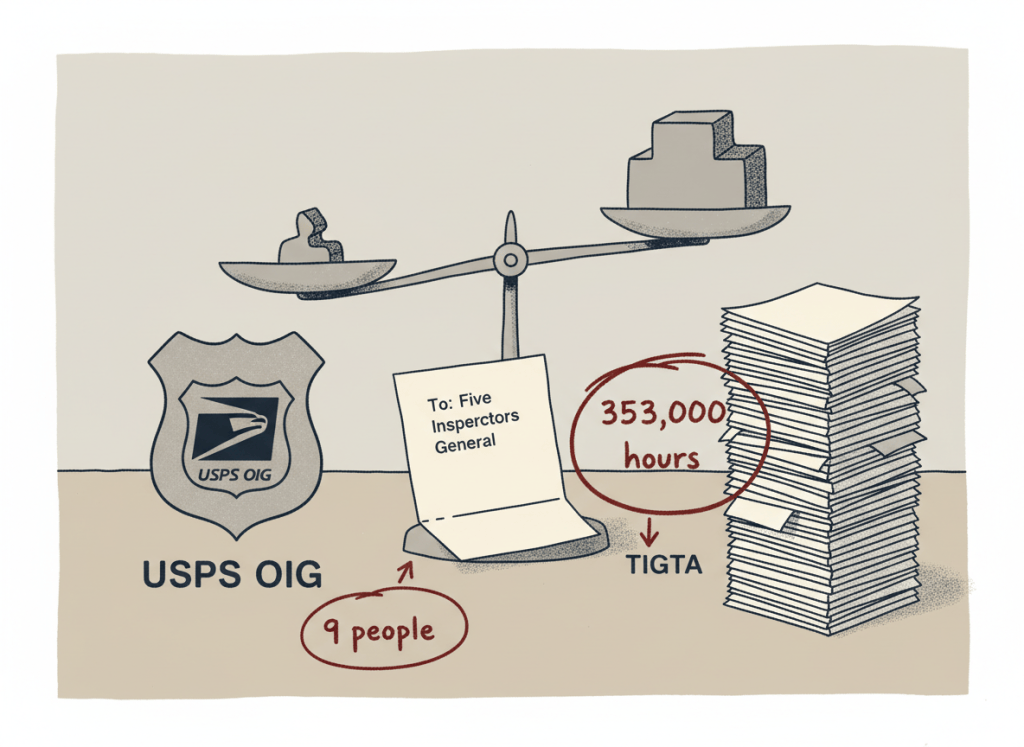
Lawmakers asked five inspectors general whether federal investigators were being pulled off white-collar crime to work immigration enforcement. The Postal Service’s answer, delivered August 19, was no.
Weeks later, Treasury’s tax watchdog answered the same request by documenting hundreds of thousands of agent hours spent on task force work. The difference lies in what each watchdog chose to count.
Six Questions, Asked and Answered
On January 22, lawmakers sent a letter to the inspectors general of Justice, Homeland Security, State, Treasury’s tax administration office and the Postal Service. It asked six questions about reassignments, case data, prosecutions, internal assessments, complaints and safeguards.
The Postal Service OIG’s review of the Postal Inspection Service answered those six questions and, by its own account, nothing else. Its scope section says the review was limited to the questions in the letter.
The headline numbers are small. Of 1,236 postal inspectors, nine (under 1 percent) were reassigned to Homeland Security Task Force regions. Another 39 (3 percent) supported investigations with an immigration-related component, mostly by running address checks for ICE and the FBI.
On white-collar work, the review reports 1,684 cases jacketed, the Inspection Service’s term for opening and documenting a case, and 1,517 closed from January 20, 2025 through March 31, 2026. Of the closed cases, 1,348 (89 percent) included charges. The Inspection Service says it does not investigate immigration cases without a postal nexus.
The OIG concluded it found no impact on white-collar investigations attributable to resource shifts. The Inspection Service agreed, and the Chief Postal Inspector wrote that no postal inspector serves as an immigration officer.
The Postal Service OIG’s fall semiannual report lists this review in its table of audit reports. It gives the review no narrative.
A Qualifier Doing the Heavy Lifting
The review says no reassignments were “solely” related to immigration enforcement, according to Inspection Service data. That word carries a lot of weight.
The nine inspectors went to task forces created under an executive order. A footnote in the report describes that order’s objective as including the use of available law enforcement tools to execute the immigration laws of the United States.
The review’s background supplies the legal frame. An Inspection Service official testified in July 2025 that inspectors have no authority to enforce immigration law, and that joint work must relate directly to criminal misuse of the mail. That is the standard against which the address checks should be measured.
The Inspection Service says the nine worked drug trafficking, human trafficking and financial crimes. That may be exactly right. The report does not independently test it.
The conclusion has its own hedge. It says the immigration-related support was tied to broader cases involving criminal use of the mail or address checks. An address check for ICE on a person suspected of being in the country illegally is not obviously a mail crime, and the report does not say how many were run.
Heads, Not Hours
The Postal Service review counted people. The Treasury Inspector General for Tax Administration, answering the same request about IRS Criminal Investigation, counted hours.
TIGTA reported that special agents spent over 353,000 hours supporting three federal task forces, the ICE effort among them, from May 2025 through March 2026. That is about 170 full-time agents and roughly $37 million in labor.
It estimated those hours equal 313 tax investigations that could have been started and completed. It also found no notable drop in the total number of investigations initiated, which is a fair caveat.
The Postal Service review reports no hours and no costs. It also reports no internal assessment, because the Inspection Service said it had no diversion to assess. The OIG recorded that answer and moved on.
The review’s own caveats are candid. It says its analysis relied in part on Inspection Service officials’ assertions about the data. It also says the closed-case and prosecution data had gaps, and that auditor judgment applied to interpret them may affect precision.
Then there is the calendar. The review’s year-by-year tables end with fiscal 2025, which closed September 30, 2025. By the report’s own Table 1, one of the nine reassignments began in September 2025, five in October 2025 and three in January and February 2026.
That means eight of the nine began after the comparison period ended. The tables cannot show whether the reassignments changed anything.
The tables do show fiscal 2025 declines from fiscal 2024. Referrals to prosecutors fell from 1,375 to 1,241, indictments from 1,880 to 1,552, and prison sentences from 2,270 to 1,940.
Those drops cannot be pinned on immigration work, because they mostly predate it. They are also not explained anywhere in the review. Chronology is not causation, in either direction.
The Question Nobody Asked
The review’s own background section recounts a different set of concerns. An April 2025 news report alleged that immigration officials sought “mail covers,” which are images of the outside of envelopes and packages, and access to data systems tracking mail, packages and financial information.
It notes that congressional inquiries cited reported misuse of mailing data. It recounts July 2025 testimony from an Inspection Service official that DHS was not granted direct access to data systems for immigration purposes and that no agreements obligate cooperation.
In a November 18 response to Bureaucracy Times, the U.S. Postal Inspection Service declined to provide substantive answers concerning its participation in immigration-related operations. Asked about inspector assignments, workload costs, address checks conducted for immigration authorities, mail-cover requests, access to postal data systems, and whether it would assess potential resource diversion, the agency stated that it does not provide information on investigations and considers investigative processes, techniques, and law enforcement partner assistance sensitive. The agency referred requests for statistics to its FOIA office. Its response did not address whether an internal resource-diversion assessment is planned.
None of that is tested in the results. The six questions concerned staffing and white-collar cases, so the review did not examine mail cover requests or system access. Its methodology lists interviews, staffing, case and hotline data, and documents on partnerships with other agencies.
One more detail matters for how much weight to give the finding. The review states it was conducted under inspection and evaluation standards, while the Postal Service OIG’s audits cite generally accepted government auditing standards.
None of this shows that postal inspectors were diverted. The numbers the Inspection Service supplied are small, the OIG’s hotline received no complaints on the subject, and the Inspection Service says it received none internally.
But absence of evidence depends on who is gathering it. The review answered Congress’s six questions with the Inspection Service’s own figures. It left the question about the data for someone else.

