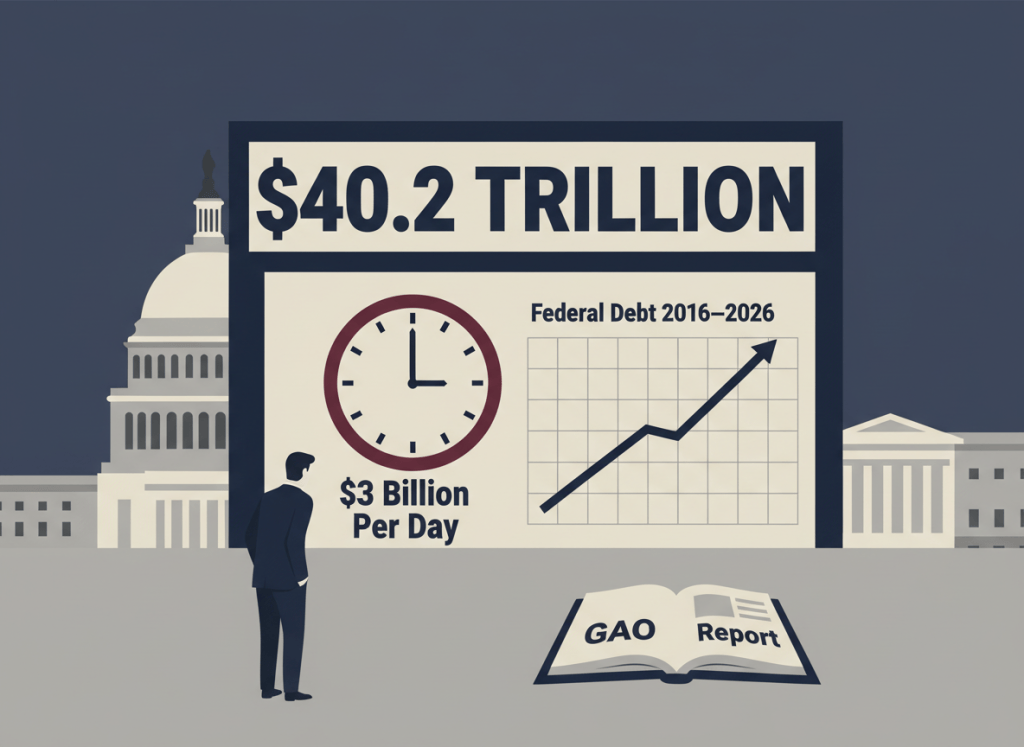
GAO finds federal debt has more than doubled in a decade, annual interest expense has nearly tripled in five years, and Washington still lacks a sustainable fiscal strategy.
WASHINGTON, Nov. 9, 2026 — The United States spent approximately $1.1 trillion in fiscal year 2026 on interest expense associated with debt held by the public, according to a new Government Accountability Office audit. That works out to roughly $3 billion every day, $125.6 million every hour, or nearly $34,900 every second.
Not to reduce the federal budget to a household checkbook, but that is an extraordinary amount of money to spend simply financing obligations already incurred. And the government is still borrowing.
The 40-page GAO financial audit, released November 9, found that total federal debt reached $40.2 trillion on September 30, 2026, an increase of approximately $2.5 trillion over the preceding fiscal year. The debt has more than doubled since 2016, when it stood at $19.6 trillion.
The report presents a particularly uncomfortable contrast for federal policymakers. Treasury’s Bureau of the Fiscal Service received favorable audit opinions for its debt schedules and relevant financial reporting controls. GAO found no instances of reportable noncompliance in its selected compliance tests. The accounting, in other words, passed inspection. The nation’s fiscal trajectory did not receive the same endorsement.
GAO again warned that the federal government’s fiscal outlook is unsustainable, citing growing debt, persistent deficits, rising borrowing costs, and the absence of a comprehensive strategy to address the problem.
The $3 Billion Daily Price of Federal Borrowing
The scale of federal interest expense is among the report’s most consequential findings.
In fiscal year 2021, interest expense on debt held by the public totaled approximately $392 billion. By fiscal year 2026, that figure had climbed to approximately $1.1 trillion, nearly tripling in just five years. The increase reflects two pressures working together. The government has borrowed substantially more money, and higher interest rates have made that borrowing more expensive.
For perspective, dividing GAO’s approximately $1.1 trillion annual figure across 365 days produces an average of $3.01 billion per day. That is a mathematical illustration of annual interest expense, not a claim that Treasury makes identical cash payments every day.
The distinction matters. GAO’s audit also reports a broader interest-cost figure of approximately $1.4 trillion, reflecting a different accounting scope. The $3 billion daily comparison uses the narrower, explicitly identified $1.1 trillion expense associated with debt held by the public. It should not be confused with the federal budget’s net-interest outlays, which are measured differently.
Even with that distinction, the magnitude is difficult to overstate. Interest expense represents the cost of financing government debt. It is not, by itself, a new highway, a veterans’ medical appointment, a military aircraft, or a completed infrastructure project. It is the financial consequence of previous borrowing decisions.
And unlike discretionary programs that Congress debates through annual appropriations, interest obligations cannot simply be eliminated without fundamentally changing the government’s financing arrangements or failing to honor its obligations. The practical result is that rising borrowing costs place additional pressure on future budgets, potentially limiting the resources available for other priorities or requiring still more borrowing.
A Debt That Doubled in Ten Years
GAO found that federal debt managed by Treasury increased by approximately 105 percent between September 30, 2016, and September 30, 2026. The increase, approximately $20.6 trillion, occurred across multiple presidential administrations and Congresses.
It would therefore be misleading to attribute the entire accumulation to a single president or political party. Federal debt reflects decades of spending and revenue decisions, economic conditions, emergency expenditures, and the compounding costs of financing previous deficits.
The report distinguishes between two major categories of federal debt. Approximately $32.4 trillion was held by the public at the end of fiscal year 2026. This includes Treasury securities held by individuals, financial institutions, businesses, foreign governments, and the Federal Reserve. The remainder consisted primarily of intragovernmental holdings, including Treasury securities held by federal trust funds and other government accounts.
Both categories contribute to the total debt figure, although they have different implications for federal financing and financial reporting. GAO also reported that publicly held debt had reached approximately 100 percent of annual U.S. gross domestic product, compared with roughly 99 percent a year earlier.
That ratio is important because it compares the government’s debt burden with the size of the economy supporting it. It does not mean the United States must repay its entire debt in a single year, but it provides a widely used measure of fiscal sustainability. The underlying trend is unmistakable. Federal borrowing has grown substantially faster than the government’s ability to bring its finances into balance.
Washington Continues to Spend More Than It Collects
The federal budget deficit reached approximately $2 trillion in fiscal year 2026, up from roughly $1.8 trillion in fiscal year 2025.
A deficit represents the difference between government spending and revenue during a particular fiscal year. Debt represents the accumulated obligations resulting from borrowing over time, along with other debt-management transactions. The distinction is essential because a government can reduce its annual deficit while continuing to add to the national debt. A smaller deficit is still a deficit. In fiscal year 2026, the deficit grew.
The Congressional Budget Office projects that, under current law, annual federal deficits will average more than $2.4 trillion over the next decade, according to GAO’s report. That implies more than $24 trillion in additional cumulative deficits over ten years if those projections materialize. The figure is a projection, not an audited future outcome, and actual results will depend on economic conditions and subsequent policy decisions.
Nevertheless, the forecast illustrates the challenge confronting federal policymakers. The government is borrowing heavily to finance current operations while simultaneously carrying a growing interest burden from previous borrowing. Unless revenues, spending, economic growth, or some combination of those factors changes sufficiently, that cycle will continue.
Another Debt Ceiling Confrontation Approaches
The audit also raises concerns about the federal debt ceiling. On October 1, 2026, debt subject to the statutory limit surpassed $40 trillion, approaching the $41.1 trillion ceiling established in July 2025.
The debt ceiling is frequently presented in political debate as a mechanism for controlling federal spending. Its actual function is narrower. Congress authorizes spending and establishes revenue policies through separate legislative decisions. The debt ceiling restricts Treasury’s authority to borrow money needed to finance obligations arising from those decisions.
Consequently, reaching the ceiling does not erase existing federal commitments. Instead, it can force Treasury to employ temporary extraordinary measures while Congress considers whether to increase, suspend, or otherwise modify the borrowing limit. Those measures may provide temporary flexibility, but they do not resolve the underlying fiscal imbalance.
GAO has repeatedly warned that debt-limit confrontations create unnecessary uncertainty and can increase borrowing costs. That possibility carries particular significance when annual interest expense already exceeds $1 trillion. A process intended to constrain federal borrowing can itself make that borrowing more expensive if uncertainty undermines confidence or disrupts Treasury’s financing operations.
The Audit Passed. The Fiscal Warning Remains.
GAO’s favorable audit findings should not be mistaken for an endorsement of federal fiscal policy. The agency concluded that Treasury’s debt schedules for fiscal years 2025 and 2026 were fairly presented in all material respects. It also found that relevant financial reporting controls were effective in all material respects as of September 30, 2026.
Those conclusions are important. Accurate accounting and reliable financial controls are fundamental requirements for public accountability. But an accurate balance sheet does not establish that the financial obligations recorded on it are sustainable.
GAO also identified certain financial reporting control deficiencies that warranted management attention, although the agency did not classify them as material weaknesses or significant deficiencies. Those findings merit further examination, particularly regarding the nature of the deficiencies and any corrective actions undertaken by Treasury.
The larger problem, however, is not an accounting failure. It is a fiscal policy problem.
GAO continues to recommend that Congress and the administration develop a comprehensive strategy to place federal finances on a sustainable path. The agency also recommends an approach to the debt ceiling that more closely connects borrowing decisions with the spending and revenue policies responsible for creating federal obligations.
The Bureau of the Fiscal Service concurred with GAO’s conclusions in its comments on the audit. That agreement does not constitute adoption of a comprehensive fiscal reform strategy by Congress or the administration.
The Accountability Question Congress Cannot Avoid
The federal government’s debt did not accumulate overnight, and no single legislative measure can realistically reverse decades of fiscal decisions. Meaningful changes would involve difficult choices about spending, taxation, economic growth, entitlement commitments, and the government’s long-term obligations.
Those choices have consequences for taxpayers, federal employees, military personnel, veterans, retirees, businesses, and future generations. The political temptation is to focus on whichever portion of the budget is most convenient to criticize while leaving the broader fiscal imbalance unresolved. GAO’s findings offer little comfort for that approach.
The government ended fiscal year 2026 with $40.2 trillion in debt, an approximately $2 trillion annual deficit, and $1.1 trillion in interest expense on debt held by the public. The independent auditor has confirmed the reliability of the debt accounting. It has also warned that the fiscal outlook remains unsustainable.
Washington therefore has a reasonably accurate picture of the problem. What remains missing is a credible, coordinated political response equal to its scale. And while Congress and the administration debate what that response should look like, the equivalent of approximately $3 billion a day continues to accrue in annualized interest expense on the nation’s publicly held debt. The arithmetic is not waiting for a bipartisan agreement.
Source: U.S. Government Accountability Office, Financial Audit: Bureau of the Fiscal Service’s FY 2026 and FY 2025 Schedules of Federal Debt, GAO-27-108795, November 9, 2026.

