A Deadline Congress Had Already Replaced
When a veteran lands in a non-VA emergency room, federal law requires VA to reimburse the reasonable value of the treatment. In lieu of repaying the veteran, VA may pay the hospital or provider directly, or whoever paid for the care. The OIG memo at the center of this story calls those payers third parties.
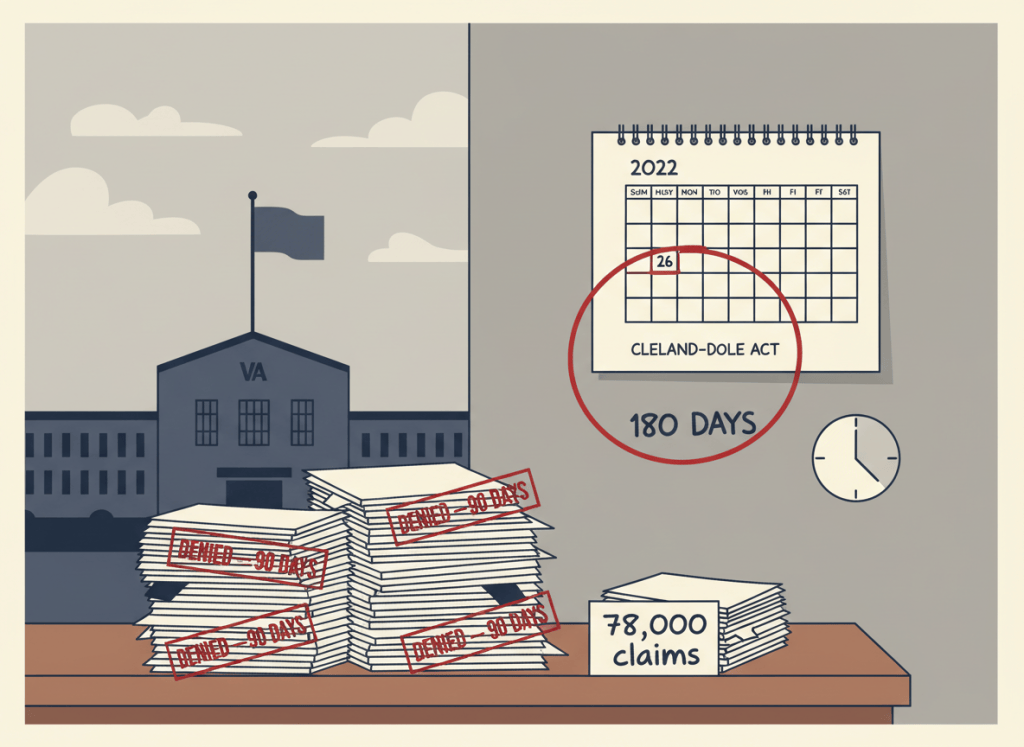
For decades the statute set no filing deadline. A 2001 regulation filled the gap with a 90-day limit for every claimant.
In December 2022, section 142 of the Cleland-Dole Act changed the rule for third parties. It gave them 180 days from the last date of treatment, and it set no deadline at all for veterans’ own claims.
VA never rewrote the regulation. As of May 7, 2026, the date the OIG finished its memo, the 2001 rule was still on the books.
Seventy-Eight Thousand Denials
The problem surfaced through a whistleblower. On July 30, 2025, Senator Jerry Moran, chairman of the Senate Veterans’ Affairs Committee, referred a complaint to the VA Office of Inspector General. It alleged that VHA staff were applying outdated regulations and wrongly denying emergency care claims.
The OIG asked VHA to examine the complaint in August 2025. On November 26, 2025, VHA’s acting assistant under secretary for health answered with a number: more than 78,000 claims, denied since the law changed, that might be payable under the longer deadline.
The billed charges on those claims exceeded $373 million. By our arithmetic, that is roughly $4,800 per claim, though billed charges are what providers asked for, not what VA would have paid.
When the OIG interviewed VHA officials on December 19, 2025, VHA had not reviewed the claims for errors or taken steps to compensate claimants when required.
By May 7, 2026, VHA had begun work on new regulations but had not finished them. The OIG concluded that claims decisions would likely stay inconsistent with the statute until it did.
Whichever Method the Processor Believed Best
VHA did change something. Starting October 1, 2025, its finance office let claims processors apply either the 90-day rule or the 180-day rule, whichever the processor believed would benefit the veteran most.
The policy official who described the change said he had not received leaders’ approval for it as of the December interview. The OIG found that the arrangement still does not appear to fully align with the law.
VHA’s explanation has two parts. Its acting assistant under secretary said the Cleland-Dole Act contained drafting errors. The policy official said the 180-day window could, in some cases, give a claimant less time than the regulation’s 90 days from the date a veteran exhausts efforts to obtain third-party payment.
The OIG was unconvinced. The law sets no deadline for veterans’ own claims, it noted, so it is unclear what the specific concern involves.
The official also said VHA had drafted a legal clarification paper, but further guidance was not pursued. The OIG asked for communications between his office and VA’s Office of General Counsel on the issue and received no response.
The inference here is ours. A rule that lets each processor pick the deadline that seems best is discretion, not a deadline, and the memo does not say whether VHA records which deadline each processor applied. The basis is the memo’s description of the October 2025 process.
The OIG chose a management advisory memorandum, the tool it uses when quick action by VA can reduce harm to veterans or financial losses. It made no recommendations and said it was taking no additional steps.
The memo is dated May 8, 2026. VHA replied June 4, and the OIG published it July 17.
Who Pays When the Claim Is Denied
Billed charges are not money owed, and the memo does not say any veteran was billed for a denied claim. What the history says is that denials can land on veterans.
In a 2019 audit, the OIG found that about 31 percent of denied or rejected non-VA emergency care claims in its sample were inappropriately processed. It put the billed amount at about $716 million.
In one case described in coverage of that audit, a processor denied a claim even though the veteran had notified VA within three days, leaving him with a $15,000 bill.
That audit also found a work culture that prized speed over accuracy. The 2026 memo says nothing about incentives behind the 90-day denials, and we are not suggesting a link. But it is not the first time the OIG has caught VA improperly denying emergency care claims.
FEDweek covered the memo in July, and we found little other coverage. The semiannual report released this fall gives the finding one sentence, as we noted in our review of that report.
Three things remain unknown. How many of the 78,000 claims have since been reviewed or paid.
Whether any veteran was billed for a claim denied under the 90-day rule. And when VA will finish rewriting a regulation the statute made outdated in 2022.
On June 4, VA’s Under Secretary for Health told the OIG the department would review affected claims, refine its guidance, and expedite the regulatory update. For a provider whose claim was denied for missing a deadline the statute had already lengthened, that is a promise to look again.

