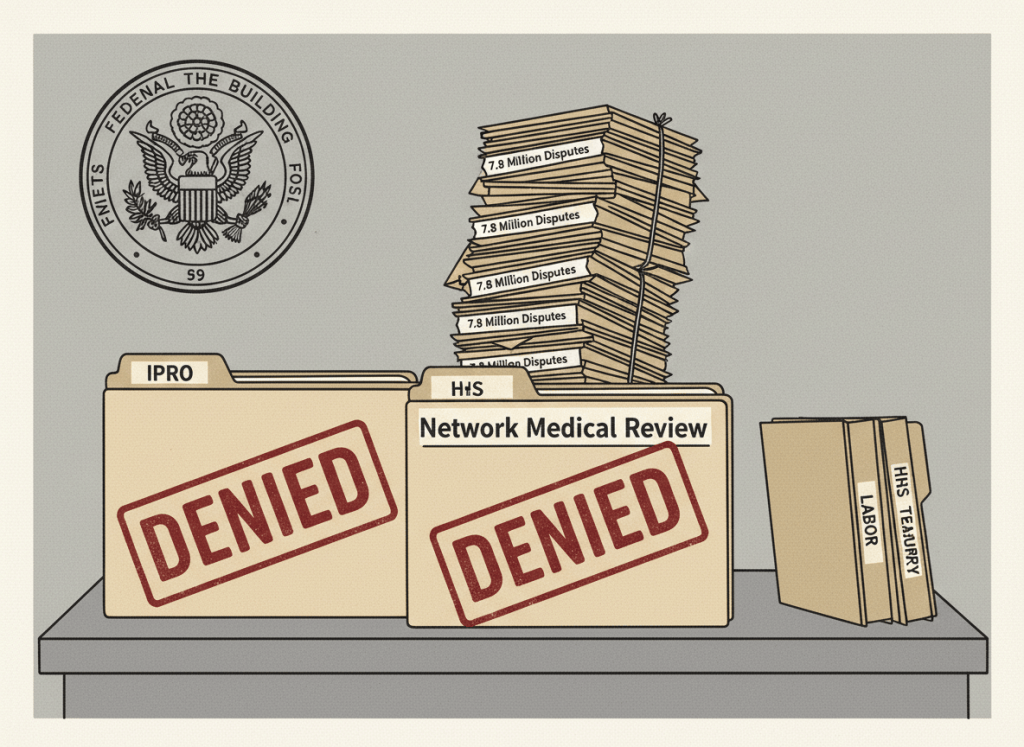
Three federal departments have denied recertification to two organizations responsible for resolving payment disputes between health care providers and insurers, finding that both failed to meet minimum performance standards under the No Surprises Act.
The November 4 announcement by the Departments of Health and Human Services, Labor, and Treasury identifies Island Peer Review Organization, Inc., operating as IPRO, and Network Medical Review Company, LLC, as the affected organizations. Neither may accept new disputes through the federal Independent Dispute Resolution (IDR) process.
The decision comes as the federal arbitration system continues processing an extraordinary volume of disputes. According to federal IDR statistics, nearly 7.8 million disputes have been initiated since the program began operating in April 2022.
Yet the departments’ announcement leaves a central question unanswered: What, specifically, did the two organizations do, or fail to do, that made them ineligible for recertification?
The departments cited minimum performance requirements governing timeliness, accuracy, independence, and impartiality, but did not identify which particular standards either organization failed. Nor did the announcement provide organization-specific performance statistics or describe the number of unresolved cases assigned to either entity.
The result is a consequential federal oversight decision whose underlying performance findings remain largely unexplained in the public announcement.
A Federal Arbitration System Under Pressure
The No Surprises Act, enacted in December 2020, was designed to protect patients from unexpected out-of-network medical bills, particularly those arising from emergency treatment and services provided by out-of-network clinicians at participating facilities.
The law also established a process for resolving payment disagreements between insurers and medical providers without transferring those disputes to patients.
When the parties cannot agree on payment during a required 30-business-day negotiation period, qualifying disputes may proceed to federal independent dispute resolution. Certified organizations review competing payment offers and select one, subject to statutory and regulatory requirements.
The process places substantial responsibility on private organizations operating under federal certification. Their determinations affect payments between insurers and providers, while their administrative performance influences how efficiently disputes move through the system.
The scale has grown considerably.
CMS reported that 390,602 disputes were initiated in September 2026 alone, a 9 percent increase over August. During those two months, certified IDR entities closed 784,352 disputes, compared with 750,022 newly initiated disputes.
That represents 34,330 more closures than initiations over the period.
The departments credited improved processing efficiency with bringing the program close to eliminating its existing backlog. Those aggregate improvements, however, do not establish that every participating organization has met the performance requirements necessary to retain federal certification.
The recertification denials illustrate that distinction.
What the Government Has Not Explained
Under 45 CFR § 149.510(e), certified IDR entities must satisfy standards governing their qualifications, administrative capabilities, independence, and operation of the dispute-resolution process.
The departments are responsible for reviewing certification applications and monitoring continued compliance. Certifications are subject to renewal every five years.
In their November 4 announcement, federal officials stated that IPRO and Network Medical Review failed minimum performance standards, making them ineligible for recertification.
The announcement did not distinguish between the two organizations’ alleged deficiencies.
That omission is important. Failure to meet a processing deadline is not equivalent to a conflict-of-interest violation, an inaccurate determination, or a broader administrative deficiency. The regulations address different aspects of performance, and the announcement does not establish which issues were involved.
The departments also did not disclose whether the deficiencies affected particular payment determinations, how many disputes may have been involved, or whether corrective measures had previously been required.
These are unanswered questions, not evidence that either organization engaged in misconduct or issued improper decisions.
The departments have said they regularly monitor certified entities and will continue taking enforcement action when organizations fail to satisfy program requirements.
For the public, however, the announcement provides the outcome of that oversight without a detailed account of the findings supporting it.
Oversight Concerns Predated the Announcement
The recertification decisions followed a broader federal effort to improve the operation of the dispute-resolution system.
On October 1, CMS Administrator Mehmet Oz, Department of Labor Assistant Secretary Daniel Aronowitz, and other federal officials met with representatives of certified IDR entities to discuss operational problems and the growing costs associated with the program.
Both IPRO and Network Medical Review appeared on CMS’s list of participating organizations.
The meeting addressed difficulties involving the administration of disputes, including eligibility questions, payment determinations, and payment-related issues. Officials also discussed possible regulatory and technological improvements.
CMS characterized the meeting as part of an effort to strengthen the program while preserving the consumer protections established by the No Surprises Act.
Nothing in the published meeting materials establishes that the issues discussed were the reasons for either organization’s subsequent recertification denial. The meeting nevertheless demonstrates that federal officials were examining operational performance across the program shortly before announcing the decisions.
The departments have also been implementing changes under the 2026 federal IDR operations rule, including revised procedures for handling disputes and a transition to a centralized electronic platform known as the IDR Gateway.
According to an October 14 CMS notice, additional Gateway functions are scheduled to become available November 13, allowing participating organizations to submit forms, review dispute records, and monitor case activity.
Those changes are intended to improve the administration of a system that has faced substantial processing demands since its launch.
Eight More Recertification Decisions Pending
The departments are also reviewing recertification applications from eight additional organizations: C2C Innovative Solutions, Federal Hearings and Appeals Services, Keystone Peer Review Organization, Maximus Federal Services, MCMC Services, Medical Evaluators of Texas, National Medical Reviews, and ProPeer Resources.
The public petition periods for those applications have closed, and the departments said they are reviewing the submissions received.
The pending applications do not indicate that those organizations failed performance standards. Their certification status remains unaffected by the November 4 announcement.
The departments have not provided a date for announcing the remaining decisions.
For the two organizations denied recertification, the immediate operational consequences are more direct.
IPRO and Network Medical Review can no longer accept new federal IDR disputes. Parties with existing disputes assigned to either organization have been instructed to await further guidance on how their cases will proceed.
The departments did not specify in the announcement whether pending disputes would be transferred, reassigned, or handled through another arrangement. They also did not disclose how many open cases could be affected.
Both organizations retain the right to appeal. Under the applicable regulations, each has 30 business days from the date of its written denial notice to request an appeal.
The departments said they will not issue final denial notices until the appeal period has expired and any submitted appeals have been considered.
The announcement therefore represents an immediate restriction on new dispute assignments, but not the conclusion of the administrative review process.
A Test of Federal Oversight
The federal IDR system occupies an unusual position in American health care administration. It was created to protect patients from surprise medical bills, but much of its day-to-day operation depends on certified third-party organizations making consequential payment decisions between insurers and providers.
The departments’ latest action demonstrates that certification is not automatic and that organizations can lose eligibility to continue participating when federal performance standards are not met.
It also exposes a limitation in the information publicly provided about those decisions.
The government has identified two organizations that failed its standards, prohibited them from accepting new disputes, and promised further instructions for parties with pending cases. It has not publicly explained the specific performance failures that prompted the action or the extent to which existing disputes may be affected.
As the departments continue reviewing eight additional applications and modernizing the arbitration system, the question is not simply whether they are exercising their oversight authority.
It is whether the public receives enough information to understand what that oversight has found.
For a program handling millions of disputes, the distinction matters.

