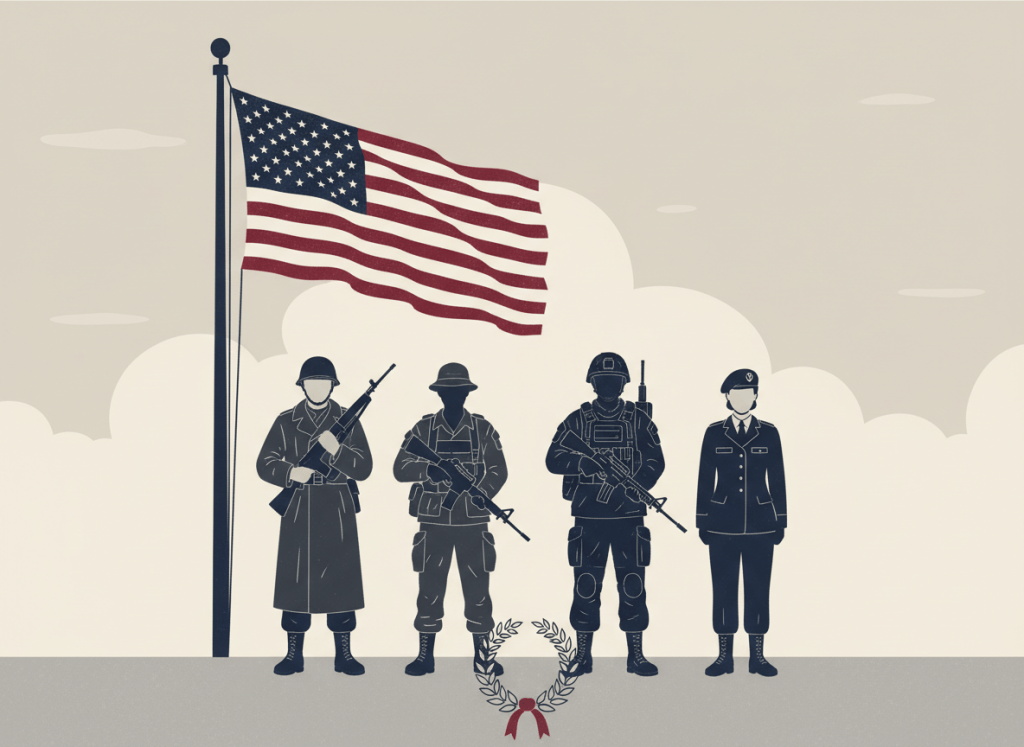
As America marks Veterans Day 2026, new Census figures reveal a changing veteran population. Behind the statistics are generations of Americans who went to war, carried the burdens of service, and helped shape the nation they defended.
Every veteran carries a story.
Some are stories of extraordinary courage under enemy fire. Others are stories of long deployments, missed birthdays, empty chairs at family gatherings, and the quiet sacrifices that seldom make the history books. Some are stories veterans tell with pride. Others remain unspoken for decades, shared only with the people who were there, or never shared at all.
They belong to the young infantryman who crossed an ocean to fight a war far from home, the aviator who flew into hostile skies, the sailor who spent months beyond sight of land, the Marine who held his position when everything around him seemed to be falling apart, and the military medic who worked desperately to keep another American alive.
They belong just as surely to the mechanics, cooks, logisticians, intelligence specialists, engineers, communications personnel, and countless others whose work made military operations possible. Not every service member went to war, and not every veteran experienced combat. But each accepted an obligation that most Americans will never be asked to undertake.
On November 11, the United States pauses to recognize those Americans.
According to new figures released by the U.S. Census Bureau on November 4, approximately 15.7 million military veterans lived in the United States in 2025. They represented 5.9 percent of the nation’s civilian population age 18 and older.
It is a remarkable number, but one that reveals surprisingly little about the lives behind it.
Fifteen-point-seven million Americans who once wore their country’s uniform. Millions of individual experiences, spanning generations, continents, and conflicts. Millions of people whose service became part of their personal history, whether they spent a few years in uniform or made the military their life’s work.
And as the nation observes Veterans Day 2026, that population is changing in ways that deserve both recognition and reflection.
The Generations That Answered the Call
The American veteran population is, in many respects, a living record of the nation’s military history.
Some of its oldest members belong to the generation that fought World War II, when American troops stormed the beaches of Normandy, fought across the Pacific, endured brutal campaigns in Europe, and helped defeat the Axis powers.
Today, those veterans are disappearing from American life.
The Census Bureau estimates that just 0.3 percent of the nation’s living veterans served during World War II. Another 2.3 percent served during the Korean War, a conflict too often overshadowed in the nation’s historical memory despite its enormous human cost.
These percentages represent service periods, not necessarily combat participation. But they also mark the passage of generations whose firsthand memories of those conflicts cannot be replaced.
The Korean War veterans who endured bitter winters and fierce fighting on the peninsula are now among the nation’s oldest surviving veterans. So, too, are the remaining Americans who served during World War II, many of whom are now more than a century old.
Their experiences are more than chapters in a textbook. They are personal accounts of fear, friendship, endurance, sacrifice, and the extraordinary demands placed upon ordinary people.
The loss of each generation brings the loss of voices that once spoke directly to those events.
The Vietnam generation now occupies a particularly important place in the veteran population.
According to the Census Bureau, 30.9 percent of veterans served during the Vietnam War era.
For many who served in Vietnam, the war was only part of the struggle. Returning home often meant confronting a deeply divided country, public hostility toward the conflict, and an inadequate understanding of the physical and psychological consequences of combat.
Some returned to communities that welcomed them. Others encountered indifference or resentment. Many simply went back to work, raised families, and carried on with their lives while bearing experiences that few civilians could fully understand.
Their service deserves to be remembered independently of the political arguments that surrounded the war.
The country could debate the decisions of its leaders without denying the courage or sacrifice of the Americans ordered to carry those decisions into battle. Too often, that distinction was lost.
For Vietnam veterans, Veterans Day is an opportunity to affirm something that should never have been in doubt: their service mattered, and their country owes them its gratitude.
The Veterans of America’s Newer Wars
The Census figures also illuminate the generations who served during more recent conflicts.
Approximately 25.6 percent of veterans served during the Persian Gulf War period, while 31.4 percent served during the post-September 11 era.
These categories overlap because some veterans served during more than one period. Together, however, they illustrate the substantial presence of Americans whose military experience was shaped by the conflicts and deployments of the past several decades.
For those who served after the September 11, 2001, terrorist attacks, war became a defining feature of military life.
American troops deployed to Afghanistan, Iraq, and other theaters of operation, often repeatedly. They fought insurgencies, conducted patrols through dangerous terrain, operated aircraft and ships, maintained complex supply networks, and worked alongside allied forces under circumstances that could change without warning.
They learned that a seemingly ordinary road could conceal an improvised explosive device, that danger did not always announce itself, and that a routine mission could become a fight for survival in seconds.
They also learned the meaning of trust.
In combat, the person beside you is more than a colleague. That person may be the reason you survive the next few minutes. Bonds formed under those circumstances can endure for a lifetime.
For many veterans, those relationships remain among the most meaningful experiences of military service.
The wars in Afghanistan and Iraq produced acts of extraordinary heroism, some publicly recognized through military decorations, others known only to the people who witnessed them.
There were service members who exposed themselves to enemy fire to rescue wounded comrades, medics who treated casualties while under attack, and troops who refused to abandon one another even when doing so placed their own lives at risk.
There were also those who did not come home.
Their names are engraved on memorials, recorded in military histories, and preserved in the memories of families and fellow service members.
Veterans Day is principally a day to honor all who served, while Memorial Day is specifically dedicated to those who died in military service. Yet the two observances are connected by the enduring bonds between the living and the dead.
For veterans who lost friends in war, remembrance is not confined to a particular date on the calendar.
A Population Growing Older
One of the most revealing findings in the Census Bureau’s 2026 Veterans Day release concerns age.
In 2025, approximately 30.5 percent of American veterans were 75 or older. By comparison, just 8.4 percent were younger than 35.
Nearly one in three veterans had reached an age when questions of health, independence, long-term care, and access to medical services become increasingly important.
These are not merely demographic observations. They have direct implications for the responsibilities the nation assumed when these Americans served.
For older veterans, those responsibilities may include treatment for service-connected conditions, assistance with disabilities, access to appropriate long-term care, and support for surviving spouses and families.
The Census Bureau’s earlier report, Aging Veterans: America’s Veteran Population in Later Life, examined the challenges facing older veterans, including disability, living arrangements, and the risk of social isolation.
Those challenges are particularly significant for veterans whose experiences may have left lasting physical or psychological consequences.
The effects of military service do not necessarily disappear when a person removes the uniform.
An injury sustained decades earlier may continue to affect mobility. Hearing loss may become more difficult to manage with age. Memories of combat may remain vivid long after the events themselves have passed into history.
Other veterans enjoy healthy, active retirements, volunteer in their communities, mentor younger generations, and continue contributing in ways that receive little public attention.
There is no single veteran experience, just as there is no single veteran identity.
But the aging of the veteran population creates an obligation that cannot be satisfied by ceremonial recognition alone.
The country must also consider whether the institutions established to serve veterans are prepared to meet their changing needs.
The Uniform Comes Off. The Service Remains.
For many veterans, leaving military service is not the end of their contribution to the country.
They become teachers, police officers, firefighters, physicians, business owners, public servants, tradespeople, parents, grandparents, and neighbors.
They serve in local governments, volunteer organizations, veterans’ groups, and community institutions. Some continue working in national security or public service. Others pursue lives entirely removed from their military occupations.
Their experiences often shape how they approach those responsibilities.
Military service can teach discipline, adaptability, leadership, and the importance of depending upon others. It can also leave people with difficult memories, interrupted careers, physical limitations, or challenges that complicate the transition to civilian life.
Both realities deserve acknowledgment.
Veterans are neither a uniformly troubled population nor an interchangeable collection of heroes whose experiences can be reduced to patriotic slogans.
They are people.
Some served for four years. Others served for thirty. Some volunteered during peacetime. Others were drafted during war. Some returned home decorated for valor. Others completed essential duties far from public attention.
Women served alongside men, often overcoming institutional barriers while contributing to military missions across generations. Americans from every region and background have worn the uniform, bringing different experiences to a common obligation.
Their service was not identical. Their sacrifices were not identical. Their lives after leaving the military have followed different paths.
What unites them is that, at some point, they accepted the responsibility of serving the United States.
That commitment deserves recognition without requiring every veteran to fit a particular image of what military service should look like.
A Nation’s Debt Cannot Be Paid With a Ceremony
Veterans Day has its origins in the end of World War I.
The fighting on the Western Front stopped on November 11, 1918, when an armistice took effect at the eleventh hour of the eleventh day of the eleventh month.
The following year, Americans observed the first Armistice Day. Congress formally recognized the observance in 1926, and it became a federal holiday in 1938.
In 1954, President Dwight D. Eisenhower signed legislation changing the name to Veterans Day, broadening its purpose to honor Americans who served in all wars and in peacetime.
More than seven decades later, the observance remains an important expression of national gratitude.
But gratitude carries responsibilities.
The nation that sends Americans into military service also assumes obligations toward them when that service ends.
Those obligations extend beyond medical treatment and disability compensation, although both are essential. They include fair treatment, competent administration of earned benefits, access to reliable information, and a government willing to acknowledge and correct its mistakes.
For an institution such as the Department of Veterans Affairs, serving veterans is not an abstract policy objective. It is the fundamental reason the institution exists.
When benefits are delayed, medical care is inaccessible, or administrative failures impose unnecessary burdens, the consequences are borne by real people who have already fulfilled their part of the bargain.
Holding those institutions accountable is not a rejection of patriotism. It is one of the ways a country can demonstrate that its promises to veterans are meant to be kept.
And yet Veterans Day should never be defined solely by the failures of government.
It should also recognize the lives veterans have built, the families who supported them, the communities they strengthened, and the sacrifices that cannot be captured in a federal report.
Fifteen-Point-Seven Million Stories
There is something inherently inadequate about trying to describe military service through statistics.
A number cannot explain what it feels like to say goodbye to a spouse or child before a deployment, not knowing exactly when the next reunion will come.
It cannot describe the fear of hearing incoming fire, the relief of seeing a missing comrade return, or the silence that follows the news that someone will not.
It cannot measure the years a military family spends apart, the strain of repeated deployments, or the pride of watching a loved one come home.
Nor can it fully capture the friendships, humor, traditions, and shared experiences that make military service memorable even when it is difficult.
The Census Bureau’s estimate of 15.7 million veterans is important because it tells us something about the country.
But its greater significance lies in reminding us that those millions are not abstractions.
They are Americans who served during some of the most consequential events in modern history. They are people who helped defend the country, supported its military missions, endured hardship, and returned to build lives in the communities around us.
Some fought in wars whose names are now familiar primarily from history books. Others served in conflicts whose consequences are still unfolding.
Some are in their twenties. Others have lived for more than a century.
Some wear their veteran status proudly on hats, jackets, and license plates. Others rarely mention their service at all.
Many have been called heroes, although some would reserve that word for the friends they lost or the comrades whose courage they witnessed firsthand.
That humility is itself worth remembering.
On this Veterans Day, the country will gather at memorials, raise flags, hold ceremonies, and offer words of appreciation.
Those gestures matter. So does the willingness to listen when veterans speak, to remember those who can no longer tell their stories, and to fulfill the commitments made to those who served.
Because behind every statistic is a human being. Behind every uniform is a life. And behind every generation of American veterans is a history of service and sacrifice that belongs to the entire nation.
Editor’s Note
Bureaucracy Times is a veteran-owned and operated publication. We are proud of our service to the United States, and we are dedicated to continuing that service through this project. We bring the integrity and accountability learned from our time in the military to every aspect of operating this publication today.
To America’s veterans, across every branch, generation, and period of service: thank you.
To the families who stood beside them: your sacrifices have not gone unnoticed.
And to the comrades who never made it home: you remain in our hearts, in our history, and in the memories of those who served alongside you.
We remember. We honor. We do not forget.

