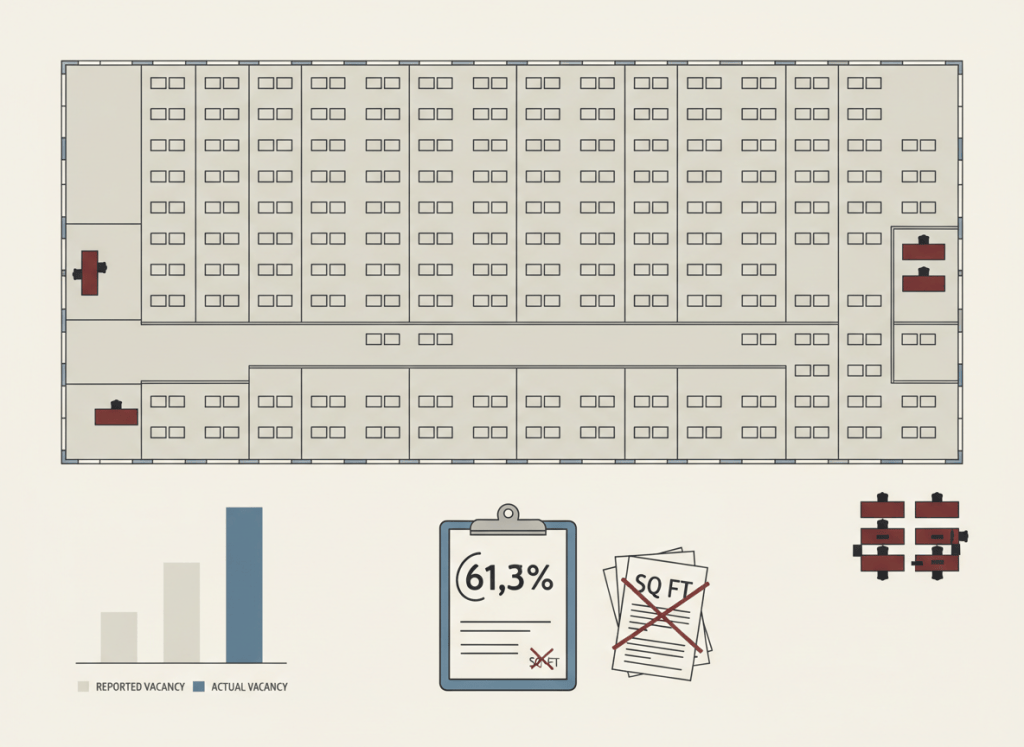
Federal agencies are finally measuring how much office space they use. A new GAO audit finds that the government’s first reporting exercise left millions of square feet of vacant property outside the picture, just as a statutory deadline for reducing underused space approaches.
WASHINGTON, October 21, 2026 — The federal government has spent years trying to determine how much office space it actually needs. Congress finally required agencies to start counting the people occupying those buildings. The government complied, collected the numbers, and published its findings.
There was just one rather substantial omission: more than 20 million square feet.
According to an October 15 report from the Government Accountability Office (GAO-27-108503), the federal government’s first occupancy reporting under the Utilizing Space Efficiently and Improving Technologies (USE IT) Act excluded significant amounts of vacant property controlled by the General Services Administration (GSA).
Using July 2026 property data, GAO identified approximately 20.2 million usable square feet of vacant space that was not reflected in the government’s March reporting. The inventory included 155 entirely vacant buildings or leased locations and vacant portions of another 724 partially occupied properties.
The distinction is important. The July inventory was compiled several months after the original reporting period, so it cannot establish precisely how much space was vacant in March. Nevertheless, the audit exposes a considerable weakness in a system designed to tell Congress which federal buildings are being used efficiently and which are not.
And the consequences could extend beyond accounting.
GAO identified 72 partially vacant locations whose reported utilization rates met or exceeded the government’s 60 percent benchmark but could fall below it if their vacant portions were included in the calculations.
The federal government, it appears, has developed a system for counting how many employees occupy its buildings without necessarily accounting for all the empty space surrounding them.
A New Law Meets an Old Problem
Federal real property management has occupied a place on GAO’s High Risk List for more than two decades. Underused buildings impose continuing expenses for rent, maintenance, utilities, security, and operations, even when relatively few employees occupy them.
In October 2023, GAO reported that 17 of 24 major federal agencies used an estimated 25 percent or less of their headquarters building capacity during the periods examined earlier that year.
Congress responded with the USE IT Act, enacted in January 2025, requiring agencies covered by the Chief Financial Officers Act to measure and report occupancy in certain federally owned and leased spaces.
The legislation established a utilization benchmark based on 150 usable square feet per employee. Under that methodology, a 30,000-square-foot office would have a calculated capacity of 200 employees. If an average of 100 employees occupied the space, its utilization rate would be 50 percent.
The law also established a 60 percent utilization threshold, with additional requirements for reducing underutilized space following consecutive years of below-threshold reporting.
In March 2026, agencies submitted their first reports.
Not one of the 24 major agencies reached 60 percent utilization across its entire reported property portfolio, according to GAO.
The new figures were supposed to give policymakers a clearer understanding of the federal government’s office-space needs. Instead, GAO found that important parts of the inventory were missing from the public presentation.
The Missing 20 Million Square Feet
The largest discrepancy concerns vacant space controlled by GSA.
As of July 2026, GSA controlled approximately 15 million usable square feet of vacant space in federally owned buildings and another 5.2 million square feet in leased properties.
Together, the vacant areas totaled 20,243,856 square feet.
About 4.6 million square feet were in 155 entirely vacant buildings or leased locations. Another 15.6 million square feet were vacant portions of properties that still housed federal tenants.
The distinction between entirely and partially vacant buildings matters because occupancy calculations can produce misleading impressions when empty portions of a property are excluded.
For example, GAO identified a federal building in California whose reported utilization rate could fall from 68 percent to 57 percent if 33,482 square feet of vacant space were incorporated into the calculation.
In Michigan, a leased location’s reported utilization could fall from 78 percent to 58 percent after accounting for 5,737 square feet of vacant space.
Both locations would move from above the statutory benchmark to below it.
GAO identified 72 such locations where including vacant space could change whether a property met the 60 percent threshold.
These are potential recalculations, not findings that GSA has formally revised the buildings’ utilization rates. They nevertheless illustrate why incomplete vacancy information matters when government officials are deciding which properties to consolidate, release, or retain.
GSA Says It Followed the Law
GSA does not dispute that its reporting excluded certain vacant spaces. The disagreement concerns whether those spaces were required to be included.
In its response to GAO, GSA maintained that the USE IT Act does not require vacant-property information to be incorporated into the occupancy reports. The agency also expressed concern that including vacant space could confuse readers and misrepresent GSA’s own utilization rate.
GAO acknowledged the statutory distinction but rejected the implication that the agency should therefore leave the information out.
Neither the USE IT Act nor the Office of Management and Budget’s implementing guidance prevents GSA from providing additional vacancy information, GAO concluded.
The auditors suggested that GSA could present vacant-property data separately from the existing occupancy calculations, allowing Congress and the public to understand both how agencies use their assigned spaces and how much federal property remains empty.
That distinction is central to the findings.
GAO did not conclude that GSA violated the law by omitting vacant properties. It concluded that the resulting reports lacked information necessary to understand federal property utilization fully.
The agency’s position may satisfy a narrow reading of the reporting requirements. Whether it satisfies the broader objective of identifying unneeded federal property is another question.
The Occupancy Numbers Have Problems of Their Own
Vacant buildings were not the only issue GAO identified.
The audit found inconsistencies in how agencies collected the attendance data used to calculate utilization rates.
Of the 23 agencies responding to GAO’s survey, 20 reported using employee badge systems to measure occupancy in at least some locations. Sixteen supplemented those systems with other methods, including daily check-in surveys, timecard analysis, manual counting, and Wi-Fi connection data.
Each method introduced potential inaccuracies.
Badge systems may miss employees who enter buildings without scanning their credentials. Wi-Fi measurements can overlook employees who do not connect to agency networks. Manual counts depend on personnel accurately recording attendance.
Some agencies also struggled to reconcile multiple datasets without counting the same employees more than once.
One agency reported relying on the number of employees assigned to locations rather than measuring how many were physically present.
That approach substitutes staffing assignments for actual occupancy, potentially producing a substantially different picture of building utilization.
GAO also found that some agencies questioned whether GSA’s guidelines accurately reflected the ways federal offices operate. Differences in which spaces were included and how non-workdays were counted could affect reported utilization rates.
The measurement problems are especially relevant because the federal government is beginning to use these figures to make consequential property decisions.
A building’s reported utilization rate is only as reliable as the attendance and space measurements used to calculate it.
Millions in Savings, With an Important Qualification
The new occupancy reporting system is already influencing agency decisions.
GAO documented several examples of agencies using utilization data to identify properties for consolidation or lease termination.
The Department of Veterans Affairs reported that its occupancy data helped inform a reduction of nearly 150,000 square feet, with estimated annual savings of $9.7 million.
GSA reported plans to consolidate or dispose of seven underutilized spaces totaling nearly 73,000 square feet, with projected annual savings of approximately $3.7 million.
The Department of Housing and Urban Development anticipated about $2.2 million in annual rent savings from reductions involving five field offices.
The Department of Energy reported terminating seven leases covering approximately 37,000 square feet, with estimated annual savings of $1.6 million.
The Small Business Administration identified reductions involving 25 spaces totaling nearly 38,000 square feet, with projected annual savings of approximately $885,000.
The Department of Homeland Security identified at least 15 space-reduction projects expected to eliminate approximately 95,000 square feet. Those projects included consolidation of several Cybersecurity and Infrastructure Security Agency locations in the Washington, D.C., area.
DHS projected savings of $350 million over 20 years.
These figures are agency-reported estimates and projections, not GAO verification that the full savings have already been realized. Several projects were still underway when auditors gathered their information.
Nevertheless, they demonstrate that occupancy data is no longer merely a statistical exercise. It is influencing decisions about federal leases, facilities, and expenditures.
That makes the quality of the underlying data increasingly important.
A $16 Million Measurement Exercise
GAO also examined how much agencies spent collecting and reporting the new occupancy information.
Twenty agencies provided actual or estimated implementation costs totaling approximately $16 million for 2025.
Most reported relatively modest expenses, frequently because they adapted existing badge systems or other technologies rather than purchasing entirely new equipment.
The Department of Agriculture accounted for the largest reported expense, approximately $9.1 million, much of it associated with developing a data platform that officials said also supported broader property-management functions.
The $16 million figure is not a complete government-wide accounting. Some agencies could not isolate or calculate their costs, while others relied on existing systems and reported no additional expense.
Still, the figures suggest that agencies were able to begin collecting occupancy data without the enormous technology investments once feared.
The more difficult challenge now appears to be ensuring that the resulting information is sufficiently complete and consistent to support decisions involving much larger amounts of federal spending.
The 2027 Deadline
The USE IT Act establishes a consequential next step.
Following the 2027 reporting cycle, GSA, in consultation with OMB, must take steps to reduce space that falls below the 60 percent utilization benchmark for a second consecutive year.
That does not automatically require every underutilized building to be sold, closed, or vacated. Agency missions, operational requirements, and other considerations remain relevant.
But it does mean that utilization measurements will help determine which properties receive additional scrutiny.
That raises an obvious question about the 72 locations GAO identified.
If their utilization rates fall below the benchmark after vacant space is considered, will those properties be evaluated differently during the next reporting cycle?
And what about the 155 entirely vacant locations that were not included in the initial reporting?
The GAO report does not establish how GSA intends to treat those specific properties under the forthcoming requirements.
It does, however, make clear that incomplete reporting could affect how Congress and federal officials understand the scale and distribution of unused space.
Four Recommendations, One Unfinished Inventory
GAO issued four recommendations to GSA.
The auditors called for future reporting to include vacant GSA-controlled property and building-wide utilization figures. They also recommended greater transparency about properties meeting the 60 percent benchmark, an evaluation of reporting guidelines, and improved coordination with agencies to ensure consistent and complete data.
GSA neither agreed nor disagreed with the recommendations, stating that it would consider them in consultation with OMB.
The central issue remains unresolved.
Congress has established a mechanism for identifying and reducing underused federal office space. Agencies have begun gathering attendance information, and some are already making decisions expected to save millions of dollars.
Yet the government’s initial reporting did not present a complete accounting of vacant GSA-controlled property, and GAO found that some of the underlying occupancy measurements were inconsistent or incomplete.
The public reporting also excluded individual properties meeting or exceeding the 60 percent threshold, limiting the ability to examine the full range of building utilization.
None of these findings proves that GSA deliberately concealed vacant property or violated the USE IT Act. The audit establishes something narrower, but still consequential: the information Congress and the public received did not fully describe the government’s office-space utilization.
For a federal property portfolio that costs billions annually to operate and maintain, that is not a minor bookkeeping problem.
Washington has finally started counting the people sitting at federal desks.
Now it needs to account for the buildings, and the empty rooms, around them.
Sources and reporting notes
Primary source: GAO-27-108503, Federal Real Property: New Occupancy Data Help Agencies Shed Unneeded Office Space But Gaps Limit the Full Picture, October 15, 2026.
Additional background: GAO-24-107006, Federal Real Property: Agencies Need New Benchmarks to Measure and Shed Underutilized Space, October 26, 2023.
Statutory basis: Public Law 118-272, Section 2302 (USE IT Act).
Outstanding questions: The report does not provide a complete public property-level inventory of the 879 locations containing excluded vacant space, establish their precise vacancy status in March 2026, or document how GSA will handle potentially affected properties in its 2027 reporting. These questions remain open for subsequent reporting.

