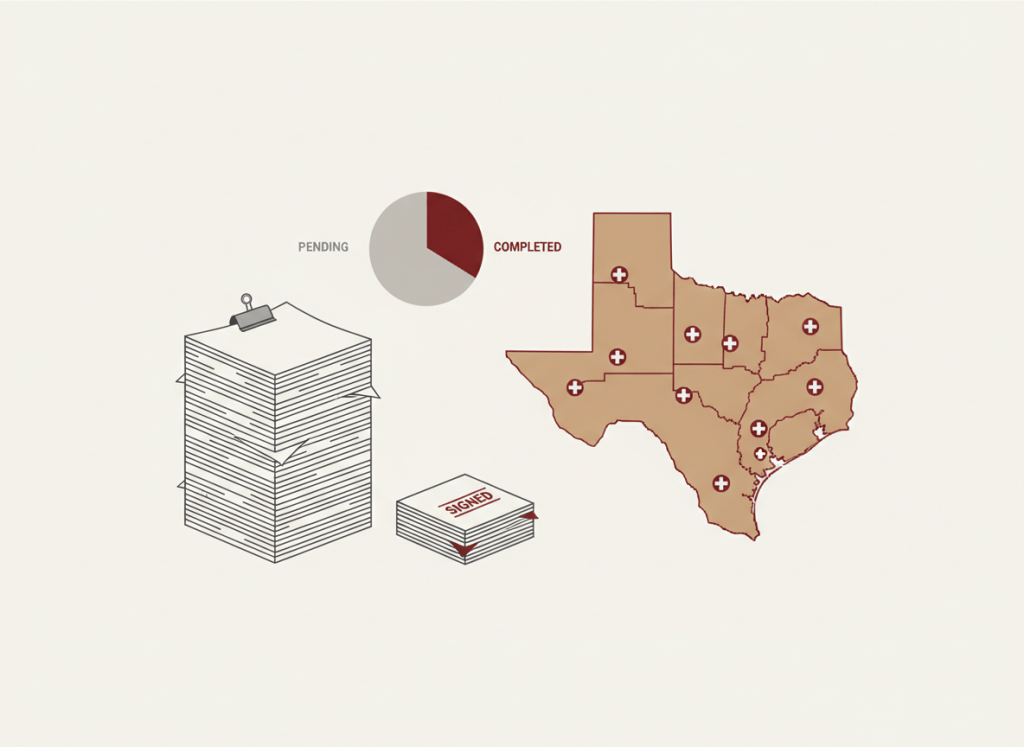
An examination of Texas grant records reconciles the announcement to the penny and distinguishes pending awards from executed contracts.
The Trump administration announced October 15 that $78 million in federal rural healthcare funding was being directed to 216 Texas providers. The money is traceable, and the arithmetic checks out. But the underlying administrative records tell a more complicated story than the announcement suggests.
An examination by Bureaucracy Times of a Texas Health and Human Services Commission (HHSC) recipient spreadsheet dated October 8, 2026 found that the announced $78,089,434.73 corresponds exactly to the first-year portions of 216 grant entries that had not yet reached fully executed contract status. The records do not establish that the $78 million had already been paid to providers.
Following the Money
The funding originates with the Rural Health Transformation Program, established under Public Law 119-21. The program provides $50 billion nationally over fiscal years 2026 through 2030, with $10 billion available annually. Half is distributed equally among states with approved applications; CMS administers allocation of the remainder.
Texas received an initial fiscal year 2026 award of approximately $281.3 million, identified in the federal award database as RHTCMS332068. HHSC’s April 21 revised budget allocated approximately $116.25 million for chronic disease prevention, $98.89 million for healthcare workforce initiatives, $56.26 million for infrastructure and capital improvements, and $9.92 million for oversight and administration. Those figures reconcile to the federal award.
The $78 Million Reconciliation
The October 8 HHSC spreadsheet contains 284 grant entries spanning three initiatives. Their listed total award amounts sum to $451,035,746.54, while the first-year portions total $129,089,434.73. The larger amount reflects listed multiyear commitments, not money already received or spent.
Of the 284 entries, 68 were marked as having fully executed contracts. Each carried a $3.5 million total award and $750,000 first-year portion. Together, their first-year portions equal $51 million. Subtracting that amount from $129,089,434.73 leaves precisely $78,089,434.73, the amount announced October 15. The remaining 216 entries also match the announcement’s count.
The pending first-year allocations are: Initiative 1, chronic disease prevention, 23 entries totaling $31,472,723.72; Initiative 4, healthcare workforce, 136 entries totaling $23,212,769.74; and Initiative 6, infrastructure and capital improvements, 57 entries totaling $23,403,941.27. All three sum exactly to $78,089,434.73.
An Intent to Award Is Not a Completed Award
HHSC defines ‘Intent to Award’ as the stage following negotiations when it intends to issue a grant agreement. The spreadsheet explicitly says a grant is not considered awarded until a contract is fully executed. All 216 entries accounting for the October announcement were marked intent-to-award but not fully executed as of October 8.
Governor Greg Abbott’s October 15 announcement also specifies that funds become available after contract finalization. An intent-to-award determination is significant, but it is not a payment, a completed purchase, or a newly delivered healthcare service. Contracts may have advanced between October 8 and October 15; the spreadsheet does not establish their later status.
The Larger Commitment Behind the Announcement
Across all 284 entries, HHSC listed approximately $451.04 million in total award amounts, versus $129.09 million in first-year portions. The approximately $321.95 million difference concerns amounts outside those first-year portions, not proven expenditures or proof that subsequent federal appropriations have been received. It raises legitimate questions about how future-year commitments will be funded and sustained.
Counting Providers Versus Counting Grants
The announcement describes 216 healthcare providers, but the spreadsheet independently supports 216 pending grant entries. Some organizations appear in multiple initiatives. Comanche County Medical Center, for example, appears in chronic disease prevention, workforce development, and infrastructure. Multiple awards are not inherently improper, but the number of grants is not necessarily the number of distinct legal entities. Abbreviated recipient names further complicate deduplication.
The Medicaid Context
The transformation program was enacted alongside substantial changes to Medicaid financing and eligibility. KFF has examined the relationship between the five-year $50 billion program and projected longer-term Medicaid spending reductions. The streams differ in purpose and time horizon and cannot simply be netted against each other for an individual hospital. Whether temporary grants yield lasting improvements will depend on each provider’s financial circumstances and ability to sustain services.
What Texas Still Needs to Explain
The October 8 records do not show how many pending contracts were executed by October 15, when payments will begin, how much of the previously contracted $51 million has been disbursed, whether 216 entries represent 216 unique entities, or how applications were scored and ranked. The relationship between listed multiyear commitments and future federal funding also requires clarification.
The October 15 announcement can be reconciled to the penny. What remains to be demonstrated is how quickly pending grants become executed contracts, how much money reaches providers, and what measurable improvements rural Texans ultimately receive. The announcement is the beginning of that accounting, not the end of it.
Bureaucracy Times will seek additional information from HHSC regarding contract execution, disbursement schedules, recipient counts, selection procedures, and oversight.

