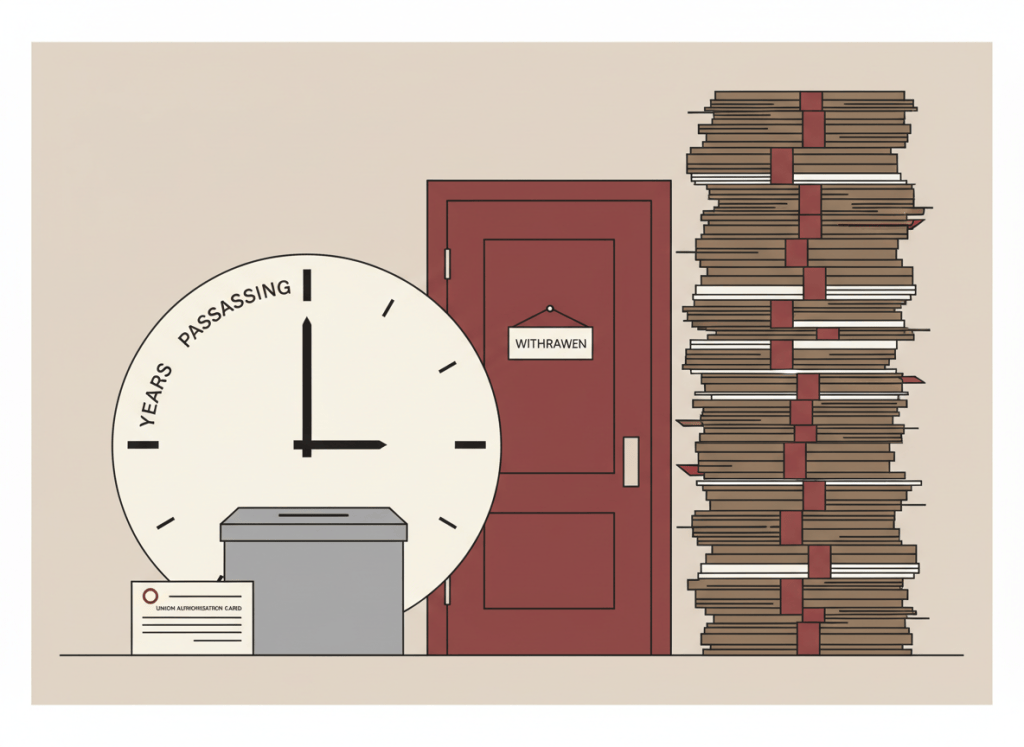
The NLRB found unlawful threats involving benefits during a Wisconsin organizing campaign. The election petition had been withdrawn years before the ruling, for reasons that remain unexplained.
In June 2022, employees at a Starbucks in West Allis, Wisconsin, petitioned for a union election. By August, the union had withdrawn its petition. On September 30, 2026, more than four years after the campaign began, the National Labor Relations Board ruled that Starbucks violated federal labor law during that campaign. The election sought in 2022 never took place under that petition.
The unfair labor practice case establishes unlawful threats concerning employee benefits and solicitation of grievances accompanied by promises to remedy them to discourage organizing. It does not establish why the union withdrew, whether these employees later obtained representation, or whether the company has completed the ordered remedies.
Workers’ grievances preceded the case
Urban Milwaukee’s June 2022 reporting identified shift supervisor Jessica Thompson as an organizer and described employees’ complaints about reduced hours, staffing, benefit eligibility tied to hours, and the store’s physical layout. Thompson acknowledged support from the store manager while arguing that many problems were beyond local management’s authority.
The Wisconsin Examiner reported that a large majority of workers had signed authorization cards, according to Workers United. The representation case, 18-RC-297612, concerned a proposed unit of 21 workers. The petition was filed June 14, 2022.
What the Board found
The Board’s September 30, 2026 decision, Starbucks Corporation, 375 NLRB No. 49, examined conversations and group meetings involving store manager Cassandra Bennett and district manager Meghan Ryan. Management discussed unionization and suggested employees could lose previously announced benefits, including changes involving medical travel and dress-code policies. The Board upheld findings that Starbucks unlawfully threatened benefit losses and solicited grievances with promises of improvements intended to discourage union representation.
The Board majority reversed other findings. Chairman James Murphy and Member Scott Mayer concluded that Bennett’s statements about leaving the store if it unionized, and her characterization of organizer Thompson as aggressive, were not unlawful coercion under the governing standards. Member David Prouty dissented on those reversals, emphasizing the organizing context and how employees could interpret management’s statements. An employer may express opposition to unionization, but cannot threaten adverse consequences for protected organizing.
The missing election
On July 21, 2022, the NLRB directed an election. On August 3, the union withdrew the petition, according to the official election docket. The accessible docket does not explain the withdrawal. The underlying correspondence was not available for immediate public inspection in our review. There is no verified evidence establishing why Workers United withdrew the petition.
Changes in worker support, turnover, or strategy are possible explanations in the abstract, but none can responsibly be attributed to this campaign without evidence. The withdrawal followed conduct that the Board later found unlawful; that chronology does not prove the violations caused the withdrawal. The Wisconsin Examiner reported in October 2022 that the petition had been withdrawn while the unfair labor practice case proceeded.
Our review did not establish a subsequent representation certification or collective-bargaining agreement for this particular West Allis store. That is not proof that no later organizing activity occurred.
Four years of proceedings
The unfair labor practice charge was filed in June 2022 and the regional office issued a complaint in September 2022. An administrative law judge heard the case in June 2023 and issued a decision that October. Starbucks and the General Counsel challenged aspects of that ruling. The Board issued its decision September 30, 2026. A June 2023 NLRB summary documents an intermediate procedural dispute. The lapse of time alone does not establish agency misconduct, but it raises questions about the practical value of remedies delivered after an organizing campaign has ended.
Changing rules for employer speech
The decision also reflects legal standards that changed while the case was pending. In November 2024, the NLRB issued decisions in Amazon.com Services LLC concerning mandatory antiunion meetings and Siren Retail Corp. concerning employer predictions about the management-employee relationship after unionization. Those changes were prospective, rather than retroactively applicable to the 2022 West Allis events. The 2026 decision did not itself expressly overrule those precedents. The Board decisions index lists the ruling as 375 NLRB No. 49.
What the remedy can and cannot do
The Board ordered Starbucks to cease the unlawful conduct, post employee-rights notices for 60 consecutive days, distribute them electronically where customary, and certify compliance after service of the order. It did not certify the union, direct a new election, or order monetary compensation in this decision. As of October 14, 2026, the public unfair labor practice docket remained open and did not establish whether notice posting or certification had occurred. Absence of a publicly displayed filing does not prove noncompliance, and deadlines depend on the service date.
A nationwide dispute, a local unanswered question
The Workers United bargaining timeline describes the much broader organizing and bargaining conflict with Starbucks. Independent Starbucks election data documents varied outcomes nationally. Neither resolves the specific West Allis withdrawal.
The record thus presents a stark distinction. Workers sought an election in 2022; the petition was withdrawn that August; the Board concluded in 2026 that management had violated their organizing rights. What caused the withdrawal, whether the workers later gained representation, and whether the ordered remedies have been completed remain unanswered. A legal finding can settle whether conduct was unlawful without establishing what relief the workers ultimately received.

