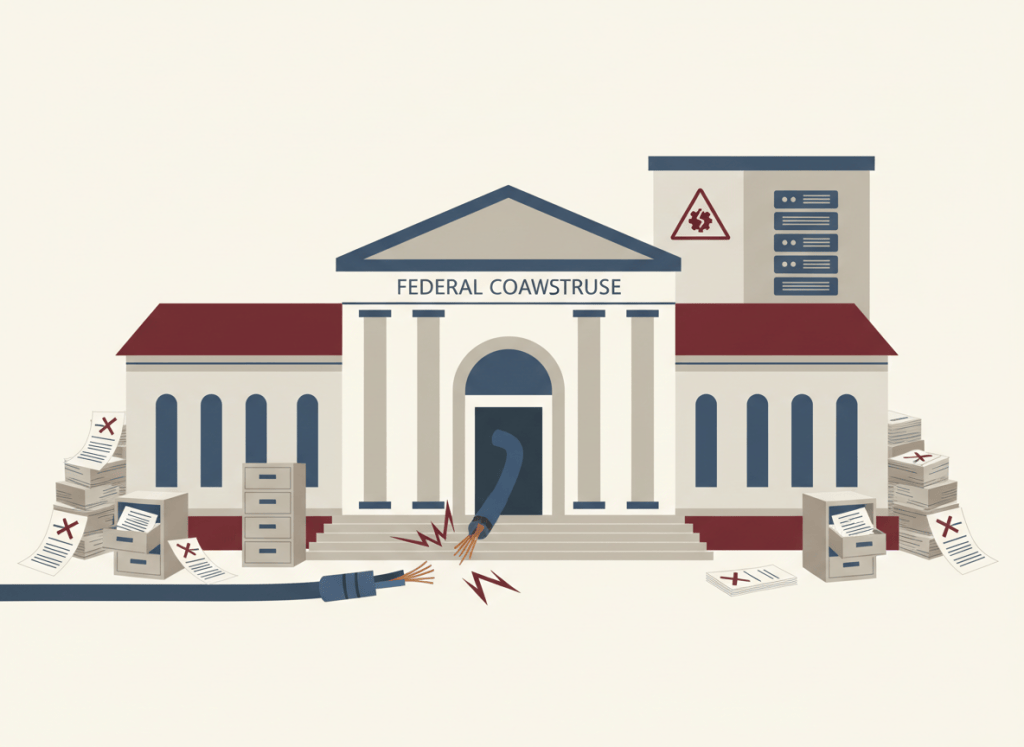
BAE Systems’ nationwide bankruptcy noticing outage interrupted legally significant court communications, prompting emergency orders and raising questions about the federal judiciary’s cybersecurity safeguards and continuity planning.
A cybersecurity incident involving a federal contractor disrupted the delivery of bankruptcy court notices across the United States, exposing a critical dependency within a judicial service that handles tens of millions of legal notifications annually and operates under a contract renewal valued at $106 million.
The interruption involves the Bankruptcy Noticing Center (BNC), a centralized system operated by BAE Systems on behalf of the federal judiciary. The center processes and distributes court-generated notices and orders to debtors, creditors, attorneys, and other parties involved in bankruptcy proceedings.
According to the Administrative Office of the U.S. Courts’ October 15 announcement, the cybersecurity incident disrupted the contractor’s operations. The consequences extend beyond unavailable websites. During the outage, bankruptcy courts were unable to use their ordinary centralized noticing service, and several have issued emergency instructions or orders addressing the interruption.
The incident raises an uncomfortable question for the federal judiciary: What happens when a system built to make court administration cheaper and more efficient becomes a nationwide operational dependency, and the contractor responsible for that system cannot perform its assigned function?
The available records establish the contractor relationship, its financial scale, the judiciary’s historical cost-saving rationale, and the legal disruptions caused by the outage. BAE Systems says no data was extracted and no personally identifiable information was breached. The precise nature of the incident and whether contractual safeguards failed remain unestablished.
A disruption that preceded the national announcement
Although the judiciary issued its national announcement on October 15, the disruption had already prompted warnings from individual bankruptcy courts.
According to an October 13 notice from the U.S. Bankruptcy Court for the Eastern District of Texas, BAE Systems notified the Administrative Office late Friday, October 9, that its systems supporting bankruptcy noticing were experiencing a disruption.
The interruption affected the contractor’s ability to process notices and several associated websites, including the Bankruptcy Noticing Center, the National Creditor Registration Service, and systems supporting creditor address information.
Other courts identified potentially earlier effects. The Southern District of Ohio reported that court notices entered on or after October 7 appeared to be affected. That does not establish that the cybersecurity incident began October 7. It does, however, indicate that the potential universe of undelivered notices may extend beyond the date BAE reported the disruption.
By October 13, courts across the country were publishing warnings. The Southern District of New York confirmed that the outage affected all U.S. bankruptcy courts and interrupted the processing and delivery of notices and orders normally distributed through the BNC. The court also reported that it had no estimated restoration time.
The sequence establishes that the contractor notified the judiciary on October 9, individual courts publicly acknowledged the interruption by October 13, and the judiciary issued its national announcement on October 15. Whether those dates reflect an evolving investigation, established disclosure procedures, or other administrative considerations remains unresolved.
A $106 million relationship
BAE Systems’ role in the bankruptcy noticing system is neither recent nor incidental.
In its 2020 preliminary financial results, the company disclosed receiving a ten-year renewal of its Bankruptcy Noticing Center contract, with a lifecycle value of $106 million. The renewal covered distribution of bankruptcy court documents to creditors.
That figure represents the announced contract lifecycle value, not necessarily the amount paid or obligated to date. The underlying contract, subsequent modifications, and actual expenditures require further examination.
The relationship stretches back at least to 2008. In its 2009 annual report, the judiciary described a performance-based contract awarded to BAE Systems Information Technology Inc. that took effect October 1, 2008.
Judiciary officials characterized the transition as successful and emphasized its financial advantages. The new contract reportedly provided additional services at prices approximately 36 percent below the previous contract. Assuming annual growth in program usage, the judiciary projected more than $50 million in savings over ten years compared with the earlier pricing structure.
Those projected savings were in addition to approximately $70 million the judiciary reported saving since 1994 through centralized noticing operations.
The rationale was straightforward: consolidating notices from bankruptcy courts nationwide allowed the judiciary to reduce manual processing, eliminate duplicate mailings, negotiate postal discounts, and increasingly replace paper notices with electronic delivery.
The arrangement was designed to achieve efficiencies that would have been difficult to reproduce through individual court operations. Those efficiencies also concentrated a critical administrative function in a centralized service. The interruption demonstrated the operational consequences when that service becomes unavailable. Whether the judiciary’s contracts and continuity plans adequately anticipated such an interruption remains an open question.
Nearly 67 million notices in one year
The scale of the Bankruptcy Noticing Center is substantial. In congressional budget testimony, the judiciary reported that nearly 67 million bankruptcy notices were issued during 2020.
The same testimony traced the creation of the BNC to 1993, when the judiciary began centralizing noticing operations to reduce the administrative burden on bankruptcy clerks’ offices and secure bulk-mailing discounts. Electronic noticing alone produced approximately $9 million in avoided costs during fiscal 2020, according to the judiciary.
A separate fiscal 2022 budget justification reported that nearly 48 percent of bankruptcy notices were being delivered electronically.
At the historical volume of 67 million notices annually, the system would average roughly 184,000 notices per calendar day. That arithmetic is illustrative, not an estimate of the current outage backlog. Actual notice volumes vary, and the judiciary has not disclosed how many notices have been delayed or failed during the October 2026 disruption.
Nevertheless, the historical figure demonstrates the scale of the service affected during the outage. The system also operates in an environment where bankruptcy activity has recently increased. More filings generally create additional noticing obligations, although filing counts cannot be translated directly into the number of notices processed.
The operational problem is therefore not confined to a malfunctioning website. It involves a nationwide mechanism for transmitting legally consequential information among courts and the parties appearing before them.
Courts confront the consequences
Bankruptcy notices serve purposes that extend well beyond administrative convenience. They inform creditors and debtors about proceedings, hearings, meetings, orders, and deadlines. Depending on the notice and applicable law, timely delivery can affect opportunities to object, assert claims, participate in proceedings, or protect legal interests.
The outage forced courts to address those risks. In an October 14 advisory, the Eastern District of Texas announced two general orders addressing deadline extensions and relief related to the interruption.
The court confirmed that it would continue accepting filings, opening cases, and processing documents through its normal procedures, but warned that service of notices and orders could be delayed.
The District of Kansas likewise announced a general order allowing parties to request deadline extensions or continuances attributable to noticing delays. Importantly, Kansas warned that certain deadlines cannot be extended by the bankruptcy court and that parties must remain vigilant.
That distinction is consequential. The existence of an outage does not necessarily suspend every legal deadline. Relief may depend on the governing rules, the type of proceeding, and action by the court.
Other courts have introduced temporary procedures for obtaining creditor addresses and arranging service. The Eastern District of Louisiana warned that alternative creditor lists available through its electronic filing system do not necessarily include every interested party, such as debtors, trustees, or the United States Trustee.
Attorneys and other parties therefore may need to take additional steps to identify everyone entitled to notice. The judiciary has not publicly established how many hearings, deadlines, or proceedings have been materially affected, or whether any participant has suffered an adverse legal consequence because of an undelivered notice.
Not every court system is down
The interruption should not be mistaken for a complete shutdown of the federal bankruptcy courts. Individual courts have repeatedly distinguished the BNC’s noticing services from the separate Case Management/Electronic Case Files system, commonly known as CM/ECF.
The Southern District of New York reported that CM/ECF Notices of Electronic Filing continue to be generated and distributed normally. Similarly, the Eastern District of Texas confirmed that ordinary filing and case-processing operations remain available.
This distinction matters because attorneys registered in cases may continue receiving electronic filing notifications even while parties who depend on the BNC experience delays. The outage affects a specific, nationally significant function rather than every component of federal bankruptcy administration. That narrower description does not diminish the importance of the interruption. It helps identify the precise operational dependency at issue.
When electronic delivery becomes mandatory
The judiciary’s own noticing rules add another dimension to the disruption. Under its mandatory electronic bankruptcy noticing program, entities receiving at least 25 paper bankruptcy notices in a calendar month may be transitioned to electronic delivery.
After an initial period during which both electronic and paper notices are provided, qualifying recipients can receive future BNC notices exclusively through electronic channels. The system is intended to reduce mailing costs and improve delivery speed.
But mandatory reliance on electronic delivery also makes the availability of the designated noticing infrastructure particularly important. The BNC’s published electronic-noticing instructions describe recipients’ responsibilities for accessing notices through the designated system.
The incident raises questions about how those responsibilities are reconciled with periods when the underlying service is unavailable. It remains unclear whether the judiciary has a comprehensive nationwide procedure for identifying every affected electronic recipient, reconstructing failed deliveries, and ensuring that notices are subsequently transmitted.
Individual court orders provide some relief mechanisms, but they do not establish that a uniform national recovery process exists.
The unanswered cybersecurity questions
The judiciary has characterized the disruption as a cybersecurity incident, but important technical details remain undisclosed. The available public information does not establish whether the incident involved ransomware, malicious intrusion, a denial-of-service attack, unauthorized system access, or another cybersecurity-related failure.
BAE Systems subsequently stated that no data was extracted and no personally identifiable information was breached. Those assertions do not, by themselves, establish whether any unauthorized access occurred. The distinction is essential. An interruption of service does not, by itself, prove that confidential information was compromised.
The contractual questions are equally important. The complete terms of the 2020 BAE renewal have not yet been established in this investigation. Consequently, it remains unknown what specific cybersecurity controls, recovery-time objectives, incident-reporting deadlines, independent backup capabilities, or continuity-of-operations requirements the judiciary imposed on the contractor.
There is also no established evidence that BAE violated any contractual requirement.
The judiciary maintains a directory of approved bankruptcy notice providers, including entities other than BAE Systems. However, approval to provide bankruptcy noticing services does not necessarily mean those firms possess the infrastructure or contractual authority to assume the BNC’s nationwide operations.
Whether the judiciary contemplated such alternative arrangements, or has any practical mechanism for activating them, is another unresolved issue. The existence of multiple approved providers should not be confused with proof of operational redundancy.
The price of efficiency, and the cost of interruption
For more than three decades, the federal judiciary has pursued a deliberate strategy of consolidating bankruptcy noticing functions, reducing paper processing, and expanding electronic delivery.
Its published financial records describe substantial savings. Its contractor’s financial disclosures identify a long-term relationship worth more than $100 million in announced lifecycle value. The strategy offers clear administrative advantages.
But the October 2026 incident illustrates a different side of the arrangement: a cybersecurity disruption affecting the contractor responsible for a centralized service can produce operational consequences across the entire federal bankruptcy court system.
That observation does not establish that centralization caused the cybersecurity incident. Nor does it establish that a decentralized arrangement would necessarily have prevented it. It does, however, raise legitimate questions about resilience, redundancy, oversight, and the balance between operating efficiency and continuity of essential judicial functions.
The most immediate unanswered question is the number of notices that have not been delivered. Beyond that lies a larger question about what protections the judiciary purchased, required, and verified under its contract with BAE Systems.
BAE Systems reported on October 29 that the BNC had resumed operations. Whether the interruption left undelivered notices, backlogs, or continuing legal consequences remains unresolved.
The federal judiciary spent decades building a more efficient way to deliver bankruptcy notices. The incident tested how well that system was designed to keep delivering them when something goes wrong.
Bureaucracy Times is examining the contractor’s cybersecurity and continuity obligations, the judiciary’s incident-response timeline, the number of affected notices, and the procedures for restoring service. Some questions remain unresolved as of October 29, 2026, notwithstanding BAE Systems’ subsequent announcement that service had resumed.
Both the judiciary and contractor respond
On October 15, Bureaucracy Times submitted separate written media inquiries to the Administrative Office of the U.S. Courts and BAE Systems, seeking details about the incident’s chronology, affected notices, potential data exposure, recovery arrangements, contractual safeguards, and accountability.
The Administrative Office responded six minutes after the inquiry was sent. At 12:49 p.m. Eastern, Public Affairs Officer Peter Kaplan wrote: “Hi, Robert. Thanks for reaching out to us. We’re not going to have any comment beyond the statement posted on uscourts.gov.” The inquiry had been submitted at 12:43 p.m. Eastern. Bureaucracy Times acknowledged that decision in writing at 12:56 p.m. The agency did respond, but declined to address the specific questions beyond its published announcement.
BAE Systems responded at 1:19 p.m. Eastern, 33 minutes after Bureaucracy Times sent its separate inquiry at 12:46 p.m. A company representative provided the following statement, attributable to a “BAE Systems, Inc. Spokesperson”:
“BAE Systems, Inc. operates the Bankruptcy Noticing Center (BNC) on behalf of the Administrative Office of the U.S. Courts (AOUSC). We are aware of a security incident that is isolated to the BNC system and have taken immediate steps to address it. We are coordinating closely with AOUSC on the response.”
BAE Systems, Inc. Spokesperson
In a follow-up provided to Bureaucracy Times on October 29, a BAE Systems, Inc. Spokesperson said the company, working closely with the Administrative Office of the U.S. Courts, had resumed BNC operations. The spokesperson also stated that no other systems were affected, no data was extracted, and there was no breach of personally identifiable information.
The statement provides an operational recovery update and a clearer account of the company’s findings about data exposure. It does not specify when service was restored, how many notices were delayed, whether a backlog remains, or whether unauthorized access occurred without data extraction. Bureaucracy Times has not independently verified the company’s forensic assertions.
The company’s description of the incident as “isolated to the BNC system” is a new, attributable assertion about its scope. BAE did not explain what technical boundaries that characterization covers or provide evidence that an independent forensic assessment has established the full extent of the incident. Nor did its statement answer questions about the number of undelivered notices, possible unauthorized access to bankruptcy-related data, backup processing capacity, contract requirements, or a restoration timetable.
BAE Systems’ subsequent statement addresses data extraction and PII exposure, but those company assertions are not independently verified forensic findings and do not settle whether unauthorized access occurred. The judiciary declined additional comment beyond its public announcement. The number of delayed notices, any remaining backlog, and contractual continuity obligations remain unresolved.

