A Council That Stopped Answering the Phone
The U.S. Interagency Council on Homelessness was built in 1987 on a modest premise, that a problem scattered across a dozen federal agencies might improve if someone made those agencies sit in the same room. The statute asks for at least four meetings a year, an annual rotation of chair and vice chair, and an executive director who reports to the chair. According to GAO’s new report, the Council had not met since December 2024 as of January 2026, officials could not say who the chair or vice chair was, and as of September 2026 staff still had no date for a meeting.
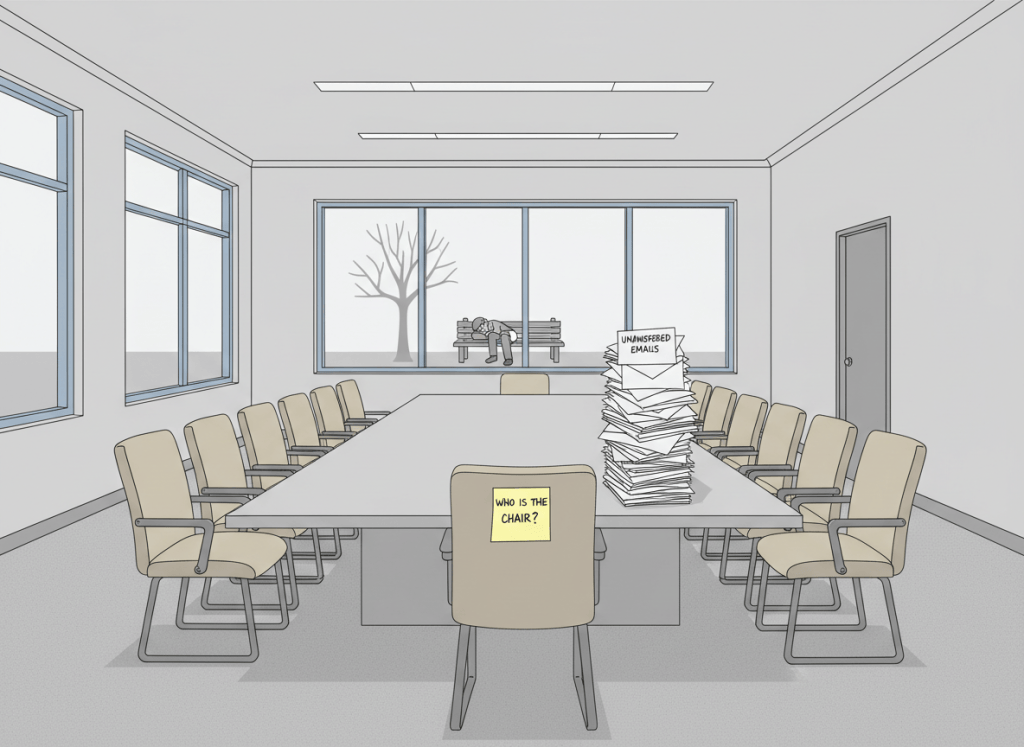
In March 2026 the staff did what any office does when the boss goes missing. They emailed all nineteen member agencies and asked for a point of contact, then followed up in April. By May, GSA had answered. HHS, OMB, Energy and Transportation confirmed they had received the email and nothing more. Fourteen agencies did not reply at all.
The agencies that matter most were not much warmer. HHS told GAO it knew of no USICH activity in 2025 and did not plan to participate in 2026. USDA said it had no one assigned. HUD, which the statute requires to provide the Council with administrative and support services, did not answer GAO’s requests. GAO notes that HHS, USDA and HUD were among eleven agencies that signed a March 2025 resolution appointing a new executive director, so the Council has been capable of paperwork when the paperwork pointed in one direction. GAO states plainly that it did not evaluate compliance with any law in this review, and so this article does not claim a violation. What GAO documents is a statutory body that exists in the U.S. Code and in a log of unreturned emails.
Hollowing Without Abolishing
Executive Order 14238, issued in March 2025, told USICH and six other entities to eliminate nonstatutory functions and cut statutory ones to the minimum the law requires. USICH is a creature of Congress, so abolition by order was not available. Reduction was.
Council members appointed an executive director who, per GAO, described the work as part-time while holding multiple concurrent federal positions. GAO could not pin down the title or the start date, because one Council resolution says March 14 and two orders signed by the appointee say April 7. That director delegated the job to someone who described themself as a member of the Department of Government Efficiency team working at GSA. The delegate then placed all but two of USICH’s thirteen employees on paid administrative leave. The two who stayed handled payroll and administration. GSA terminated the lease and took back the equipment, and employees on leave were offered a choice between a deferred resignation effective September 30, 2025 and termination through a reduction in force.
Congress had appropriated $4.3 million for fiscal year 2025. USICH spent $3,749,079 and returned $550,921, with most of the spending going to pay and benefits, including employees sent home for roughly six months of the fiscal year, and to rent on an office the government had just taken away. The taxpayers bought a staff and then paid the staff not to staff.
In November 2025 a federal court in Rhode Island, in Rhode Island v. Trump, found the implementation unlawful. The court reasoned that cutting USICH to two employees made it impossible to perform its statutory duties, vacated the actions taken, and barred future ones under the order. USICH has appealed to the First Circuit, and the appeal was pending as of September.
Awaiting Direction
The staff came back in stages. New equipment arrived in January 2026, and eight employees returned to active status on February 17. Three others had already left. As of May USICH had ten full-time employees across four subcomponents, all teleworking, and GAO notes the Director of Legislative Affairs left in August.
Five of those employees are regional coordinators. The statute requires no fewer than five, so the staff sits exactly at the legal floor. That observation comes from reading the statute beside GAO’s staffing counts, and GAO makes no such finding.
What they do not have is work. Staff told GAO that since returning they have received no direction on homelessness policy or priorities from the Council or from the executive director. The director told GAO the Council should provide guidance before USICH drafts a strategic plan or starts any policy initiative, and that the Council’s future approach to homelessness may differ significantly from past ones. A new deadline is already running. As amended effective July 11, 2026, the statute gives the Council twelve months to develop a National Strategic Plan to End Homelessness, take public comment, and send it to the President and Congress. That puts the clock at roughly July 2027, for a Council with no scheduled meeting.
Meanwhile the money shrank. Congress appropriated $3.0 million for fiscal year 2026, about 30 percent less than the year before.
The Quiet Way to Close an Agency
What follows is inference, and it should be read as such. It rests on three things in GAO’s report, the court’s finding that two employees could not perform the statutory duties, the staff’s account that ten employees have no direction, and the Council’s near total silence in response to outreach. The reasoning is that headcount was only ever one way to stop an agency from working. A council that does not meet, does not designate contacts and does not issue direction produces the same result without a single personnel action for a court to review. The court asked whether USICH could do its job with two people. The harder question now is whether it can do it with ten and no instructions. GAO has not answered that and was not asked to.
USICH’s own comments on the draft report are worth reading in that light. The executive director said USICH looks forward to resolution of the lawsuit and to moving forward with the Council on its mission, while preserving the right to make changes consistent with applicable law and Executive Order 14238. A reservation of rights is not a plan, though it is a fine place to keep one.
The calendar is not waiting. The President’s fiscal year 2027 budget proposes terminating USICH and requests $200,000 for an orderly closeout. Current funding runs only through December 11, 2026, and the statutory termination date is October 1, 2028. GAO also reports that the Council and USICH had not shown evidence of fully implementing recommendations from 2020 and 2022 to clarify governance roles and write down procedures for meeting statutory requirements, as of July 2026.
The backdrop is not abstract. GAO cites HUD’s count of more than 771,000 people experiencing homelessness in 2024, the highest on record and 19 percent above the first count in 2007. Congress built a body to coordinate the federal response to that, and the response currently consists of fourteen unanswered emails. The court told the government it could not gut the agency. It did not tell the government how to make anyone show up. The contrast with other federal spending programs is instructive: the Rural Health Transformation Program shows what happens when the federal government is fully engaged — using $50 billion in grant money as ongoing leverage over state policy decisions, with clawback authority and no meaningful right of appeal. USICH, by comparison, cannot get nineteen agencies to return an email. And on the question of what Congress can actually see before federal money goes out the door, the Commodity Credit Corporation’s $30 billion line of credit offers a useful counterpoint: the executive branch spending first and letting Congress settle up later is a feature, not a bug, of that particular vehicle.

