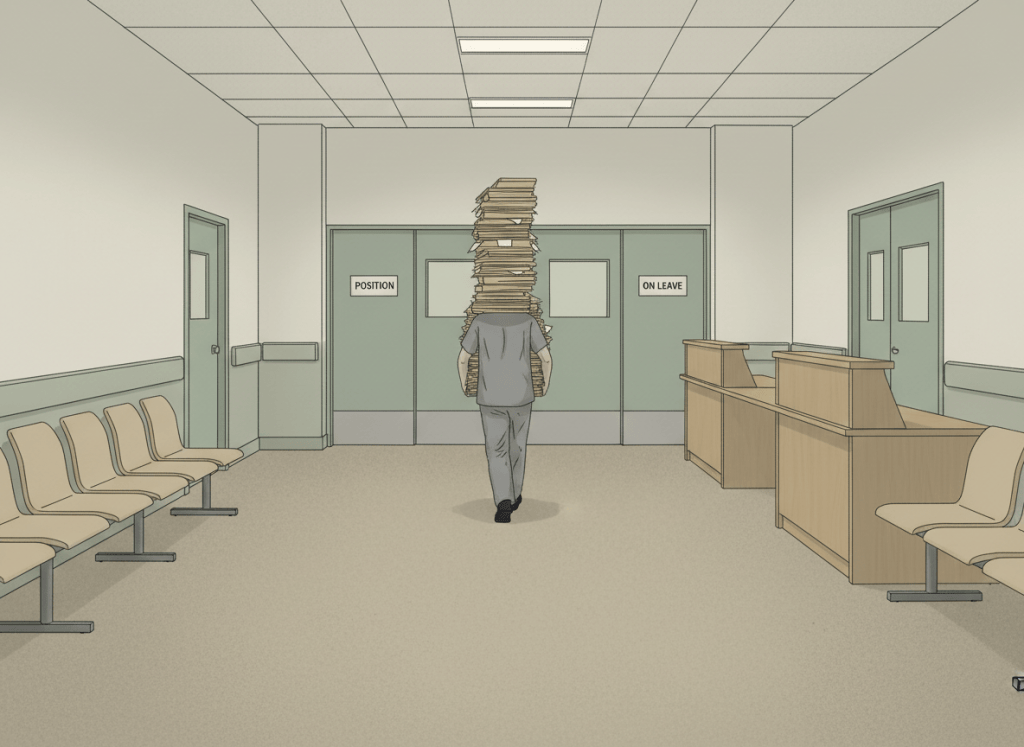
Federal efforts to reshape the government workforce reached well beyond Washington offices at the VA Pittsburgh Healthcare System, where an inspector general review found position downgrades, employee departures, return-to-office requirements and deferred resignations were contributing to staffing pressures inside one of the Department of Veterans Affairs’ most complex medical systems.
The findings are tucked inside a broader VA Office of Inspector General inspection released Oct. 6. The OIG formally issued four recommendations, all involving the hospital environment: cleanliness, medical-equipment maintenance, pharmaceutical-waste disposal and electrical safety.
But the report also documents a wider problem that did not produce a formal recommendation.
VA Pittsburgh officials told inspectors that several federal workforce initiatives had resulted in experienced employees leaving, made vacant positions more difficult to fill and increased workloads for remaining workers. In at least some cases, officials warned the staffing problems could affect services provided to veterans.
The Pittsburgh system is not a small outpost. It is a high-complexity healthcare system serving roughly 93,000 patients and operating with approximately $1.2 billion in medical-care funding.
Dozens of jobs downgraded
According to the OIG, an Office of Personnel Management classification review resulted in approximately 75 to 100 VA Pittsburgh employees having their positions downgraded.
Some employees resigned.
Among the positions affected were industrial hygienists, purchasing agents and environmental-management workers, jobs that generally operate outside the public-facing clinical workforce but support the machinery necessary to keep a hospital running.
Facility leaders told inspectors that losing experienced administrative employees responsible for equipment purchases and contracts could delay patient care.
Officials also said lower grades made the positions more difficult to fill because the resulting salaries were less competitive with private-sector employment. Retention bonuses were authorized in an attempt to keep employees, but leaders described those payments as a short-term measure.
The distinction matters.
Federal workforce reductions are frequently discussed in terms of headcounts, administrative positions and payroll savings. At a healthcare system, however, the line between an “administrative” employee and patient care can become considerably less tidy when the employee is responsible for buying medical equipment, maintaining contracts or keeping hospital operations moving.
Transportation workforce fell by about 25 percent
The consequences were particularly visible in transportation.
According to the OIG, VA Pittsburgh’s transportation workforce declined by approximately 25 percent, reducing the facility’s ability to provide transportation services to veterans.
The OIG also found staffing pressure in community care.
Five positions were vacant and awaiting authorization to be filled at the time of the inspection, while existing clinical and administrative employees were working overtime.
Community-care appointments took an average of eight days to schedule, one day longer than VA’s seven-day scheduling standard. The facility had improved from an average approaching 10 days, however, and inspectors did not issue a recommendation.
Return-to-office policy complicated recruiting
VA Pittsburgh employees also pointed to the federal government’s return-to-office push.
Facility leaders told the OIG that elimination of telework caused some employees to leave, adding to the workload of those who remained. They also said recruiting administrative employees had become more difficult because competing healthcare employers continued to offer telework.
That local account follows a department-wide policy adopted the previous year.
In February 2025, VA announced that eligible employees would generally be required to work full time at their agency worksites, implementing the administration’s broader return-to-in-person-work directive. At the time, VA reported that more than 20 percent of its workforce of more than 479,000 employees had remote or telework arrangements.
The department argued the change would improve performance, collaboration and productivity while treating employees more equally, particularly because most clinical personnel could not work remotely.
At Pittsburgh, however, inspectors documented another side of that equation: some employees left, remaining employees absorbed additional work and the facility found itself competing against employers still offering remote-work flexibility.
Three of four environmental foremen left
Another federal workforce initiative landed directly in a department that subsequently drew OIG scrutiny.
The chief of VA Pittsburgh’s Environmental Management Service told inspectors that three of the department’s four foremen had left through the federal deferred resignation program.
That left one foreman overseeing environmental operations.
During its inspection, the OIG found dust beneath patient mattresses, on examination-table bases and on shelving in supply rooms. Inspectors also discovered that a temperature and humidity monitor in one supply area had been shut off during construction and apparently remained off for more than a year.
The OIG recommended that VA Pittsburgh take corrective action to ensure patient-care areas and storerooms are properly cleaned.
The report does not establish that the departure of the three supervisors caused the cleanliness deficiencies, and the timing alone cannot demonstrate causation.
But the juxtaposition is difficult to ignore: a department lost three-quarters of its foremen through a federal workforce-reduction program, and inspectors subsequently found deficiencies in the work that department supervises.
The deferred resignation program was not unique to VA Pittsburgh.
VA reported that employees participated in both OPM’s government-wide deferred resignation program and a subsequent VA program. Department workforce reports described the initiatives as part of broader efforts to reshape staffing while exempting hundreds of thousands of positions considered essential to veteran healthcare and other services.
Government-wide, the scale was substantial.
The Government Accountability Office reported that nearly 378,000 employees separated from 22 major federal agencies during 2025 while approximately 127,000 were hired. The combined workforce of those agencies declined by nearly 256,000 employees, or more than 11 percent, between December 2024 and January 2026. GAO said roughly 65 percent of the year’s separations occurred during the second half of 2025 as workers participating in deferred resignation programs departed.
Equipment effectively disappeared from maintenance tracking
Workforce pressures were not the OIG’s only concern.
Inspectors found portable infusion pumps and suction devices that were overdue for preventive maintenance.
In the case of some suction equipment, the problem exposed an unusual weakness in VA’s tracking system.
Equipment identified for replacement could be automatically removed from the facility’s preventive-maintenance schedule even though the equipment itself remained in service.
In practical terms, equipment could disappear from the maintenance schedule before it disappeared from the hospital.
The OIG recommended that the facility ensure all medical equipment receives required inspections and testing.
Inspectors also found problems involving pharmaceutical-waste containers and electrical safety. Some employees could not explain the correct pharmaceutical-disposal procedures, while inspectors found unsecured power strips and strained electrical cords.
The electrical issue was especially notable because a similar problem had been identified during a 2023 Joint Commission accreditation inspection.
All four of the OIG’s recommendations remain open.
A workforce policy becomes a healthcare issue
The inspection does not depict VA Pittsburgh as a healthcare system in collapse.
Veteran trust scores exceeded national averages, primary-care waits remained below the threshold used to determine eligibility for community care, and inspectors identified functioning patient-safety practices.
Nor does the OIG establish that federal workforce policies caused patient injuries or directly caused each of the operational deficiencies inspectors discovered.
What the report does provide is a rare view of how broad federal personnel policies can work their way down to the hospital level.
A position-classification review becomes a purchasing-agent vacancy. A return-to-office mandate becomes a recruiting disadvantage. A deferred resignation becomes three missing environmental-services supervisors. Administrative vacancies become overtime and slower community-care scheduling.
And a workforce policy that looks like a personnel decision in Washington can eventually become a question of who buys the equipment, who maintains the building, who schedules the appointment and who gets the veteran to the hospital.
That is a considerably larger story than four housekeeping recommendations.

