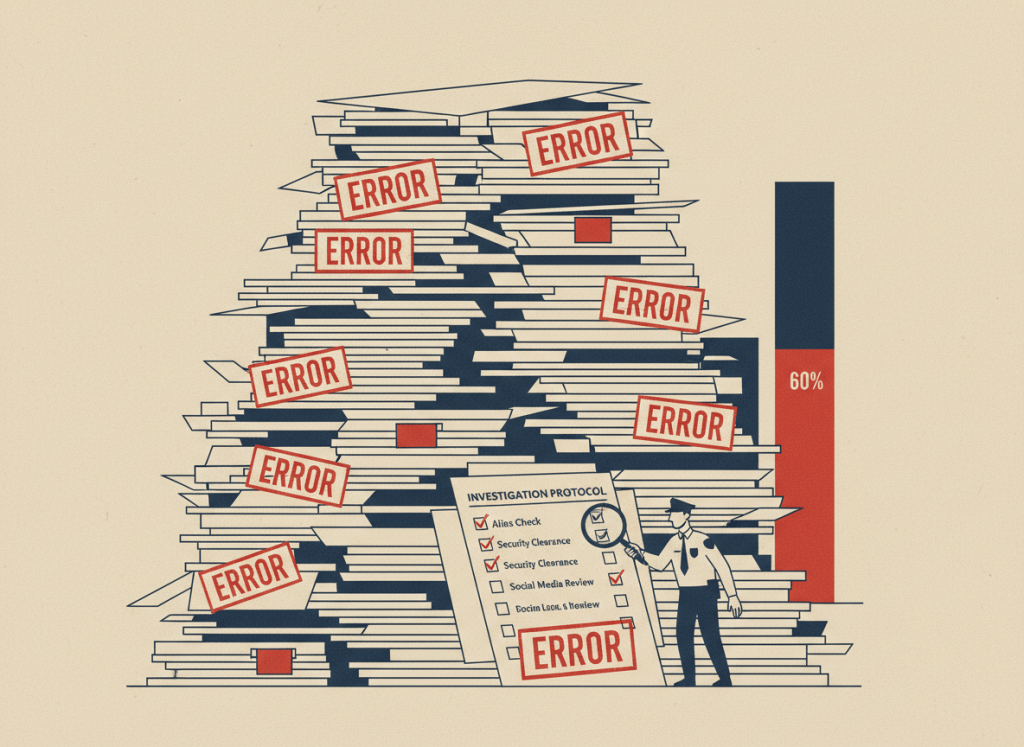
A Department of Homeland Security watchdog review of asylum cases for Afghan evacuees found errors in 40 percent of the files it sampled, including hundreds of missed aliases, missing security checks and two cases involving potential inadmissibility on terrorism-related grounds.
The findings come from a redacted DHS Office of Inspector General report examining asylum applications associated with Operation Allies Welcome, the federal effort established following the 2021 withdrawal from Afghanistan.
The numbers are difficult to dismiss as clerical trivia.
DHS OIG examined a statistical sample of 678 applications drawn from a population of 13,682 adjudicated Operation Allies Welcome asylum applications. Within those files, auditors identified 303 missed aliases, 23 missing security checks, 45 unresolved records and 115 other documentation issues.
Altogether, the watchdog calculated an adjudication error rate of approximately 40 percent.
The significance of those errors is not that 40 percent of applicants presented security concerns. The report does not make that finding.
Rather, the Inspector General concluded that the frequency and nature of the mistakes created opportunities for U.S. Citizenship and Immigration Services to miss connections between names supplied by applicants and derogatory information contained elsewhere in government systems.
That distinction is important. So is the problem.
An immigration file does not disappear after an asylum officer makes a decision. The resulting alien registration file, or A-File, becomes part of the government’s continuing record of that individual and may later be relied upon for immigration benefits, administration and enforcement.
When aliases, security checks or unresolved records are missing from that file, today’s paperwork error can become tomorrow’s incomplete government record.
And among the hundreds of errors DHS OIG found were two cases that raised a considerably more serious question: potential inadmissibility on terrorism-related grounds.
Hundreds of Missed Aliases
The most common problem identified by investigators involved names.
OIG found 303 missed aliases among the applications it reviewed. Some resulted from asylum officers failing to identify variations in the spelling of applicants’ names.
That might appear minor until considered in the context of security screening.
Names and aliases are among the identifiers used to compare individuals against information maintained in government databases. If an applicant’s alternate name or spelling variation is not properly identified and searched, the government may fail to connect that person with information filed under the other name.
That does not mean every missed alias concealed derogatory information. The report does not establish that.
It means USCIS did not always perform or document the process necessary to find out.
The task can also be considerably more complicated than spotting whether someone used “Mohammad” instead of “Muhammad.” OIG encountered one application containing 124 aliases, illustrating the volume of names officers can be required to reconcile. Common names can also produce large numbers of potential matches that must be distinguished from the applicant actually sitting before the government.
That context helps explain why errors can occur. It does not eliminate the government’s responsibility to resolve them.
Investigators also found 23 missing security checks and 45 unresolved records, along with another 115 documentation problems. Some errors were mundane, including officers failing to reprint a document and place it into an A-File.
Taken individually, those mistakes vary considerably in seriousness. Taken collectively across a statistical sample of hundreds of adjudicated asylum cases, they produced the 40 percent error rate that prompted the Inspector General’s concern.
The OIG warned that those deficiencies could compromise the integrity of A-Files subsequently relied upon by other government personnel for immigration administration and enforcement.
In other words, the problem does not necessarily end when the asylum case is closed.
Two Cases Stand Apart
The report’s most consequential finding involves two applications associated with potential terrorism-related grounds of inadmissibility.
That wording deserves care.
The Inspector General did not conclude that two terrorists were granted asylum. Nor does the finding establish that either individual engaged in terrorism.
Immigration law contains broad terrorism-related inadmissibility provisions, and a potential issue can require additional examination without ultimately making an applicant ineligible.
What the OIG documented were failures in the adjudicative process used to evaluate those concerns.
In one case, supplemental documentation concerning potential inadmissibility was missing from the file, preventing the required second-level authority from approving the analysis.
In another, senior officials had signed the relevant analysis, but the portion of the paperwork indicating whether they actually approved or disapproved it was left blank.
The distinction is important because the problem identified by OIG was not that investigators subsequently discovered two terrorists hiding inside the asylum program. It was that USCIS’s records did not reliably demonstrate that potentially serious inadmissibility questions had traveled through the complete review and approval process.
That is precisely what an A-File is supposed to establish.
If future immigration officials encounter the same individual years later, they should not have to reconstruct whether a terrorism-related concern was reviewed, who reviewed it and what that official decided.
The record should already contain the answer.
Social-Media Findings Went Unresolved
The audit identified another category of unfinished work.
OIG found at least eight cases containing social-media information characterized as derogatory or otherwise of interest where USCIS did not conduct the expected follow-up.
USCIS attributed at least part of the problem to ambiguity in its guidance governing how officers should document and resolve social-media findings.
That explanation is plausible, but it also illustrates the larger concern running through the audit.
Security screening does not end when potentially relevant information appears on a computer screen. Someone must determine whether the information belongs to the applicant, evaluate its significance, document the analysis and preserve the result for the officials who may rely upon that record later.
If the guidance does not clearly tell adjudicators what to do with potentially derogatory information once they find it, the screening process can identify a concern without actually resolving it.
OIG consequently recommended that USCIS clarify its requirements for documenting social-media findings.
The Deadline Wasn’t the Explanation
There was an obvious potential explanation for the errors: speed.
Afghans evacuated following the collapse of the former Afghan government entered an immigration system facing extraordinary logistical and administrative demands. Congress required expedited processing of qualifying asylum applications, directing DHS to conduct initial interviews within 45 days and, absent exceptional circumstances, complete final administrative adjudications within 150 days.
Processing delays eventually produced litigation.
In Ahmed v. DHS, Afghan asylum applicants challenged USCIS over failures to meet the congressionally established deadline. A September 2023 settlement required the government to improve compliance, including a commitment aimed at having 90 percent of covered applications adjudicated within 150 days.
That created a straightforward hypothesis for investigators.
Perhaps adjudication errors increased because officers were being pushed to finish cases faster.
DHS OIG tested that proposition.
It did not find a statistically significant increase in the error rate following the settlement.
That finding makes the report considerably more interesting.
If the errors had sharply increased after USCIS came under pressure to satisfy the 150-day requirement, the explanation would have been relatively simple: speed came at the expense of accuracy.
The watchdog’s analysis does not support that conclusion.
Instead, the errors appear to reflect a problem that cannot readily be blamed on the settlement-imposed processing pressure.
USCIS itself reported in late 2022 that it had already received 10,848 Operation Allies Welcome asylum applications and said more than 97 percent of completed cases were being processed within the congressionally mandated 150-day period. At the time, the agency reported a 99 percent approval rate among completed cases.
Later court reporting illustrates the scale of the program. By November 27, 2024, USCIS reported receiving 21,599 asylum applications from members of the Ahmed class and adjudicating 20,251 of them, including 19,505 grants.
The OIG’s findings therefore concern an adjudication system processing thousands of consequential immigration decisions, not a handful of anomalous files.
USCIS Pushes Back, But Accepts the Fixes
USCIS did not accept every implication the Inspector General drew from the errors.
The agency emphasized that asylum adjudication operates within a broader screening and vetting system and argued that individual errors in asylum files should not be interpreted as evidence that the government’s overall security-screening architecture failed.
That is an important qualification.
Redundant security systems exist precisely because individual safeguards sometimes fail. An error by one officer does not establish that every other security layer failed with it.
But redundancy does not make the underlying errors irrelevant, particularly when the government is producing a permanent immigration record that other officials may subsequently treat as complete.
USCIS ultimately accepted all five recommendations made by the Inspector General.
Those corrective actions include establishing an acceptable error-rate benchmark, improving procedures for identifying and recording aliases, ensuring required security checks are completed before cases are administratively closed, and clarifying documentation requirements for social-media findings.
The agency’s response therefore produces an important middle ground in interpreting the audit.
USCIS disputes the suggestion that the errors demonstrate wholesale failure of the government’s vetting system.
It nevertheless agrees that the adjudication process documented by OIG needs fixing.
Both things can be true.
Administrative Errors With Long Memories
Operation Allies Welcome was born from an extraordinary event. More than 85,000 Afghan nationals ultimately resettled in communities across the United States through the program. The evacuation unfolded amid the collapse of Afghanistan’s government, the Taliban’s return to power and an enormous federal effort to identify, transport, screen and resettle Afghans in a matter of months.
Extraordinary circumstances inevitably create imperfect records.
But asylum adjudication was supposed to be one of the opportunities to improve those records.
Instead, DHS OIG found errors in roughly four out of every ten adjudications it sampled.
Most were not evidence of hidden terrorists or undiscovered criminals. Some were as ordinary as an officer failing to place the correct document in a file. Others involved aliases, incomplete security checks, unresolved social-media information and unfinished documentation concerning potentially serious inadmissibility questions.
That is precisely why the finding is worth examining without embellishment.
Government records acquire authority simply by existing. Future adjudicators, investigators and enforcement officers reasonably assume that required checks were performed, aliases were captured and unresolved records were actually resolved.
A missed spelling variation today can become an apparently complete A-File tomorrow.
A social-media finding that nobody documents as resolved can become a question somebody else has to reconstruct years later.
And a form concerning potential terrorism-related inadmissibility that is signed but never marked approved or disapproved leaves the government with signatures where a decision should be.
The Inspector General did not find that 40 percent of Afghan evacuees presented security threats.
It found something more prosaic and, for a bureaucracy built upon records, consequential: in four out of every ten files it sampled, the government’s paperwork did not reliably demonstrate that the adjudication process had been completed as it was supposed to be.

