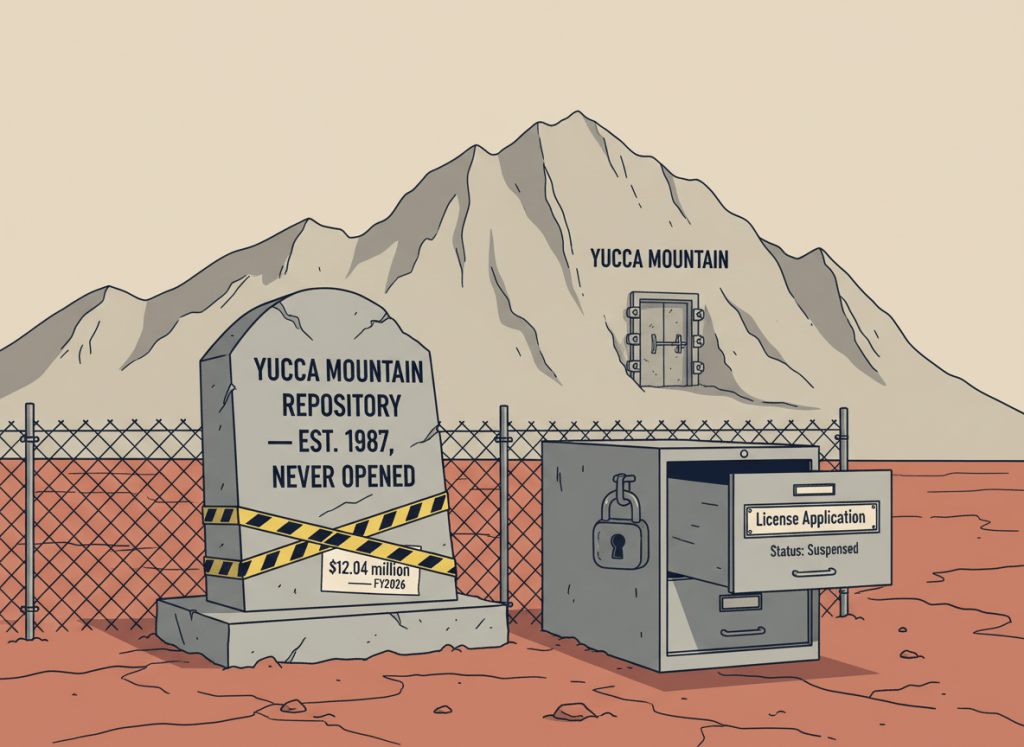
For a nuclear waste repository that has never stored a single spent fuel assembly, Yucca Mountain has enjoyed an unusually long federal afterlife.
Congress selected the Nevada site nearly four decades ago. The Department of Energy spent billions studying it, drilling into it, designing it and eventually applying for permission to build a permanent underground repository there.
Then the project stopped.
Except, legally, it didn’t.
Yucca Mountain remains the only site designated under federal law for development as the nation’s permanent repository for spent nuclear fuel and high-level radioactive waste. DOE’s license application remains on the Nuclear Regulatory Commission’s docket. The required adjudicatory proceeding remains suspended rather than completed.
And in fiscal year 2026, taxpayers are still paying to secure the site and maintain the federal government’s Yucca Mountain licensing records.
America has managed to build something stranger than a nuclear waste repository: a nuclear waste repository that exists principally as a legal and administrative condition.
Congress Picks a Mountain
The modern story begins with the Nuclear Waste Policy Act of 1982.
Congress assigned the federal government responsibility for developing a permanent geologic repository for commercial spent nuclear fuel and high-level radioactive waste. DOE would develop the repository, the Environmental Protection Agency would establish environmental standards, and the Nuclear Regulatory Commission would regulate and license it.
The law also established a Nuclear Waste Fund, financed largely through fees charged to nuclear utilities and ultimately their customers.
Initially, several potential repository sites were under consideration. Congress dramatically narrowed the field in 1987.
Amendments to the Nuclear Waste Policy Act ordered DOE to phase out site-specific activities everywhere except Yucca Mountain, roughly 100 miles northwest of Las Vegas. Federal law still contains that instruction today.
The decision was fiercely opposed in Nevada and acquired the less-than-affectionate nickname “Screw Nevada Bill.” But it was federal law, and DOE got to work.
Scientists drilled boreholes, examined groundwater, studied earthquakes and volcanism, modeled radioactive releases and excavated miles of underground tunnels.
By 2011, the Government Accountability Office reported that DOE had spent nearly $15 billion since 1983 evaluating repository sites, studying Yucca Mountain and developing its license application. Roughly $9.5 billion came from the Nuclear Waste Fund.
After decades of work, DOE finally reached the nuclear equivalent of the building-permit counter. On June 3, 2008, it submitted an application to the NRC seeking authorization to construct the repository.
Then Washington Pulled the Plug
Less than two years later, the Obama administration moved to terminate the project.
On March 3, 2010, DOE asked the NRC’s Atomic Safety and Licensing Board for permission to withdraw its application. The licensing board refused. The NRC itself subsequently divided evenly over whether to reverse or uphold that decision.
Meanwhile, Congress reduced funding for the licensing review, and the NRC began shutting down its Yucca Mountain activities. By September 2011, the adjudicatory proceeding was suspended.
That could easily leave the impression that federal nuclear regulators examined Yucca Mountain and rejected the site.
They didn’t.
In 2013, the U.S. Court of Appeals for the District of Columbia Circuit ordered the NRC to resume its review using money Congress had already appropriated. NRC staff ultimately completed a five-volume Safety Evaluation Report.
In its final evaluation, staff found that DOE had met the applicable regulatory requirements for the proposed repository, subject to proposed conditions, with two significant outstanding exceptions involving ownership and control of the land and certain water rights. NRC staff also completed the remaining environmental-impact supplement in 2016.
That did not constitute a license.
DOE still lacked the land and water requirements identified by NRC staff. More importantly, the legally required adjudicatory hearing—where Nevada and other parties could challenge technical and legal aspects of the application—never reached completion. It remains suspended.
Yucca Mountain was not licensed. But neither did the NRC complete the licensing proceeding and reject it.
The federal government simply stopped in the middle.
The Waste Didn’t Stop
Unfortunately, nuclear reactors did not receive the memo.
DOE was supposed to begin accepting commercial spent nuclear fuel for disposal in 1998 under its contracts with utilities. It didn’t.
Without a federal repository, utilities continued storing spent fuel themselves, first in pools and increasingly in heavily shielded dry-storage casks. The government was then sued for failing to perform its contractual obligation. Again and again.
By 2021, GAO reported that approximately 86,000 metric tons of commercial spent nuclear fuel were sitting at 75 sites around the country and that the federal government had already paid reactor owners approximately $9 billion because DOE had failed to take the material. The inventory has continued growing.
That creates the central contradiction in America’s nuclear waste system.
The federal government created a permanent-disposal program. It collected money to finance it. It selected a repository site. It spent nearly $15 billion developing the project. It submitted a construction application. Its nuclear regulator conducted most of the technical safety review.
And nearly three decades after DOE’s contractual deadline to begin accepting spent fuel, the government still has nowhere permanent to put it.
Not Quite Dead Enough to Stop Paying For
Yucca Mountain today occupies a peculiar bureaucratic limbo.
The NRC says it currently has no active safety-oversight responsibilities at the site. DOE discontinued site activities and closed the Yucca Mountain Project Office years ago. Congress has not funded the licensing proceeding necessary to bring the application to a final decision.
But federal law still identifies Yucca Mountain as the repository site. DOE’s application remains unresolved. And Washington is still spending money on the remains.
DOE’s fiscal year 2026 budget requested $12.04 million for Nuclear Waste Fund oversight. Among the activities covered by that account are physical security at Yucca Mountain, site maintenance and environmental work, and operation of Yucca Mountain’s legacy licensing and data-management systems.
The United States is therefore maintaining the records and security infrastructure for a repository it isn’t building, under a license proceeding it isn’t finishing, at the only permanent repository site currently designated by law.
Bureaucracy occasionally approaches performance art.
Washington Starts Looking Somewhere Else
The situation has become more conspicuous as the federal government simultaneously pushes for a major expansion of nuclear energy.
The Trump administration has begun pursuing another approach through proposed Nuclear Lifecycle Innovation Campuses—potential state-federal partnerships involving portions of the nuclear fuel cycle that could include spent-fuel management, storage and reprocessing.
That approach emphasizes something Yucca Mountain conspicuously lacked: a willing host.
Nevada officials have interpreted the initiative as evidence that Washington is moving away from Yucca Mountain, although the statutory designation has not disappeared. Nevada’s congressional delegation is trying to make that change permanent.
In August, Sens. Jacky Rosen and Catherine Cortez Masto introduced legislation that would repeal Yucca Mountain’s designation, require DOE to terminate the NRC licensing proceeding and direct the federal government to consider alternative uses for the site.
Unless Congress changes the law, however, Yucca remains where Washington left it.
On paper.
The Mountain Beneath the Nuclear Expansion
That unresolved history matters considerably more if the United States is serious about building substantially more nuclear generating capacity.
Every reactor produces spent nuclear fuel. Reprocessing and advanced reactor technologies may reduce or alter portions of the waste stream, but they do not eliminate the need to permanently dispose of radioactive material. And the existing inventory already needs somewhere to go.
The federal government therefore enters its next nuclear expansion carrying a problem inherited from the previous one.
Yucca Mountain is not merely a story about Nevada, geology or a particularly stubborn federal construction project. It is the physical monument to an unfinished federal promise.
Congress decided that the country needed a permanent nuclear waste repository. Congress selected the place. DOE spent decades and billions of dollars trying to build it. The government missed its 1998 deadline to begin accepting waste. Utilities sued. Taxpayers paid. The waste accumulated.
And nearly 40 years after Congress told DOE where to put it, the United States still doesn’t have a permanent repository.
Yucca Mountain may someday be revived. Congress may erase it from federal law and start over somewhere else. A consent-based repository may eventually emerge from the government’s latest effort.
But those are future decisions.
For now, America’s only legally designated permanent nuclear waste repository remains exactly where Washington left it: underground in Nevada, unfinished on paper, empty of nuclear waste—and very much still on the books.

