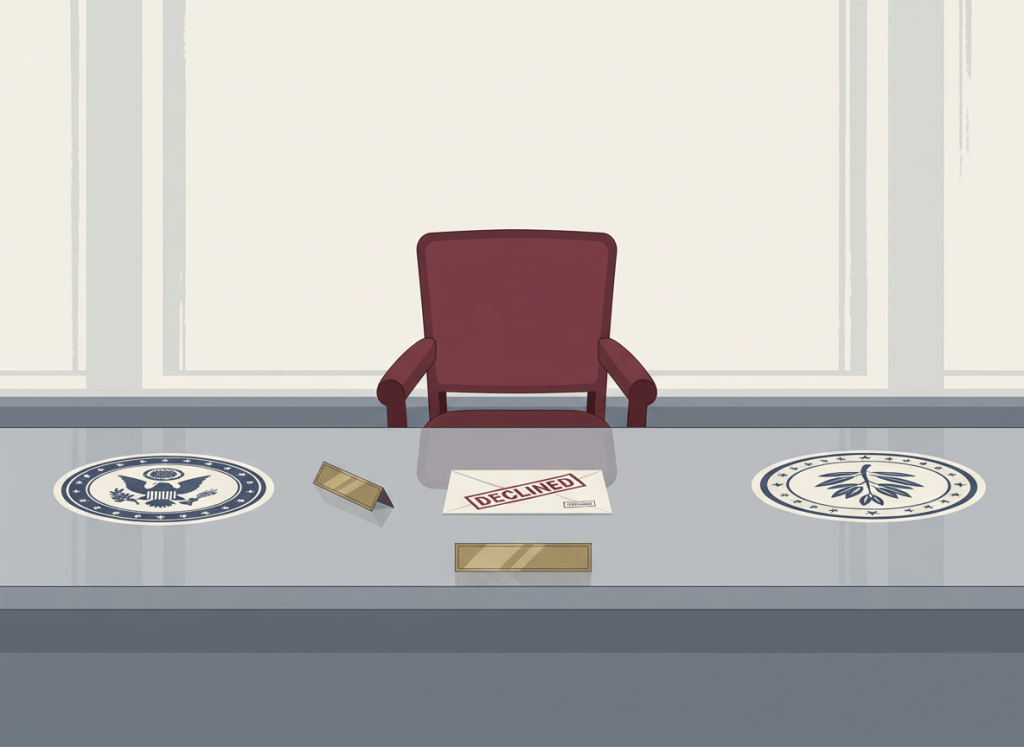
The Ortega-Murillo government has now rejected ambassadorial nominees from two consecutive U.S. administrations. The latest refusal has prompted Washington to recall its senior diplomat, but neither government has broken diplomatic relations.
Nicaragua has rejected another American ambassador, and Washington is bringing its senior diplomat home for consultations. It is the second time in four years that the government of Daniel Ortega and Rosario Murillo has refused to accept a U.S. ambassadorial nominee, leaving the American diplomatic mission in Managua without an ambassador since May 2023.
The latest confrontation became public on October 2, when Deputy Secretary of State Christopher Landau disclosed that Nicaragua had refused to grant diplomatic approval to Natasha Franceschi, a career Foreign Service officer nominated by President Donald Trump and confirmed by the Senate just two days earlier.
On October 13, the State Department announced that Secretary of State Marco Rubio had directed Elias Baumann, the American chargé d’affaires in Managua, to return to Washington for consultations.
The department accused Nicaragua’s leadership of demonstrating an unwillingness to engage in productive diplomatic dialogue. What Washington did not explain was precisely why Managua rejected Franceschi. Nicaragua, for its part, has not publicly offered a specific explanation. But the diplomatic record reveals a pattern that reaches across two American presidencies, two ambassadorial nominations, and four years of deteriorating relations.
Two Presidents, Two Nominees, Two Rejections
The confrontation has a striking precedent. In July 2022, Nicaragua withdrew its approval of Hugo Rodríguez, President Joe Biden’s nominee to serve as ambassador in Managua. Unlike the latest rejection, that episode came with a publicly documented explanation.
During his Senate confirmation hearing, Rodríguez pledged to support economic and diplomatic measures intended to change the direction of Nicaragua’s government. He also discussed the possibility of reconsidering Nicaragua’s participation in the Dominican Republic-Central America-United States Free Trade Agreement, commonly known as CAFTA-DR.
The remarks drew an immediate response from Nicaraguan Foreign Minister Denis Moncada, who accused Rodríguez of interfering in Nicaragua’s internal political affairs. In a subsequent diplomatic statement, Moncada reaffirmed that Rodríguez would not be admitted to the country as the American ambassador under any circumstances.
The objection was explicit: Managua regarded the nominee’s statements as unacceptable interference in its sovereignty. Four years later, Franceschi’s nomination encountered a similar outcome.
During her September 24, 2026, appearance before the Senate Foreign Relations Committee, Franceschi reportedly pledged to maintain diplomatic pressure on the Ortega-Murillo government using the tools available to Washington. The Senate confirmed her on September 30 by unanimous consent. Within days, Washington publicly disclosed that Nicaragua had refused to accept her.
The similarity between the two episodes is notable. Both nominees publicly supported diplomatic pressure on Managua, and both were rejected. There is, however, an important evidentiary distinction. Nicaragua directly attributed its 2022 decision to Rodríguez’s remarks. No comparable public explanation has been established for Franceschi’s rejection. The earlier episode provides a plausible explanation for the latest confrontation, but it does not prove the government’s motive.
The Diplomatic Approval Washington Cannot Compel
The dispute turns on a longstanding rule of international diplomacy. Under Article 4 of the 1961 Vienna Convention on Diplomatic Relations, a country seeking to appoint an ambassador must first obtain the receiving state’s approval, known as agrément. The receiving state is under no obligation to explain a refusal.
That means Nicaragua possesses the legal authority to reject an American ambassadorial nominee, even after that nominee has received Senate confirmation. The United States cannot compel Managua to accept Franceschi simply because Washington considers her qualified. Nor does the refusal automatically terminate diplomatic relations.
An embassy can continue operating under a chargé d’affaires, as the American mission in Nicaragua has done since Ambassador Kevin Sullivan completed his assignment in May 2023. This distinction is central to understanding the current confrontation.
Nicaragua has not announced that it is severing diplomatic relations with the United States. Washington has not announced that it is closing its embassy in Managua. The State Department’s October 13 announcement did not establish that consular operations were being suspended or that additional sanctions would follow.
Instead, the American government recalled its senior representative for consultations, a diplomatic response that communicates dissatisfaction while preserving the possibility of continued engagement. The practical consequence is a relationship in which formal diplomatic channels remain available, but Washington has been unable to restore ambassador-level representation.
A Rejection Amid Growing International Pressure
The latest refusal occurred against the backdrop of an increasingly contentious relationship. The United States has imposed sanctions and visa restrictions on Nicaraguan officials and individuals associated with the Ortega-Murillo government, citing concerns about political repression, human rights, and democratic institutions.
In 2026, American sanctions also targeted individuals and businesses associated with Nicaragua’s gold sector, including members of the governing family’s network. The diplomatic dispute also coincided with renewed attention from the Organization of American States.
On October 2, the OAS considered Nicaragua’s political and human-rights situation and approved an initiative establishing a ministerial follow-up group intended to encourage dialogue and address political prisoners, fundamental rights, and electoral conditions. That same day, Landau publicly disclosed Franceschi’s rejection.
Nicaragua withdrew from the OAS in 2023 and has repeatedly accused Washington and regional institutions of interfering in its domestic affairs. The coincidence of these events raises an obvious question: Was Franceschi’s rejection intended to discourage further American involvement in international efforts concerning Nicaragua? The public record does not establish that connection.
Nevertheless, the timing places the rejection within a larger diplomatic confrontation rather than an isolated disagreement over an ambassador’s qualifications.
A Career Diplomat, Not a Political Appointee
One distinguishing feature of the 2026 nomination is Franceschi’s professional background. Franceschi is a career Foreign Service officer with approximately 25 years of diplomatic experience, including assignments in Tunisia, Slovakia, and Iraq. Washington presented her selection as an effort to maintain a professional diplomatic channel with Nicaragua.
Following the rejection, American officials emphasized that Franceschi was a career diplomat rather than a partisan political appointee. That distinction matters because the 2022 and 2026 nominations originated under different presidents representing opposing political parties. Yet both encountered the same fundamental obstacle.
The pattern suggests that Nicaragua’s objections may be directed less at the partisan identity of the American administration than at Washington’s stated policies toward the Ortega-Murillo government. It remains possible that Managua had objections specific to Franceschi. Without a public explanation or disclosure of the relevant diplomatic communications, those possibilities cannot be ruled out. What is established is that the government has now declined to accept two successive American nominees.
A Diplomatic Relationship Without an Ambassador
The October 13 recall introduces another uncertainty. The State Department described Baumann’s return to Washington as necessary for consultations, but did not announce how long he would remain away from Managua or whether another American diplomat would assume leadership of the embassy during his absence. Nor did the department announce whether Washington intends to nominate another ambassador.
Those omissions matter. The United States has maintained diplomatic relations with Nicaragua throughout the dispute. American officials have continued to communicate with the government, even as Washington has criticized its conduct and imposed economic and diplomatic restrictions.
That arrangement has allowed the two governments to preserve official channels without resolving their disagreement over ambassadorial representation. The rejection of Franceschi now raises the possibility that the arrangement could continue indefinitely. It also raises questions about the State Department’s approach to future nominations.
Would Washington seek another nominee whose public statements might be more acceptable to Managua? Would it continue appointing diplomats committed to the same pressure policies, knowing Nicaragua might reject them? Or would the administration leave the mission under a chargé d’affaires while pursuing other diplomatic measures? The State Department has not publicly resolved those questions.
The Unanswered Question
The most consequential unanswered question is not whether Nicaragua possesses the authority to reject Franceschi. International diplomatic law makes that clear. It is whether Managua is rejecting particular nominees or resisting the restoration of ambassador-level American representation more generally.
The 2022 record establishes that Nicaragua objected to Rodríguez’s public statements about diplomatic and economic pressure. The 2026 record establishes that Franceschi also supported continued pressure and that Managua subsequently refused to accept her. Those facts demonstrate a recurring confrontation over the terms of diplomatic engagement, but they do not conclusively establish a single motive.
For now, the United States and Nicaragua remain formally connected, even as their relationship has produced another rejected ambassador and another diplomatic consultation in Washington. After more than three years without an American ambassador in Managua, the question is no longer simply who Washington will nominate next.
It is whether Nicaragua is prepared to accept an American ambassador who publicly represents Washington’s existing policy toward the Ortega-Murillo government. Until either government provides a clearer answer, the diplomatic vacancy remains one of the most visible consequences of a relationship neither side has formally ended.

