The Order of Operations
The paperwork for dismantling the U.S. Agency for Global Media has an unusual sense of chronology. Executive Order 14238 was signed on March 14, 2025 (the litigation and funding fight that followed has been covered here). The next day, according to the agency’s own report to the Office of Management and Budget, USAGM sent termination letters to its grantees, put 994 of 1,147 employees on leave, and cancelled 594 personal services contracts. The full-year continuing resolution that carried forward the prior year’s broadcasting requirements, Public Law 119-4, was signed that same Saturday.
The thinking arrived later. A member of the agency’s implementation team provided leadership a memorandum on USAGM’s statutory requirements on March 17, which was after the actions had begun. The statutory minimum memo itself, reprinted in Appendix C, bears a CFO signature stamped March 18. Congress was notified on June 3, 2025, which the inspector general describes as almost three months after the reduction in operations (page 11). By our count the gap was 80 days from the leave letters. At least one implementation team member was asked to sign the notification without being consulted on its contents.
The inspector general’s September 2026 evaluation measures all this against GAO’s 2018 key questions for agency reform, and USAGM does not come off well. The report’s own comparison is telling. It puts the State Department’s arms control reorganization at 19 months, Homeland Security’s creation at 10 months, and the USAID realignment at 96 days, against one day for USAGM (page 4). Most reforms are allowed to be planned before they are announced.
The Homework Congress Assigned
Appropriators, meanwhile, had questions, and their answers are reprinted in Appendix D. The record reads like a ledger of things owed.
The FY2025 continuing resolution required an operating plan by April 29. Staff said they had not received one, and the agency replied that a summarized program plan had accompanied a June 20 notification. An internet freedom spend plan was due June 13. The agency said it was drafting one and expected to share it no later than September 30, 2025. A notification about significant changes to broadcast hours was, in the agency’s words, something it would submit “at a later date”. A required report on Ukraine supplemental funding, due in April, was answered with a description of the data USAGM had been giving the State Department’s inspector general, plus an estimate that a little more than $1 million remained. Asked for the cost of the reductions in force, the agency said it had no estimate at that time.
House minority staff put the central question plainly. Why did it take two and a half months to start a conversation with Congress? The answer was that USAGM “respects the constitutional role played by Congress” and intends to engage as appropriate. The question asked for a reason, and the answer supplied a sentiment.
Whether any of these items has since been delivered is not something the inspector general’s report addresses, and it is a question worth asking the committees directly.
Consultation, Conjugated
The most instructive thread in the documents is the Department of State. The agency’s own plan treats consultation with it on language services as a requirement, and the record shows the verb changing tense as it moves through time.
In the report to OMB, the agency said its senior adviser had consulted with State Department officials on the relevant matters. In the statutory minimum memo, the recommendation was that USAGM should engage with the State Department on the deletion of language services. By August 2025, asked for details about those engagements, the agency said only that it has plans for engagement. In its formal response to the inspector general, USAGM says it is committed to conducting the legally required consultations with State.
That is four documents and four grammatical moods. The letter to the inspector general also says the agency has been in regular communication with its committees and with State over the past six months, and that it is now in weekly contact with State, congressional staff, internal management and its grantee networks (page 51). This is welcome. It is also a description of the last six months, not the first three. Consulted, should engage, has plans for, is committed to. The one tense missing from the sequence is the past, with details.
Already Undertaken, Eventually
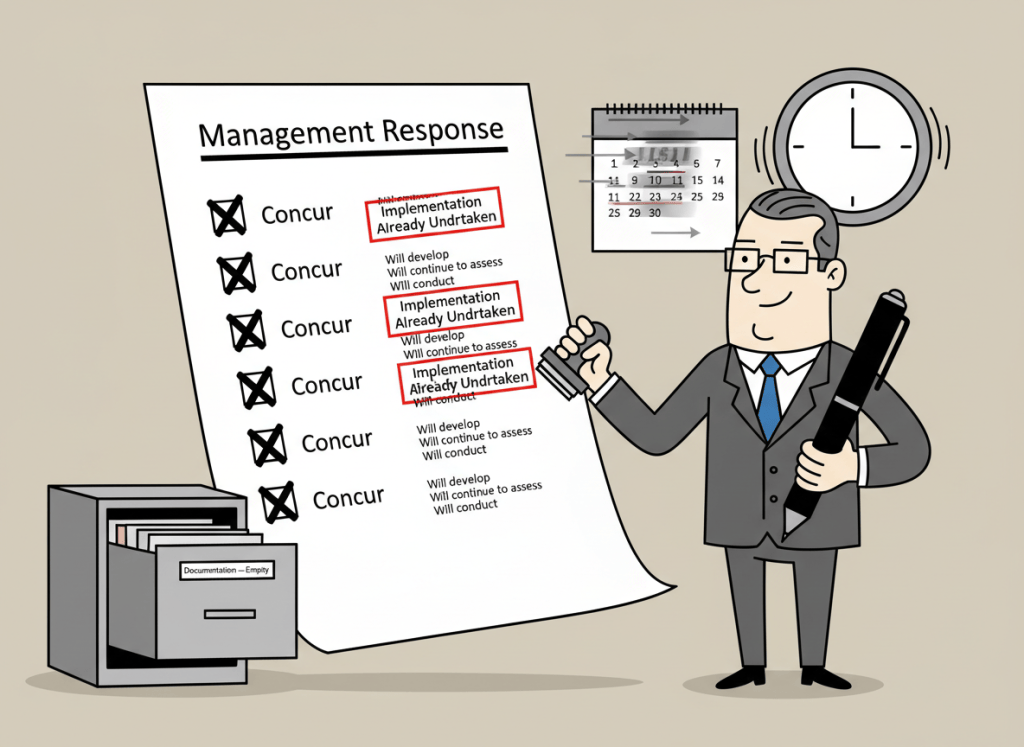
The formal response, reprinted in Appendix F, concurs with all six recommendations. It marks five of them “Implementation already undertaken.” The wording of the promises inside those five is instructive. On the first recommendation, to determine the statutory minimum in full, the agency says it “will develop” the plan and “will continue to assess” government-wide requirements. On the fourth, comprehensive workforce planning, it says it “will conduct” the effort, while noting it is already hiring under an approved hiring plan. GAO’s guidance says workforce planning should precede staff realignments and downsizing. The inspector general found USAGM could not provide any documentation of workforce planning done before it acted.
On the third recommendation, a real strategic plan, the agency says it has an internal draft. Under the GPRA Modernization Act, agencies must post a strategic plan on their public websites by the first Monday in February of the year after a presidential term begins, which in this case was February 2, 2026. The inspector general reported that the plan on USAGM’s site had not been updated since January 2025.
On the fifth recommendation, to establish a dedicated implementation team, the response says management will continue to coordinate, execute, and monitor reform efforts. That is a promise to continue doing something the inspector general found had been done around the existing team rather than through it, and it does not name a team.
The inspector general has treated all six as resolved, which means the agency agreed. They will be closed only when documentation arrives showing the work is finished. That leaves the paper trail with an ending that has yet to be written. Until it is, the documents on file describe an agency that acts first, plans afterward, and reports on the whole affair in the future tense.

