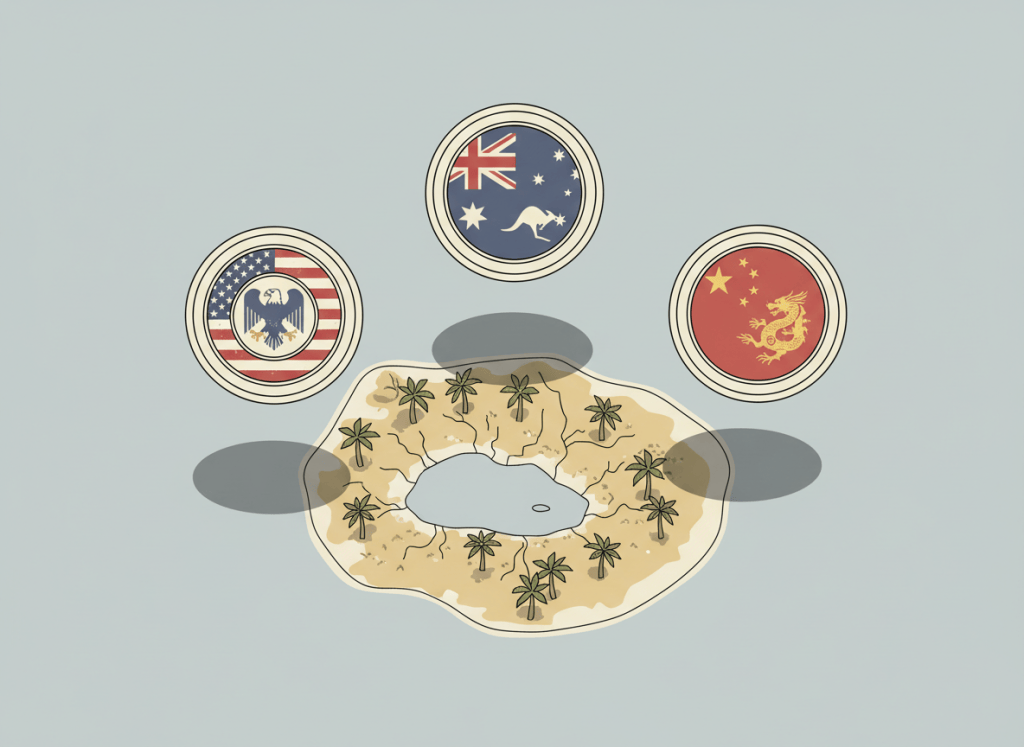
Vanuatu rarely makes American headlines. A newly effective U.S. investment agreement looks routine on its own. Put it beside Australia’s security pact, China’s development push and a growing contest over Pacific infrastructure, and the paperwork becomes considerably more interesting.
On paper, it is seven pages about investment guarantees in a country most Americans would struggle to locate on a map.
Zoom out, however, and Vanuatu starts looking less like an obscure South Pacific archipelago and more like a very small table where three very large countries keep pulling up chairs.
On May 20, 2026, the United States and the Republic of Vanuatu signed an Investment Incentive Agreement in Port Vila. It entered into force June 4.
The agreement’s stated purpose is development. It establishes the legal framework necessary for the U.S. International Development Finance Corporation, or DFC, to operate in Vanuatu. DFC can provide debt and equity investments, investment guarantees and insurance, feasibility studies, grants and other forms of support.
Read alone, it is precisely the sort of international agreement capable of putting an otherwise alert reader into a medically concerning nap.
Read alongside everything else happening around Vanuatu, and it becomes harder to ignore.
Vanuatu is an archipelago of roughly 80 islands in the South Pacific, east of Australia and west of Fiji. Its domestic economy is small. Its geography is not.
And geography appears increasingly to be the valuable commodity.
Congress provided an unusually explicit clue about American intentions in H.R. 562, the proposed BLUE Pacific Act. The legislation stated that DFC must have an investment incentive agreement with a country’s government before pursuing development projects there. It specifically identified private-sector development and economic growth in Vanuatu and the Solomon Islands as being in the United States’ foreign-policy interest.
In other words, the seven-page agreement wasn’t itself an American investment in Vanuatu.
It unlocked the door through which future American investments can enter.
And everyone else appears interested in the building.
China is already there
China already has an extensive relationship with Vanuatu. In April, Vanuatu’s government publicly rebutted reporting that it was negotiating a security agreement with Beijing. Port Vila insisted the proposed arrangement was instead a comprehensive development cooperation agreement covering infrastructure development, capacity building and economic support.
The distinction is important. So is the fact that Vanuatu felt compelled to make it.
Prime Minister Jotham Napat’s government has reiterated Vanuatu’s longstanding nonaligned foreign policy, saying the country intended to remain friends to all and pursue multiple development partners rather than allow outsiders to dictate its relationships.
That isn’t the language of a government unaware that larger powers are circling.
It sounds considerably more like a government determined to make the circling useful.
Then Australia arrived with a much bigger document
Forty days after the United States signed its investment agreement, Australia and Vanuatu signed the legally binding Nakamal Agreement on June 29.
The agreement contains the usual diplomatic language about partnership, development and cultural ties. Then it gets down to business.
Vanuatu agrees not to permit its territory to be used for any foreign military base or infrastructure. Australia is formally recognized as Vanuatu’s longstanding primary policing partner, with expanded cooperation covering police training, maritime security, cybersecurity, intelligence and infrastructure.
Then comes Article 8.
It specifically identifies ports, telecommunications and digital systems, aviation and energy as critical infrastructure. Vanuatu agrees to keep that infrastructure free from militarization, foreign interference and unauthorized access.
Most notably, Vanuatu agrees to consult Australia about proposed third-party involvement in that critical infrastructure.
“Third party” is admirably diplomatic terminology.
There aren’t many countries competing to build strategically important Pacific infrastructure whose identity requires great feats of deduction.
Australia itself describes the agreement as strengthening regional collective security and emphasizes both the prohibition on foreign military infrastructure and the consultation requirement for outside involvement in Vanuatu’s critical infrastructure.
Australia also has money on the table. Canberra remains Vanuatu’s largest development and humanitarian partner, budgeting substantial official development assistance for the country.
The Australian agreement therefore isn’t merely a security arrangement. It encompasses economic development, digital infrastructure, renewable energy, policing, disaster response and mobility.
And Vanuatu didn’t simply sign the first draft Canberra put in front of it.
Its government says negotiations stretched from early 2025 through May 2026 and included extensive domestic political consultation before final approval.
That detail matters because the easiest version of this story is also probably the wrong one.
Vanuatu is not merely a helpless pawn being shuffled around a Pacific chessboard.
It appears to be playing.
Enter Washington
That makes the timing of the American agreement particularly interesting.
The U.S. document gives DFC substantial legal protections while operating in Vanuatu. DFC isn’t subject to Vanuatu’s normal regulation of insurance companies, financial organizations or private-equity funds. It isn’t subject to Vanuatu’s jurisdiction for claims arising from its investment support, and proceeds from that support are protected against attachment or seizure.
DFC’s operations and associated payments also receive broad tax exemptions, although the agreement explicitly says those exemptions do not automatically extend to the private projects or investors receiving DFC support.
Those provisions initially look remarkably muscular when viewed against the size of the country signing the other side of the document.
A comparison with other American investment agreements, however, indicates that much of this is standard DFC and predecessor-agency legal architecture. There isn’t sufficient evidence to conclude that Washington imposed uniquely aggressive terms on Vanuatu.
That actually makes the more interesting question simpler:
Why did Washington need the machinery installed now?
The public record does not yet provide an answer.
We found no disclosed DFC loan, port project, energy development, telecommunications investment, mining concession or other specific transaction explaining why the agreement was concluded in May.
That absence should not be filled with speculation.
But neither should the surrounding context be ignored.
Congress had already identified DFC access to Vanuatu as an American foreign-policy interest. China was discussing a broad development agreement involving infrastructure and economic support. Australia was negotiating a legally binding arrangement governing security and third-party participation in critical infrastructure.
And Washington quietly opened Vanuatu to American development finance.
The commodity may be Vanuatu itself
There is a temptation whenever large countries become interested in a small one to start looking underground.
Oil?
Rare-earth minerals?
Some obscure strategic ore destined to become the next indispensable ingredient in missile guidance systems?
Perhaps future investigation will uncover a resource component. Nothing found so far supports making that claim.
The more obvious asset is sitting above ground.
Vanuatu possesses sovereign territory in a strategically important part of the Pacific and controls decisions involving its ports, airports, telecommunications networks, undersea connectivity, energy systems, policing relationships and maritime domain.
Australia’s Nakamal Agreement expressly brings ports, telecommunications, digital infrastructure, aviation and energy within its critical-infrastructure framework.
Washington’s agreement, meanwhile, establishes the financial mechanism through which American-backed capital can participate in Vanuatu’s development.
None of this proves coordination between Washington and Canberra. Nor does it establish that China’s proposed development agreement conceals a military purpose. Vanuatu has explicitly denied that characterization, and the evidence currently available does not justify contradicting it.
What the documents establish is interesting enough without embellishment.
Three consequential powers have economic, security or infrastructure relationships converging on an island country most of the world seldom discusses.
Australia wants consultation before third parties become involved in critical infrastructure.
China wants expanded development cooperation.
The United States has just obtained the agreement necessary for DFC to start investing.
And Vanuatu apparently intends to keep talking to everybody.
There may be no better indication of how much the Pacific strategic landscape has changed than the bureaucratic title stamped across the document that started this inquiry:
“Finance. Guarantees.”
Seven pages of diplomatic paperwork.
And, tucked behind them, an increasingly crowded Pacific.

