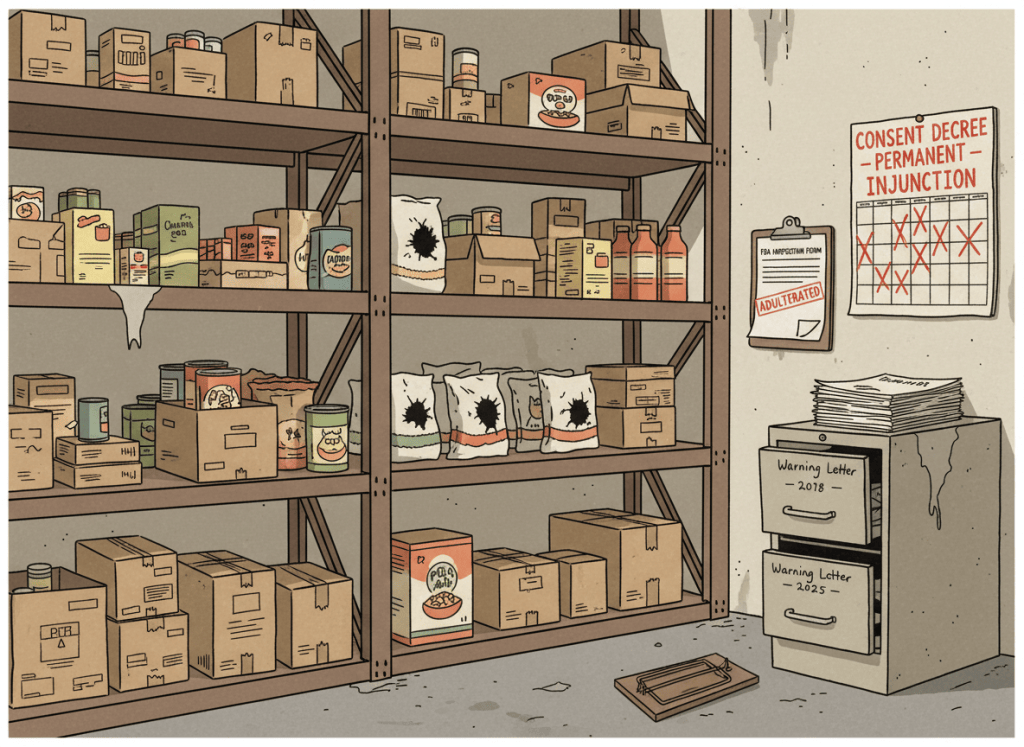
Federal regulators warned a Minnesota distributor in 2018 that persistent rodent contamination could eventually lead to seizure or an injunction.
Seven years later, after inspectors found live rodents, decomposing rodents, birds, worms, feces, urine stains and gnawed packaging inside the company’s warehouse, the injunction finally arrived.
A federal court entered a consent decree of permanent injunction against Gold Star Distribution Inc. and owner Bassam Abu Samrah on Sept. 21, barring the company from receiving, holding or distributing a wide range of FDA-regulated products until extensive corrective measures are completed and the Food and Drug Administration gives written permission for operations to resume.
But the latest enforcement action is more than the story of one spectacularly unsanitary warehouse.
It is the end — at least for now — of a regulatory history stretching back more than a decade, including an FDA warning issued in 2018 describing some of the same problems regulators would encounter again years later.
According to FDA, Gold Star operated a warehouse in Minneapolis handling human and pet food, dietary supplements, drugs, medical devices and cosmetics. Its inventory included products ranging from rice and cat food to sanitary pads and pharmaceuticals.
The company was not new to regulators.
FDA says it inspected Gold Star five times before the November 2025 inspection that ultimately preceded the federal case. The Minnesota Department of Agriculture conducted another 26 inspections between 2013 and 2025.
Many of those inspections, according to FDA, identified rodent-related insanitary conditions.
The paper trail becomes particularly revealing in 2018.
Following an inspection that year, FDA sent Abu Samrah a formal warning letter documenting what inspectors had encountered inside the warehouse.
Among the findings were rodent excrement that inspectors described as too numerous to count, gnawed food packaging, nesting material, dead rodents, live birds, a dead bird and evidence of other pest activity. FDA laboratory testing confirmed mouse feces and rat or mouse hairs in samples collected during the inspection.
Inspectors also documented structural and maintenance problems, including roof leaks.
FDA concluded that food stored at the facility was being held under conditions that could allow it to become contaminated and therefore was adulterated under federal law.
Gold Star responded with a corrective-action plan that included pest-control measures, sanitation improvements, roof repairs, employee training and internal audits.
FDA was not entirely reassured.
The agency noted in its warning letter that Gold Star had not provided sufficient documentation showing that the promised corrections had actually been completed or provided timelines for completing some of them.
The letter ended with a familiar regulatory warning: failure to promptly correct the violations could result in additional enforcement action, including seizure or injunction.
Gold Star continued operating.
Public records show additional FDA inspections followed, and the consent decree now requires the company’s independent expert to review FDA inspection observations dating back to 2018.
Meanwhile, state regulators kept visiting.
FDA’s current account says Minnesota agriculture officials conducted 26 inspections between 2013 and 2025 and that many documented rodent-related insanitary conditions. The agency says federal and state authorities took several regulatory and compliance actions during those years.
Whatever those interventions accomplished, they did not produce a permanent end to the problem.
When FDA inspectors returned in November and December 2025, the conditions they documented were difficult to mistake for a minor sanitation lapse.
Inspectors reported finding nine live rodents and 17 dead rodents in various stages of decomposition.
There were also eight live birds, one dead bird and five live worms.
Investigators documented rodent feces, urine stains, nesting materials and gnaw holes around pallets containing products including rice, cat food, drugs, sanitary pads and cosmetics.
Laboratory testing confirmed rodent urine, urea, excrement and hair.
Elsewhere, inspectors found overflowing or leaking refuse near outgoing shipments, openings in the building capable of allowing pests inside, ceiling leaks affecting storage areas and accumulated trash outside the facility.
By then, regulators were moving beyond warning letters.
The Minnesota Department of Agriculture imposed embargo and cease-and-desist actions against Gold Star’s food operations in November 2025 and revoked the company’s food-wholesale license.
The Minnesota Board of Pharmacy separately ordered Gold Star to stop warehousing and distributing over-the-counter drugs because the company lacked the required pharmacy license. Those drugs were detained at the warehouse.
Then came the recall.
On Dec. 26, 2025, Gold Star announced a recall covering FDA-regulated products stored at the facility because of possible contamination associated with rodents, birds and the warehouse’s insanitary conditions.
The recall stretched far beyond food.
It included drugs, medical devices, cosmetics, dietary supplements, human food and pet food distributed to retailers in multiple states.
Minnesota health officials also advised that Gold Star had supplied food and infant formula to some small stores authorized to participate in the Women, Infants and Children nutrition program.
FDA reported no illnesses associated with the recalled products at the time the recall was announced.
The federal government eventually went to court.
The Justice Department, acting on FDA’s behalf, alleged that Gold Star caused regulated products to become adulterated by holding them under insanitary conditions. The government also alleged violations involving the storage of drug products.
The resulting consent decree goes considerably further than another promise to clean the warehouse.
Gold Star, Abu Samrah and associated persons are prohibited from receiving, holding or distributing covered FDA-regulated products from any current or future location until the decree’s requirements have been satisfied.
Existing regulated inventory must be destroyed under FDA supervision.
The company must hire an independent expert to develop sanitation and drug-storage programs acceptable to FDA, eliminate pests and contamination, make structural repairs designed to prevent pests from entering the building, and undergo additional inspections by independent experts, pest-control professionals and federal regulators.
Even after completing those steps, Gold Star cannot simply declare itself ready for business.
FDA must provide written authorization before operations resume.
That brings the regulatory timeline full circle.
In 2018, FDA documented rodents, feces, nesting material, gnawed products and other insanitary conditions at Gold Star and warned that failure to correct the violations could eventually result in an injunction.
In 2025, inspectors again documented rodents, feces, nesting material and gnawed products — this time amid conditions serious enough to trigger state embargoes, license action and a sweeping recall.
In 2026, the injunction finally arrived.
The available record does not establish that regulators simply ignored Gold Star during the intervening years. FDA says federal and Minnesota authorities conducted repeated inspections and took multiple compliance and regulatory actions, and the complete enforcement history is not contained in the agency’s announcement.
But the outcome is difficult to miss.
More than two dozen state inspections, multiple FDA inspections, an explicit federal warning and years of regulatory intervention did not prevent inspectors from eventually walking back into a warehouse where they found essentially the problem FDA had warned about seven years earlier.
Only this time, there were 26 rodents waiting for them — nine alive and 17 dead.
The government had finally reached the injunction FDA warned about in 2018.
It just took seven years to get there.

