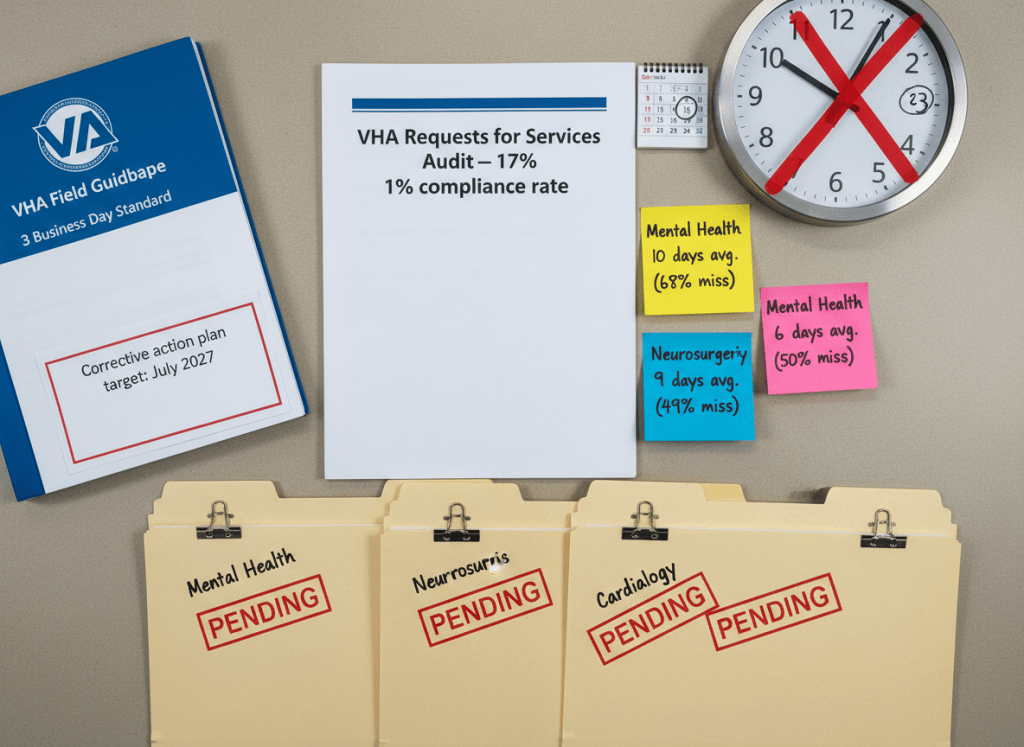
There is a certain bureaucratic poetry to the fact that the Veterans Health Administration’s own guidebook sets a three business day deadline for deciding whether a veteran can get more specialty care, and that the specialty most likely to blow past that deadline by the widest margin is mental health.
A new VA Office of Inspector General audit of “requests for services,” the paperwork mechanism community providers use to ask VHA for authorization beyond a veteran’s original referral, found that mental health requests took an average of ten days to decide, missing the three day standard 68 percent of the time.
Neurosurgery came in at nine days, missing the mark 49 percent of the time.
Cardiology averaged six days and missed 50 percent of the time.
These are not edge cases. They are three of the specialties where the cost of delay is measured in more than inconvenience.
The audit examined 2.6 million requests for services filed between October 2024 and January 2026 and found VHA met its own three-day standard just 17 percent of the time nationally. Buried inside that number, though, is a distribution that should worry anyone who thinks a national average tells the whole story.
A veteran waiting on an oil change delayed by a week is an inconvenience. A veteran waiting on a decision about a psychiatric hospitalization step down, a tumor resection, or a cardiac procedure delayed by a week or more is something else entirely, and OIG’s report does not shy from saying so.
The Ten Day Wait for a Mental Health Decision
Mental health’s ten day average and 68 percent miss rate are the worst of any specialty category OIG broke out in the report. That is worth sitting with, because “requests for services” in mental health typically means a provider has already begun treating a veteran and determined the original authorization does not cover what the veteran now needs, additional therapy sessions, an extended course of medication management, a step up in care intensity.
The request is not hypothetical. It describes a clinician, in the middle of active treatment, saying this patient needs more, now.
OIG’s report notes that delayed decisions on requests for services can result in delayed diagnoses, interrupted treatment, and worse health outcomes, and flags that three specific cases identified during the audit were serious enough to be referred to OIG’s Office of Healthcare Inspections for a dedicated review of potential clinical harm.
The report does not specify which specialties those three cases fell under, which is its own kind of answer. When the agency conducting the audit will not tell you, you are left to guess whether they involve the specialty averaging ten days and missing the standard on two out of every three requests, or one of the others. None of the options are comforting.
Neurosurgery and Cardiology Are Not Exactly Forgiving Specialties Either
Neurosurgery’s nine day average and 49 percent miss rate deserve the same scrutiny, if for different reasons. A request for services in a neurosurgical context typically means a provider needs authorization to proceed with something time sensitive, additional imaging following a concerning finding, a follow up procedure, an extended course of post-operative care. Waiting nine days on average for a paperwork decision, in a specialty where the cost of delay is frequently irreversible, is not a rounding error.
Cardiology’s numbers look almost better by comparison, six days on average and a coin flip miss rate, until you remember that cardiology is a specialty where “we will get back to you within the week” is not a phrase most clinicians would want said out loud to a patient with an active cardiac concern. VHA’s own field guidebook does not carve out faster timelines for these specialties.
The three day standard is the three day standard, mental health, neurosurgery, cardiology, or otherwise, and the audit found VHA cannot reliably meet it in any of them, with the categories carrying the highest clinical stakes performing among the worst.
What Happens Between the Request and the Decision
It is worth being precise about what a delayed decision actually means for a veteran in these specialties, because “administrative delay” undersells it. Until VHA authorizes the additional care, the community provider is in an uncomfortable position: continue treating the veteran without confirmed authorization, at the provider’s own financial risk, or pause care and wait.
OIG’s report notes that when these decisions and their notifications go missing or delayed, providers may keep delivering care that ultimately goes unauthorized and unpaid, which creates a disincentive to keep treating veterans through the gap rather than an incentive.
For a veteran in an active mental health crisis, a nine day wait for a neurosurgical follow up, or a cardiology patient hoping for a swift answer, that gap is not an abstraction. It is the interval in which a provider has to decide, unilaterally, whether to keep going and hope VHA eventually pays for it, or whether to pull back until the request clears. Neither option was supposed to exist. The three day standard exists specifically so this decision never has to be made by a provider guessing at VHA’s intentions.
Nothing in VHA’s response to this audit proposes a faster track for high acuity specialties. The agency concurred with all six of OIG’s recommendations, which is the standard bureaucratic gesture of agreement that commits the institution to eventually building better tracking and reporting tools, on a timeline stretching into July 2027.
There is no recommendation, and no indication in VHA’s response, that mental health, neurosurgery, and cardiology requests should be prioritized differently than a routine referral for physical therapy. The three day clock runs the same for all of them. It is simply ignored more often, and for longer, in the specialties where ignoring it costs the most.
A national average of 17 percent compliance is bad enough to justify an audit on its own. A breakdown showing that the worst performing categories happen to be the ones where a delayed decision can mean a missed diagnosis, an unmanaged psychiatric crisis, or a postponed cardiac intervention is the sort of detail that should reorder VHA’s priorities rather than simply add another line item to a corrective action plan.
Instead, the plan treats every specialty as interchangeable, a queue to be cleared eventually, with no acknowledgment that some queues carry more risk per day of delay than others. The veterans waiting in those three specialties are not waiting on a bureaucracy that does not know it has a problem.
They are waiting on one that knows precisely which categories are failing worst and has scheduled the fix for a year from now.

