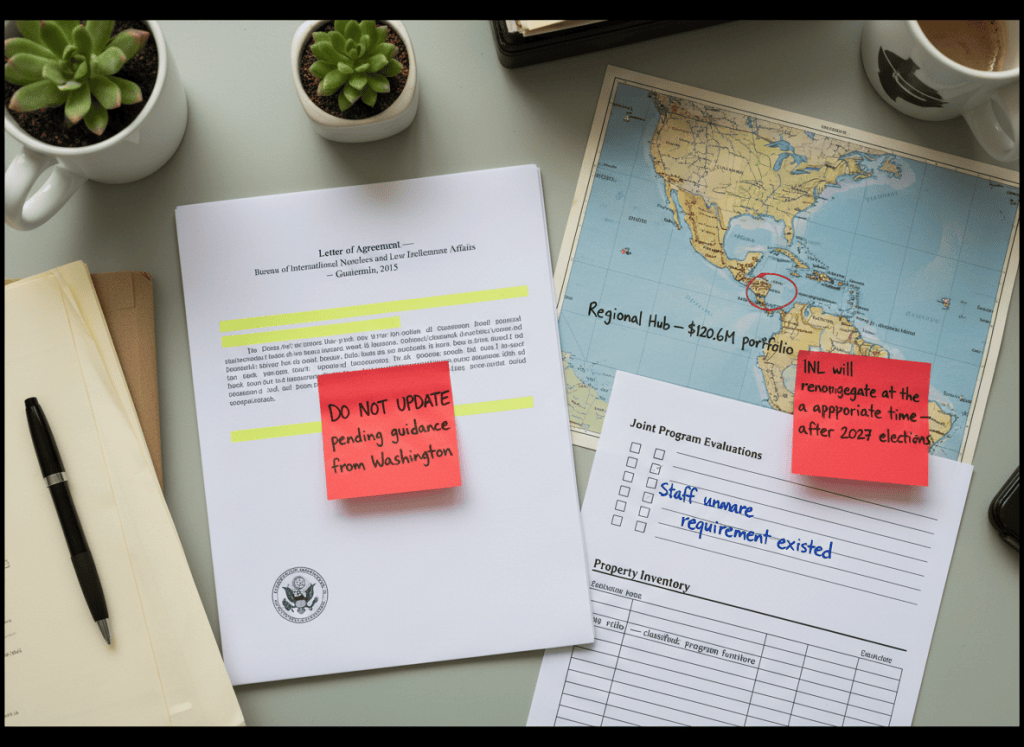
There is a particular kind of bureaucratic failure that doesn’t require anyone to be corrupt, lazy, or even wrong. It only requires two offices that disagree about who is allowed to fix something. The State Department’s Inspector General found exactly that arrangement sitting inside Embassy Guatemala City, in a report that spends most of its pages on the usual inventory of a mismanaged outpost (unregistered networks, overdue travel advances, a warehouse full of furniture nobody can account for) before landing on something more interesting.
An agreement the United States signed with a foreign government sits frozen because nobody in Washington will let anyone update it, alongside a set of legally required evaluations that nobody at post even knew they were supposed to conduct.
A Regional Hub Built From the Wreckage
Guatemala’s embassy was never a quiet posting. It sits on a 9.4 acre compound, serves a community of roughly 50,000 US citizens, and functions as a category 4 embassy, the State Department’s own term for a post carrying outsized political and economic weight in its region.
When USAID stopped implementing foreign assistance on July 1, 2025, following the Trump administration’s foreign aid review, the Bureau of Western Hemisphere Affairs designated Guatemala City as the regional assistance hub for Central America. The embassy inherited 18 legacy USAID projects worth $120.6 million and staffed the transition with three US direct-hire employees and five locally employed staff, a skeleton crew for a portfolio that size.
The report is candid about what that transition actually felt like from inside the building. Staff described incomplete and shifting guidance, unclear expectations about what a “regional hub” was even supposed to do, travel restrictions, and a steadily rising pile of administrative approvals. The OIG’s own prior work found that the Department’s Assistance Transition Working Group never built a strategic workforce plan to figure out how many positions the new arrangement actually needed, following the same key practices the Government Accountability Office has been recommending for years.
The Department’s last workforce strategic plan expired in 2023 and has not been replaced. So the hub was staffed by instinct rather than by plan, which is one way to run a $120 million portfolio, just not a durable one.
The Letter Nobody Is Allowed to Fix
Buried in the foreign assistance section is the finding that should worry anyone who cares about how the United States keeps its word. The Bureau of International Narcotics and Law Enforcement Affairs operates in Guatemala under a 2015 Letter of Agreement that still commits the US government to sectors, including community policing and justice sector reform, that INL quietly stopped funding years ago. Embassy staff told OIG they started drafting an update. Then, in January 2025, INL Washington told them to stop, pending further guidance that never arrived.
INL’s official response to this finding is a small masterpiece of institutional confidence. The bureau maintains its current activities technically fall within the scope of the old agreement and its modifications, even while conceding the document needs modernizing, and says it will renegotiate “at an appropriate time,” citing Guatemala’s 2027 general elections as a scheduling consideration. OIG’s reply does not buy the premise.
As the report notes, the agreement commits the US to activities INL no longer supports, which is precisely the risk the finding describes, and the embassy already did the preparatory work before Washington told it to sit down. The recommendation stays open until the Department produces an actual updated agreement, not a plan to eventually consider producing one.
The companion finding is worse, because it is a repeat offense. INL Guatemala never conducted the joint program evaluations required by that same 2015 agreement and its subsequent amendments, evaluations meant to happen annually, then quarterly, then biannually as the agreement was modified. Embassy staff simply didn’t know the requirement existed.
This is not INL’s first time getting caught here. OIG flagged the identical failure in a 2023 inspection, and the bureau’s fix at the time was a February 2024 cable instructing embassies to meet with counterparts and file an annual summary. Two years later, Guatemala’s INL staff still hadn’t produced documentation of a single formal joint evaluation, offering instead a description of regular but informal meetings under the High-Level Security Dialogue.
Regular conversation is not the same thing as a written evaluation measured against agreed metrics, and the Department’s own instruments say so in writing, which makes this less a lapse than a pattern the bureau has now failed to correct twice.
The Ledger of Small Failures
Once you get past foreign assistance, the report reads like a checklist of an embassy running on staff who are stretched too thin to double check anything. Twenty nine of 140 residential properties never received the seismic safety evaluation required for a country OBO itself rates as very high risk for earthquakes, a gap the embassy blames on management oversight rather than resources. Property management fared no better.
Some $315,000 in nonexpendable equipment, including $267,000 of IT hardware, moved from warehouse to office without the required transaction paperwork, while the furniture and appliance pool sat at nearly double the Department’s stock cap, with $89,000 in assets misclassified, including baby cribs and vacuums somehow coded as program furniture.
Fourteen chauffeurs blew past the 10 hour daily duty limit on 34 occasions across ten pay periods, a driver safety violation the embassy attributes to poor trip planning rather than any shortage of drivers.
INL itself ran up $115,000 in overdue travel advances, nearly all of it tied to an internal 90-day repayment habit that directly contradicts the Department’s 30-day standard, the same section that couldn’t produce its evaluation paperwork running its own informal exception to a different rule entirely.
The most quietly damning number in the whole report involves money the Department didn’t lose so much as fail to notice. Only one of the embassy’s five US direct-hire Diplomatic Technology positions was funded through International Cooperative Administrative Support Services, the mechanism that splits IT costs across the agencies who actually use the service, despite the embassy’s own estimate that a second position spends more than half its time on ICASS work.
The Department had been quietly absorbing costs that other agencies were supposed to share, to the tune of an estimated $219,000 over three years, not because anyone hid it, but because nobody at post knew the requirement to check existed.
It is the same root cause running through half the findings in this report: not fraud, not negligence in any dramatic sense, just an institution that never told the people doing the work what the rules actually required of them.
What the Concurrence Actually Buys You
Embassy Guatemala City concurred, or partially concurred, with all 11 recommendations, and OIG considers every one of them resolved, which in the audit world is a term of art meaning the parties agree on what should happen next, not that it has happened yet. The seismic assessments are still eight properties short of complete.
The FAP stock reduction target is still short of the Department’s cap, aimed for the end of September. The updated Letter of Agreement is not yet negotiated, and INL’s own timeline explicitly runs it past a foreign election it hasn’t happened yet.
Resolved, in other words, is a status the Department assigns to problems it has agreed to eventually stop having, which is a useful thing to remember the next time an agency’s press office announces that an inspector general’s findings have been addressed.
Sources: U.S. Department of State Office of Inspector General, Inspection of Embassy Guatemala City, Guatemala (ESP-25-01, 2026); Executive Order 14169, Reevaluating and Realigning United States Foreign Aid (January 2025).

