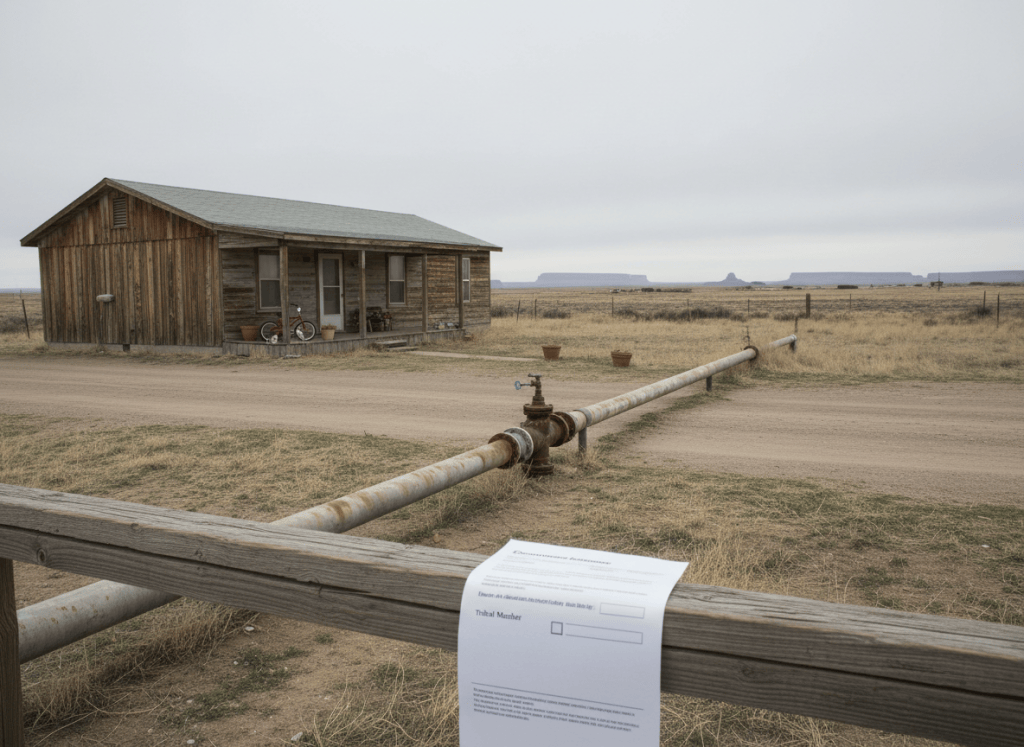
There is a category of person, according to the federal government, whose existence complicates plumbing. That person is a spouse, a grandparent, or another relative living in a tribal community who happens not to be an enrolled tribal member.
Under Indian Health Service policy, a home occupied by such a person can be legally invisible to the agency whose entire mission, per the Indian Sanitation Facilities Act, is to build water and wastewater infrastructure for Indian homes, communities, and lands.
The Government Accountability Office documented this in a new report on tribal water infrastructure, and the arrangement is exactly as absurd as it sounds when you say it out loud (Government Accountability Office, GAO-26-107178).
The Household IHS Cannot See
IHS interprets its own statutory authority narrowly. A home is eligible for funding if it belongs to a tribal member or the tribe itself. A home is not eligible if it belongs to, say, a non-member spouse or a non-member grandparent, even though tribal members and their children live there every day.
GAO heard repeatedly from tribal and tribal health consortium officials that these mixed and multigenerational households are common, not rare, in tribal communities.
One tribal water utility official put it about as plainly as an interview subject can put anything to a federal auditor, saying that every single water infrastructure project their tribe had sought or received IHS funding for included at least one ineligible home where tribal members actually lived.
Every single one.
Add to that the leasing wrinkle. A tribal member renting a home from their own tribe, or from another tribal member, can also fall outside IHS’s eligible category if fewer than five years remain on the lease at the time engineers are designing the project.
That means a teacher living in tribally owned housing, or a tribal member on a short-term lease from a relative, can be sitting inside a project area that IHS is actively funding while remaining, on paper, someone IHS is not funding.
IHS itself does not even track how often this happens; the agency does not collect data on the number of tribal members living in homes its own rules classify as ineligible.
It knows the loophole exists. It has simply never counted through it.
Eighty Hours for Eight Thousand Dollars
Here is where the definitional problem stops being abstract and starts costing real staff time. When a home falls outside IHS eligibility, somebody still has to pay for the water hookup, and that somebody is usually the tribe, scrambling for outside money while an IHS field engineer walks them through it.
GAO’s example is almost too clean to be real. Officials from one IHS area office reported spending more than 80 hours helping a single tribe apply for and manage an outside grant worth $8,000.
After the tribe received the money, the same officials spent additional hours helping it report on how the grant was spent, on top of the original 80. An agency employee’s time is not free. The officials themselves told GAO that once outside funds are transferred to IHS, managing and overseeing them imposes a significant expense on the agency, expense that dwarfs, in staff hours, the size of the grant it produced.
Run the arithmetic and it gets worse before it gets better. Eighty-plus hours of a federal engineer’s time, spent to unlock $8,000 for a home the agency’s own charter arguably should have covered in the first place, is not an isolated inefficiency. It is what happens, systematically, every time IHS’s definition excludes a home that a tribal member actually lives in.
Multiply that by however many mixed households and short leases exist across Indian Country, a number IHS admits it does not track, and you get a hidden administrative tax charged entirely in engineer hours, paid for the privilege of routing around a definition the agency wrote for itself.
A Fix That Fits on One Page
GAO’s response to this is not a demand for a wholesale rewrite of federal Indian law. It is a request that Congress define, in the statute itself, exactly what “Indian homes, communities, and lands” means, so IHS stops having to guess at the boundaries of its own mandate case by case.
Absent that, GAO recommends IHS update its own policy to reflect any new statutory definition once one exists, in consultation with tribes.
This is not a controversial ask. It is closer to basic housekeeping, the kind of clarifying language that should have existed since the Indian Sanitation Facilities Act was written, rather than something an outside audit has to surface decades later as a formal recommendation.
What makes the current arrangement particularly galling is that IHS is not accused of malice here, or even of especially poor judgment. The agency is applying a plausible reading of an old statute that never anticipated, or never bothered to specify, how it should treat a reservation home where a grandmother happens to hold a state, rather than tribal, enrollment card.
The absence of a definition did the damage. Everything downstream (the excluded homes, the outside grant hunts, the 80 hours for $8,000) follows directly from Congress never having bothered to spell out a term that shows up in the law’s own name.
Who Actually Pays For the Gap
The people who pay for this gap are not, in the end, IHS engineers, whose hours are at least salaried and accounted for somewhere in a federal budget. The people who pay are tribal families living in homes that fall on the wrong side of a definition nobody wrote down clearly, families who may wait longer for a water connection because their household includes a relative who checked the wrong box on a tribal enrollment form decades ago, or none at all.
GAO’s report does not put a number on how many households currently sit in this limbo, because, again, nobody is counting. That absence of a number is itself the finding. An agency whose entire job is connecting homes to water cannot say how many homes its own eligibility rule disconnects.
Congress created this problem by leaving three words undefined in the 1959 Indian Sanitation Facilities Act and letting an agency’s legal interpretation harden around the gap for six and a half decades.
Fixing it requires nothing more dramatic than actually finishing the sentence.

