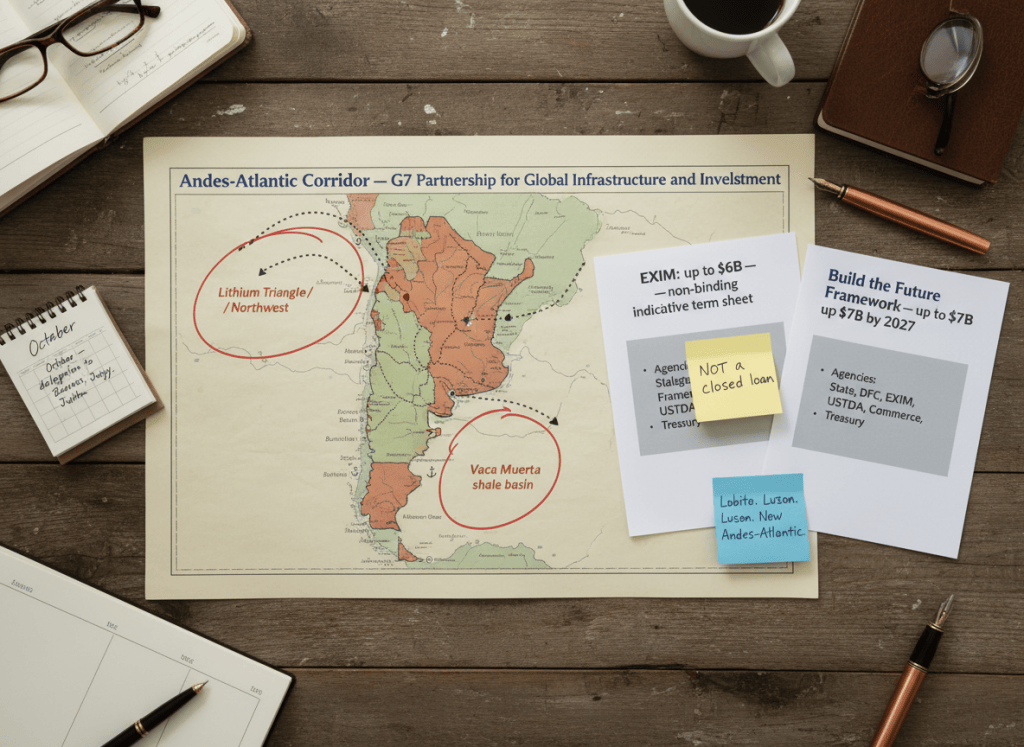
The State Department announced a new economic corridor with Argentina this week, complete with railways, pipelines, ports, power lines, digital infrastructure and potentially billions of dollars in U.S.-backed financing.
But the most interesting thing about the Andes-Atlantic Corridor may not be the infrastructure.
It is what Washington wants moving through it.
The United States and Argentina formally launched the Andes-Atlantic Corridor on September 23, describing it as an effort to connect Argentina’s mineral-rich northwest and the Vaca Muerta energy basin with Atlantic ports and Western markets.
According to the State Department, the corridor is intended to strengthen supply chains for lithium, copper, oil and natural gas while opening infrastructure projects to American companies.
It is also the first corridor in the Western Hemisphere under the G7’s Partnership for Global Infrastructure and Investment.
That makes the announcement considerably more than a transportation project.
The corridor connects two things Washington increasingly considers strategic: infrastructure and critical minerals.
Argentina sits inside the so-called Lithium Triangle and possesses major lithium and copper resources. Earlier this year, the United States and Argentina signed a bilateral Framework for Securing of Supply in the Mining and Processing of Critical Minerals. The new corridor is explicitly designed to support projects developed under that agreement.
Then there is Vaca Muerta, Argentina’s enormous shale formation.
The State Department says the corridor will support expanded development and export of those resources through pipelines, rail, ports and energy infrastructure.
And Washington has brought its checkbook. Sort of.
The State Department says the Export-Import Bank of the United States and Argentina have signed a “Build the Future” framework capable of providing up to $7 billion in financing by 2027 for infrastructure and productive-capacity projects.
That should not be confused with $7 billion already spent, appropriated or even committed to individual corridor projects.
The largest identified financing proposal illustrates the distinction.
EXIM has issued a non-binding indicative term sheet for as much as $6 billion for Argentina LNG, a proposed $51 billion project involving Argentina’s YPF, Italy’s Eni and the United Arab Emirates’ XRG. The project would turn Vaca Muerta gas into liquefied natural gas for export.
The financing would support purchases of American goods and services. State says American company Pumpco, a MasTec subsidiary, working with Bonatti and Contreras Hnos., has already received an engineering, procurement and construction contract worth more than $1 billion for the project’s export pipeline system, although that contract remains subject to a final investment decision.
In other words, the corridor may have been formally launched this week, but the machinery underneath it was already moving.
Argentina opened international tenders in August for 50-year concessions covering the Belgrano, San Martín and Urquiza freight rail systems. Together, the networks include roughly 7,594 kilometers of track across 16 provinces and connect major production regions with ports and international crossings.
Argentina’s own government says decades of deterioration, inadequate maintenance and insufficient investment helped create the need for private capital.
Those railways now appear on Washington’s corridor map.
So does the Hidrovía waterway. So do proposed connections between Vaca Muerta and Atlantic ports. So do electricity projects and a planned modernization of Argentina’s ARSAT fiber-optic network.
The corridor, therefore, looks less like a single new construction project and more like an umbrella placed over a collection of existing and proposed infrastructure projects, with U.S. financing agencies and American companies being encouraged to participate.
And the strategy itself predates the launch.
In February, Under Secretary of State for Economic Affairs Jacob Helberg told the House Foreign Affairs Committee that he had directed his office to conduct a strategic review of logistical corridors with previous State Department involvement. He specifically named the Andes-Atlantic Corridor alongside the Lobito Corridor in Africa and the Luzon Corridor in the Philippines.
Seven months later, the corridor has officially arrived.
The federal cast is substantial.
State says the U.S. International Development Finance Corporation, EXIM and the U.S. Trade and Development Agency can provide financing, development assistance and technical support. The Departments of State, Commerce and Treasury are also expected to provide commercial expertise.
A delegation from State, DFC and EXIM is scheduled to travel to Buenos Aires, Jujuy and Salta in October to identify and advance potential transactions. Deputy Secretary of State Christopher Landau is expected to follow later in the month to promote corridor investments.
That makes the next phase worth watching carefully.
The announcement contains some very large numbers, but much of the financing remains prospective. “Up to $7 billion” is not the same thing as $7 billion obligated, and a non-binding $6 billion EXIM term sheet is not a closed loan.
What Washington has established is the framework through which those deals could happen.
And the objective is unusually clear.
The Andes-Atlantic Corridor is designed to connect Argentine lithium, copper, oil and natural gas with Western markets while giving American companies opportunities to build and finance the infrastructure required to get those resources there.
The railroad tracks may be in Argentina.
The supply-chain strategy runs straight through Washington.
Sources: U.S. Department of State, Andes-Atlantic Corridor Fact Sheet (September 23, 2026); Export-Import Bank of the United States, Build the Future Framework Announcement.

