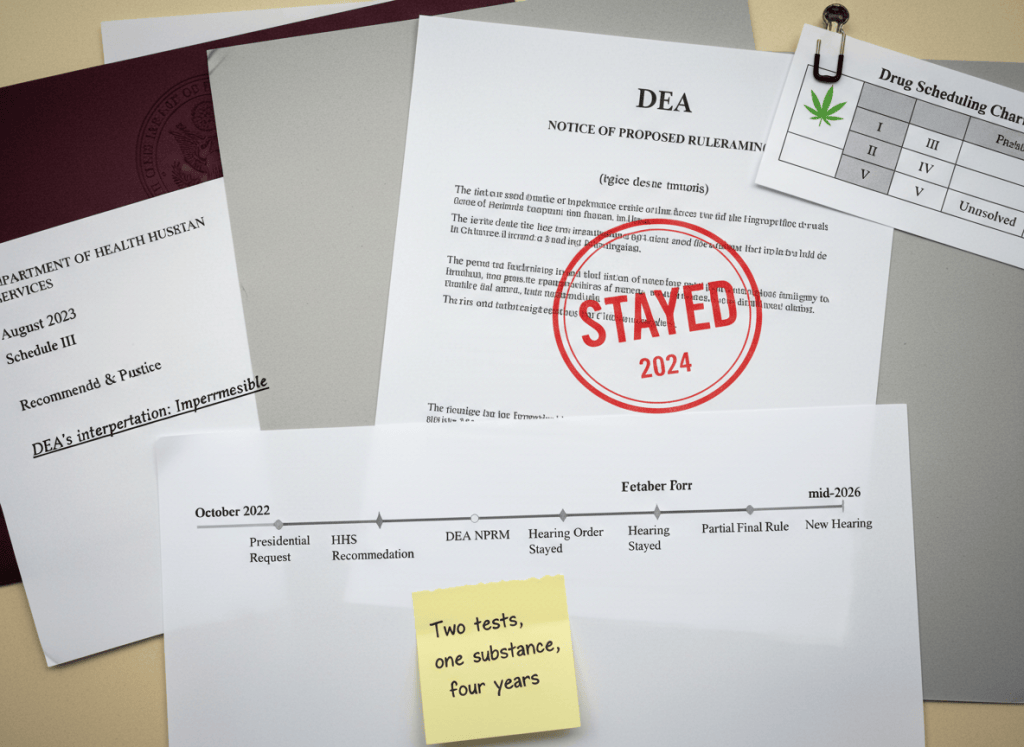
In October 2022, the President asked two federal agencies a fairly simple question. Should marijuana still sit in Schedule I, the category reserved for heroin and LSD, alongside a legal finding that it has no currently accepted medical use in the United States. Four years later, the honest answer is that nobody in the federal government has fully answered it, and the paper trail explaining why, laid out in detail in a new GAO report on drug scheduling, reads less like science than like a jurisdictional turf fight that occasionally paused for actual medicine.
HHS Answers a Question DEA Did Not Think It Was Allowed to Ask
By August 2023, HHS had its answer. Applying a new two part test it had adopted that same year for judging whether a drug has a currently accepted medical use, HHS concluded marijuana met the standard and recommended DEA move it to Schedule III. The trouble was that DEA had spent decades applying a stricter, older five part test for the same question, one that generally required something close to FDA approval.
HHS’s new test did not require that. It asked instead whether there was widespread current medical use recognized by licensed practitioners operating in state authorized programs, plus some credible scientific support for at least one such use, a bar dozens of state medical marijuana programs could plausibly clear even without a single FDA approved cannabis product.
This is not a scientific disagreement so much as a disagreement over who gets to decide what counts as a medical use in the first place. DEA’s traditional test, in place since 1992, effectively let the agency treat state legalization as legally irrelevant, since it generally required something close to FDA approval before any substance without one could be called medically accepted. HHS’s new test, adopted in 2023, built state level medical practice directly into the federal legal standard instead.
Whichever test wins determines the schedule, and the schedule determines the criminal exposure. GAO’s report is careful to note that FDA officials insist the two tests coexist rather than replace one another, that FDA approval remains, in their words, the most straightforward path to establishing accepted medical use. Straightforward is doing a great deal of work in that sentence for a process that has just taken four years and counting to sort out a single substance.
The Justice Department Settles a Fight Between Two Other Agencies
In April 2024, the Department of Justice’s Office of Legal Counsel weighed in and sided with HHS. DEA’s traditional approach to currently accepted medical use, the opinion found, was an impermissibly narrow reading of the Controlled Substances Act. Satisfying HHS’s new two part test was sufficient on its own, the opinion held, regardless of FDA approval or DEA’s own five part framework.
The opinion also concluded DEA could satisfy the country’s obligations under the Single Convention on Narcotic Drugs by placing marijuana in Schedule III while layering additional restrictions on top through its own regulatory authority, closing off DEA’s other plausible argument for keeping marijuana more tightly controlled.
DEA published a notice of proposed rulemaking the following month to reschedule marijuana to Schedule III, then a notice of hearing that August. In January 2025, the presiding administrative law judge stayed the entire hearing pending an interlocutory appeal to the DEA Administrator, meaning the agency that had just lost the legal argument at the Justice Department got to pause the hearing on its own initiative while it sorted out internal procedural objections.
The rulemaking sat that way for nearly a year.
An Executive Order Breaks the Stall, Then Splits the Difference
In December 2025, the President issued an executive order directing the Attorney General to take all necessary steps to finish the rulemaking. Four months later, the Acting Attorney General moved, but not by finishing what DEA had proposed in 2024. Instead, in April 2026, the Acting Attorney General issued a final rule immediately placing FDA approved marijuana products and marijuana used under a state medical license into Schedule III, using the narrower authority to reschedule drugs for treaty compliance rather than the broader rulemaking DEA had been sitting on for two years.
In the same order, the Acting Attorney General withdrew the stalled 2024 hearing notice and issued a fresh one covering the original, wider question of rescheduling all marijuana, with the actual hearing to run from late June through mid July of this year.
So as of this writing, a portion of marijuana has been in Schedule III since April, reached through the narrowest available legal doorway, while the broader question that started this entire four year process, whether marijuana generally belongs in Schedule III, sat through a new round of hearings that only just concluded.
Two federal agencies agreed on the underlying science within a year of being asked. It then took a Justice Department opinion, a stayed hearing, a change in test, an executive order, and a second hearing notice to produce a result that only partially answers the question the President posed in 2022, using an authority nobody had originally proposed using for the purpose.
What the Timeline Actually Measures
None of the four years this took were spent gathering new pharmacological data. HHS finished its scientific evaluation within roughly a year of being asked, well inside the range GAO’s broader report found typical for far more obscure substances. Every subsequent delay was procedural, a fight over which test applies, which agency’s reading of the statute controls, whether a hearing already scheduled could be paused by the same agency contesting the outcome, and eventually whether the President’s own order was enough to force a decision at all.
The Controlled Substances Act was written to sort chemicals by their pharmacology. What this timeline actually documents is how much of that sorting, at least for the one substance most Americans have an opinion about, ends up decided by agencies arguing over their own jurisdiction rather than by anything found in a laboratory.
Sources: U.S. Government Accountability Office, Drug Scheduling: DEA and FDA Should Strengthen Policies and Procedures for Scheduling Controlled Substances (GAO-26-108623, September 2026); DEA Notice of Proposed Rulemaking, Rescheduling of Marijuana (Federal Register, May 21, 2024); DOJ Office of Legal Counsel opinion on HHS marijuana scheduling recommendation (August 2024). Related: The Word That Decides Every Drug Sentence in America Was Never Actually Defined and The Two Year Emergency Order That Needed Seven Years and an Act of Congress to End.

