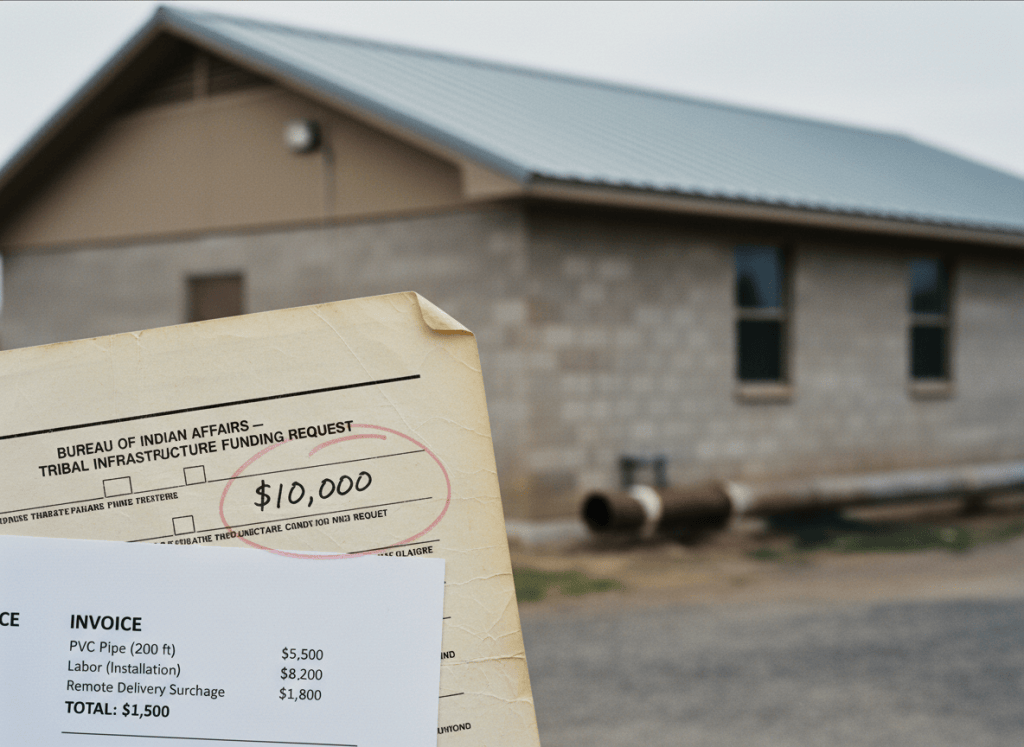
In 1985, a gallon of gas cost about $1.09, the Berlin Wall was still standing, and the Indian Health Service decided that $10,000 was a reasonable amount of money to connect a tribal school or ceremonial ground to a water system. Forty years later, gas costs three times as much, the Wall is a tourist attraction, and the Indian Health Service still thinks $10,000 is a reasonable amount of money to connect a tribal school or ceremonial ground to a water system.
This is not an oversight in the sense of a memo nobody read. Per a new report from the Government Accountability Office, IHS senior officials told auditors they had never adjusted the figure because they did not believe it was constraining anyone (Government Accountability Office, GAO-26-107178). Constrain is an interesting verb choice for a policy that has been used exactly twice in two years.
A Cap With Nothing Under It
IHS runs a special project fund that can, in theory, pay up to $10,000 to connect an existing tribal community building, a Head Start school, a gathering place, a ceremonial ground, to a water line already being built for a nearby project. It sounds like a sensible bit of flexibility, the kind of accommodation an agency writes into its own rules so tribal communities do not have to run a separate federal gauntlet just to get a spigot into a building that already has walls and a roof.
In practice, GAO found that of roughly 800 tribal water projects IHS funded in fiscal years 2023 and 2024, exactly two used special project funds for existing community buildings. Two. Not two percent. Two projects, full stop, out of eight hundred.
Tribal officials and staff from a tribal health consortium told GAO exactly why the number is so small, and it is not because the buildings do not need water. It is because $10,000 does not buy water infrastructure anymore; it barely buys the truck that delivers the materials to build it.
Tribal health consortium officials said the cap does not come close to covering even basic connection costs, citing the price of materials and the price of hauling those materials to remote tribal land as the primary obstacles. Faced with a fund that cannot fund anything, tribes do the rational thing and skip it, going hat in hand to EPA or USDA instead, agencies with broader statutory mandates that let them pay for the same buildings IHS’s own rule was theoretically designed to help.
The special project fund exists on paper as a convenience. In practice it functions as a formality tribes have learned to route around.
Math From the Reagan Administration
Here is the part where the story becomes less about neglect and more about arithmetic nobody bothered to do. GAO ran the inflation numbers, and $10,000 in 1985 dollars is worth about $30,000 in fiscal year 2025 dollars, triple the amount IHS is still authorized to spend.
That is not a rounding error produced by decades of general price creep; it is the kind of gap that appears when an agency simply stops looking at a number it wrote down once and filed away. IHS itself, to its credit, did not try to defend the figure once GAO put the inflation math in front of them. Agency officials acknowledged that construction costs have risen since 1985 and said the limit could warrant reevaluation in light of current labor and materials costs.
That is a remarkably mild way to describe a policy that has effectively been auto-denying itself for four decades. Nobody at IHS appears to have decided, at any point between the second Reagan administration and now, that $10,000 no longer covered what $10,000 used to cover.
The number simply sat there, technically still on the books, functionally inert, while every input it was meant to pay for, labor, pipe, transport, concrete, kept climbing. A ceiling that never moves is not neutral. It is a ceiling that gets lower every year, measured against the thing it is supposed to buy.
The Workaround Tax
The consequence of a dead-letter fund is not that the work stops; the consequence is that the work gets more expensive to arrange, just not on IHS’s books. When a community building cannot get water through the special project fund, tribes and IHS staff go looking for outside money, usually from EPA or USDA, and that search comes with its own overhead. GAO documents this pattern repeatedly across the broader report; pursuing outside funding to cover costs IHS itself will not cover tends to multiply administrative time for everyone involved, IHS engineers included, because now two or three agencies’ worth of paperwork has to be reconciled instead of one.
A $10,000 cap that functioned properly would resolve a small, incidental cost in house. A $10,000 cap that has not functioned properly since roughly 1990 instead generates a shadow bureaucracy of grant hunting, all to connect a building that, in many cases, sits a few hundred feet from a water main that is already being installed.
GAO’s recommendation here is almost apologetically modest. It does not ask Congress to rewrite the Indian Sanitation Facilities Act or reorganize IHS’s funding authority. It asks the Director of the Division of Sanitation Facilities Construction to evaluate whether $10,000 is still appropriate, in light of inflation and increases in labor and materials costs, and adjust it accordingly.
This is, functionally, a request that the agency check a number against the last four decades of economic reality, a task that requires no legislation, no new appropriation, and no interagency task force. It requires someone to open a spreadsheet.
What Stagnation Actually Costs
It would be easy to read this as a minor line item in an 86 page report about a much larger set of problems, IHS’s narrow eligibility rules, USDA’s underwriting demands, EPA’s application backlogs. But the frozen $10,000 cap is worth isolating because it is the cleanest example in the whole document of a specific kind of federal failure, not malice, not even obvious negligence, but a number that was correct once and was never revisited, sitting quietly inside an agency’s own internal rules for so long that revisiting it now counts as a recommendation rather than routine maintenance.
Somewhere in a tribal community right now, a Head Start school or a ceremonial ground is going without a water connection it could plausibly have gotten already, not because the money does not exist in the federal system, but because the specific pot of money set aside for exactly this purpose has been mathematically useless since roughly the first Bush administration, and nobody thought to check.
That is not a scandal in the traditional sense. Nobody profited. Nobody hid anything. It is simply what happens when the machinery of government runs on numbers that were never designed to update themselves, and the humans responsible for updating them assumed, without checking, that the machinery was fine.

